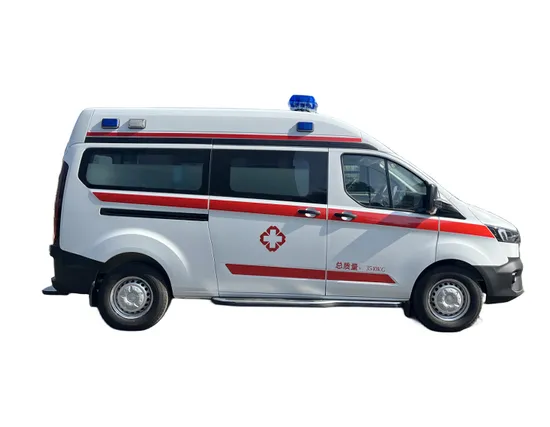
The Foton G7 Gasoline ICU Monitoring Ambulance Euro 4/5, model CLW5030XJH, is a patient transport vehicle intended for cases where vital signs must be watched throughout the journey. It runs on a 1998 ml gasoline engine with a five-speed manual gearbox and offers two to six seats, so a driver, an attendant and a stretcher patient fit with room to spare.
We position this version for hospitals, emergency centres and medical transfer companies that move patients between facilities and want a compact vehicle rather than a large van. Its 4840 mm length makes it easier to use in dense urban areas, hospital courtyards and older streets than a long-wheelbase ambulance would be.
How an ICU monitoring ambulance is used
An ICU-type transfer ambulance carries a patient who needs continuous observation, for example of heart rate, blood oxygen and blood pressure, during a move from one ward or hospital to another. The vehicle's job is to give the medical team a stable, well-lit space and a smooth ride, while the monitoring equipment itself is chosen to suit your clinical protocol.
Because equipment differs between hospitals, we ask for your required monitor, ventilator and oxygen arrangements at the quotation stage and confirm what will be installed. This avoids a mismatch between the vehicle and the way your staff work, and it lets our team check weight and power needs against the chassis before anything is built.
Engine, brakes and suspension
The gasoline engine displaces 1998 ml with multipoint injection, and it produces a maximum power of 95 kW and a maximum torque of 186 Nm. The manual gearbox has five forward gears and one reverse. Top speed is 156 km/h, and the fuel tank capacity is 65 L for planning refuelling during longer transfers.
Smooth handling reduces stress on a patient who is connected to monitors. The front suspension is McPherson independent, and the rear uses non-independent leaf springs. The braking system is a hydraulic double-circuit disc type. Together these give the driver predictable control, though how the ride feels with a fully loaded patient area is something we are happy to discuss with you.
Size, weight and seating
Overall dimensions are 4840 mm in length, 1695 mm in width and 2435 mm in height, with a wheelbase of 2570 mm. The curb weight is 1855 kg and the gross vehicle weight is 3020 kg. The cab and patient area together provide two to six seats, depending on the layout you choose.
The difference between curb weight and gross weight is the budget for crew, patient and every item added to the interior. Heavy monitoring devices, oxygen cylinders and storage cabinets use up that budget quickly, so we recommend listing every item you plan to carry before you choose between a lighter and a fuller seating arrangement.
What to confirm before ordering
Please tell us the drive side you require and the emission standard needed where the vehicle will be registered. The emission level for your unit is confirmed in the quotation together with the exact specification, so share your regulatory requirements at the first enquiry rather than after the build has started.
Also confirm the monitoring and life-support equipment you want installed, the number of seats, interior finish, exterior colour and any markings. Describing the typical transfer distance and road conditions helps us check that this compact gasoline ambulance suits your service before you commit to an order.
Request a current quotation for your selected configuration, quantity and delivery terms.