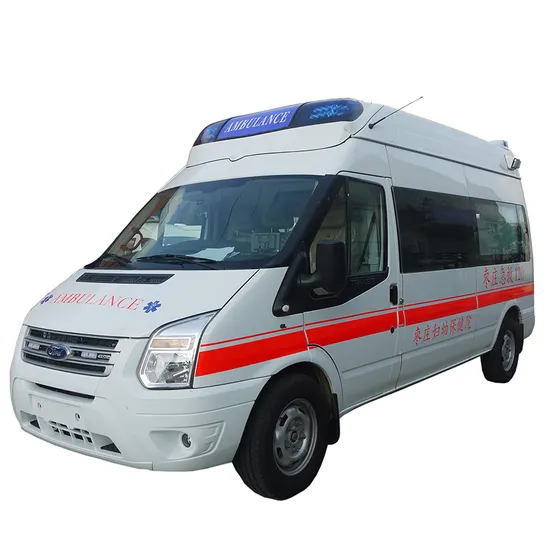
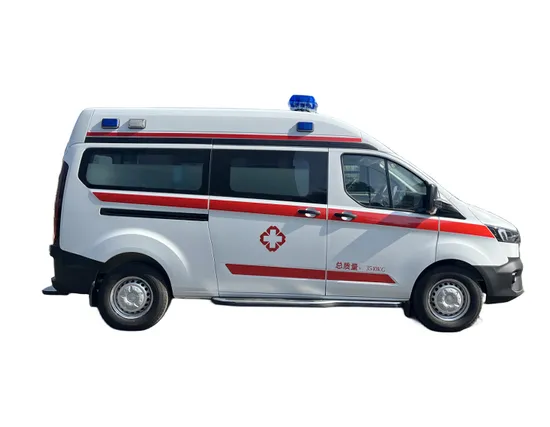
The Ford Transit ICU Ambulance with First-Aid Equipment is a Transit-based ambulance built for emergency response and for transferring patients who need clinical care on the way. It has a diesel engine, a manual gearbox and a wheelbase of 3750 mm. The vehicle meets the Euro VI emission level.
It suits hospitals, emergency medical services, private ambulance operators and industrial sites that keep their own first-response unit. The van body gives enough interior room for a stretcher, an attendant and equipment, while its overall size of 5780 × 2000 × 2580 mm still allows it to be driven through ordinary city streets.
Where this ambulance is used
An intensive care ambulance bridges the gap between a basic transport vehicle and a hospital ward. Crews monitor a patient during transfer, give first-aid treatment at the roadside and then take the patient to the nearest facility. Typical tasks are emergency calls, transfers between hospitals and standby at events with a high medical risk.
The medical equipment is fitted to your needs, so the same van can be set up for different roles. A hospital transfer service may need monitoring and power points, while a roadside response unit may need first-aid supplies within quick reach. Describe your protocols to our team and we will propose a layout that supports them.
Chassis, engine and drivetrain
The engine has a displacement of 2198 ml and a power of 100 kW, running on diesel. The gearbox is manual. Diesel engines give good torque at low revolutions, which suits a loaded van moving away from junctions and climbing ramps. The vehicle runs on four 215/75R16LT tyres.
Gross vehicle weight is 3700 kg and the kerb weight is 2600 kg. The difference gives a working margin for crew, patient and equipment, and every added item uses part of it. Review your equipment list against these figures so the vehicle is not driven close to its limits when fully crewed.
Interior capacity and layout
The rated capacity is three to nine persons, depending on how the interior is arranged. A full intensive care set-up usually uses fewer seats to leave room around the stretcher, while a transfer layout may use more. Seat positions and medical fittings are agreed in advance and written into the quotation.
Customisation is available. Colour, markings, lighting and the interior fit-out can be adjusted to suit the organisation that will run the vehicle. Think about how the crew will move around the stretcher, where supplies will be stored, and which controls the driver must reach. A short written brief from your medical team helps our team respond accurately.
What to confirm before ordering
Please confirm the drive side (left-hand drive is standard and right-hand drive is available on request), the number of seats, and the exact list of first-aid and clinical equipment to be installed. Confirm the emission standard and the power output that apply to your configuration, and whether you want any extra lighting, warning devices or storage inside the patient area.
It also helps to tell us about the typical journey length, the road conditions and the people who will drive the vehicle. Our team will compare these with the chassis and the interior plan and note any limits in the quotation. That way, the final ambulance matches the service you intend to provide.
Request a current quotation for your selected configuration, quantity and delivery terms.