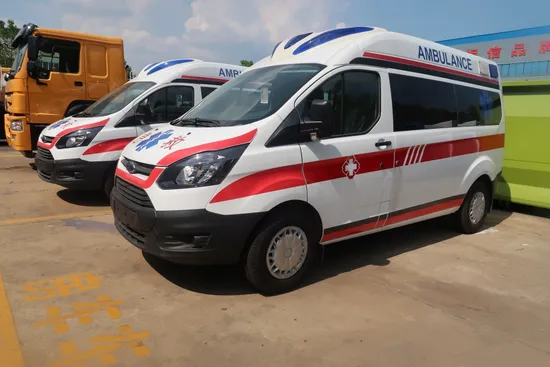
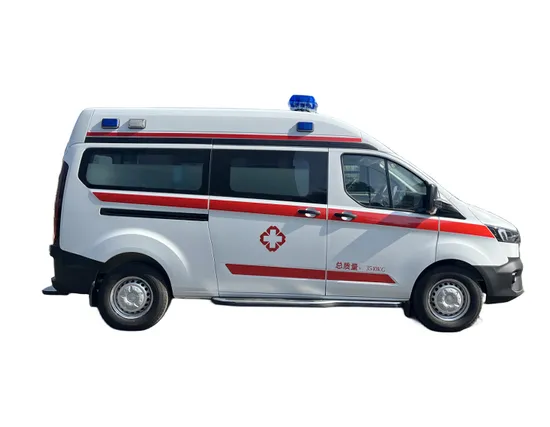
The Ford ICU Patient Transit Ambulance Euro 5 122HP is a van ambulance for moving critically ill patients between hospitals, supplied with medical equipment. It uses a Ford Duratorq 4D206H diesel engine rated at 90 kW (122HP) and a five-speed manual gearbox, and its colour is white. Left-hand drive is standard, and right-hand drive is available on request.
It is intended for intensive care transfers, where a patient arrives with drips, a ventilator or monitors that must keep working throughout the journey. Hospitals, specialist transfer teams and private critical-care services are the natural users.
Typical working routines
An ICU transfer is planned in advance. The patient is stabilised, equipment is moved from the ward bed to the ambulance stretcher, and a doctor or nurse travels in the back to watch the monitors. The vehicle has to give a smooth ride, steady power for medical devices and enough room around the stretcher for the crew to work.
The overall dimensions are approximately 5341 × 2032 mm in length and width, with a height of 2460 or 2590 mm depending on the roof option. The wheelbase is 3300 mm. This is a mid-size van, long enough for a stretcher plus equipment on one side and seats for the crew, but still manageable in city hospital grounds.
Chassis, engine and drivetrain
The engine is an in-line four-cylinder diesel, supercharged and intercooled, with a displacement of 1.998 litres. Power is 90 kW (122HP). The gearbox is a manual unit with five forward gears and one reverse.
The tyres are 215/75R16LT, four fitted. The vehicle also has ABS and EBD, which help the driver keep control under hard braking and distribute braking force between axles, and power steering. Gross vehicle mass is 3510 kg with an approximate kerb weight of 2560 kg. That leaves limited payload margin, so the weight of any equipment you add, such as ventilators, defibrillators, oxygen cylinders and a mains inverter, should be tallied before the final specification.
Equipment and operating system
The vehicle comes with medical equipment, and the exact list and the size of the medical cabin are confirmed in the quotation. Ask for a written list that covers the stretcher and its fixings, the oxygen supply and regulators, the electrical supply for devices, interior lighting, storage cabinets, suction, and the arrangement of seats for crew.
For ICU work the electrical supply is critical. Confirm how devices are powered when the engine is off, whether there is a mains connection for use at the hospital, and how long the batteries can supply the equipment.
Cab comfort and daily checks
The cab has air conditioning, a USB socket and a radio sound system. A cool, quiet cab matters for a driver who must hold a steady speed over long distances, as sudden braking and rough handling affect a patient on life support. ABS and EBD add to safety in wet or uneven road conditions.
A transfer ambulance only earns its place if it starts and runs when the call comes. Check engine oil, coolant and tyre pressures at the start of each shift, test the brakes and warning lights, and run the air conditioning for a few minutes. The supercharged engine benefits from a short idle before it is switched off after a hard run. Inside, test the stretcher locks, the oxygen supply and the backup battery for the devices, and record the results in a logbook so that faults are noticed early.
What to confirm before ordering
The emission standard and the fuel type depend on the configuration and are confirmed in the quotation. This vehicle is Euro 5 with a diesel engine, so confirm that the version you are quoted matches the rules where the vehicle will be registered.
Also confirm the roof height, the final dimensions of the patient area, the equipment list and its power supply, and the steering side.
Request a current quotation for your selected configuration, quantity and delivery terms.