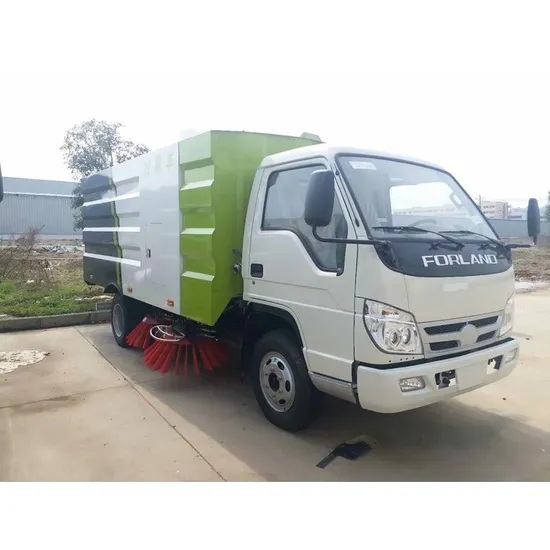
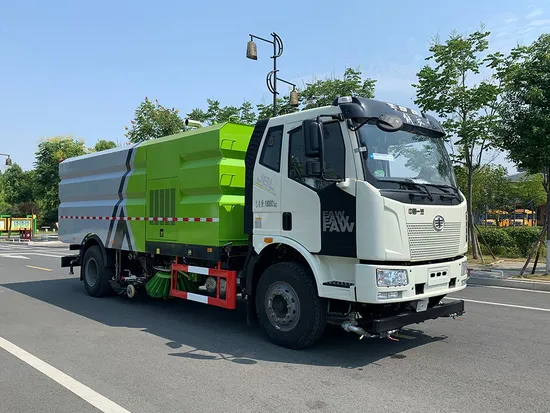
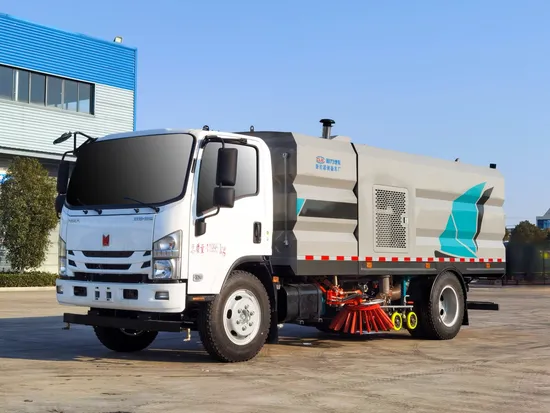
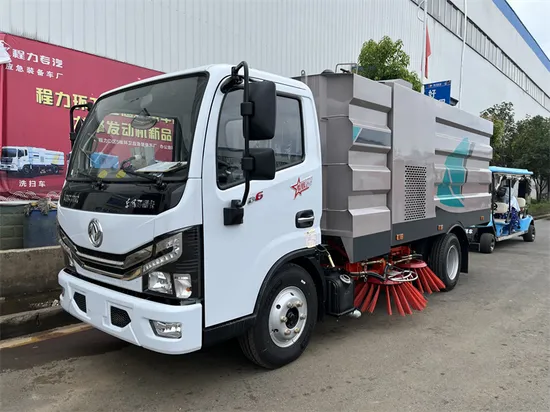
The Foton Forland Small Vacuum Sweeper Truck 68HP, model CLW5042TSLB, is a compact sweep-and-suck street cleaner on a Foton Forland diesel chassis. It has a single-row tilting cab, a stainless steel vacuum tank, a separate water tank and four sweeping brushes.
Its dimensions of 5210 × 1760 × 2280 mm make it a good match for municipal crews, estate managers and contractors who clean lanes, pavements, plazas and small roads where a larger sweeper would be hard to manoeuvre.
How the sweep-and-suck system works
A sweep-and-suck truck combines mechanical brushing with air suction. The brushes loosen debris from the surface and move it toward the intake, and a fan creates the airflow that lifts the material into the collection tank. A water tank supplies the cold water cleaning process used on this model, which wets the surface so that fine dust is held down during sweeping.
The cubage is 0.8 m³ for the water tank and 2 m³ for the dust tank. The standard configuration also includes an auxiliary engine, which on trucks of this type normally drives the brushes and fan so that the chassis engine only has to move the truck.
Chassis, engine and drivetrain
The chassis engine is a four-cylinder, in-line, four-stroke, water-cooled, turbocharged and inter-cooled diesel of 2.770 L. It is rated at 68 horsepower, 50 kW and a maximum torque of 123 N·m. The gearbox is a five-speed manual with one reverse gear, steering is power-assisted, and the brake system is an oil (hydraulic) brake.
The front axle is rated at 1.8 tons and the rear axle at 3.5 tons. The wheelbase is 2600 mm, the approach and departure angles are 18 degrees each, and the curb weight is 3880 kg. Tyres are 6.0-15, with six fitted plus one spare. The electrical system is 24 V, and the cab seats two or three people.
Equipment and options
Standard equipment includes the tank body, four sweeping brushes, the stainless steel vacuum tank, the water tank, a fan and the auxiliary engine. Optional equipment includes a front and rear road flushing system and a garbage tank self-cleaning system. The second option is useful when the truck collects wet or sticky waste, because it reduces the manual work needed at the unloading point.
Colour and logo can be customised. Left-hand drive is standard and right-hand drive is available on request. If you need right-hand drive, state it when you request the quotation.
Daily routine and checks
Start each shift by filling the water tank and checking that the vacuum tank is empty and its door seals are clean. Look at the four brushes for wear and for wire, rope or plastic wrapped around the spindles. Run the fan briefly and listen for abnormal noise before driving to the work area.
At the end of the shift, tip the dust tank, wash out the inside and clear the suction path of anything that could block it. Check engine oil and coolant on both the chassis engine and the auxiliary engine, and look at tyre condition, including the spare. Because the brake system is hydraulic, check the brake fluid level as well.
What to confirm before ordering
Payload and the permitted load of the finished truck are confirmed in the quotation. The emission standard is Euro 2, and you should check that this suits where the truck will work.
Ask which tank volumes apply (0.8 m³ water and 2 m³ dust), what the suction intake and brush width are, which optional systems are fitted, and whether the auxiliary engine is diesel or another type. Confirm the drive side, the colour, the logo and any other customisation you require.
Request a current quotation for your selected configuration, quantity and delivery terms.