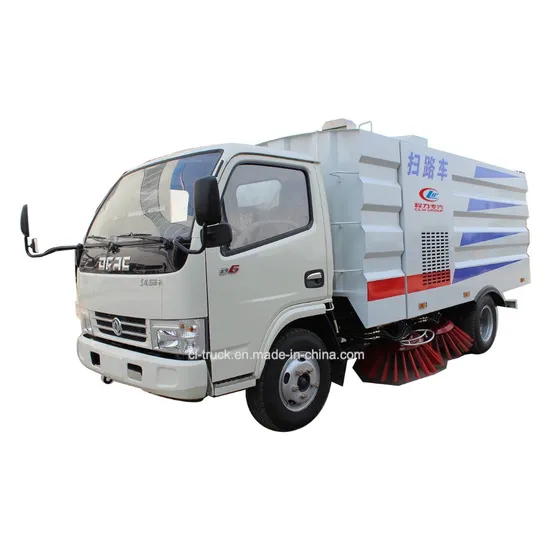
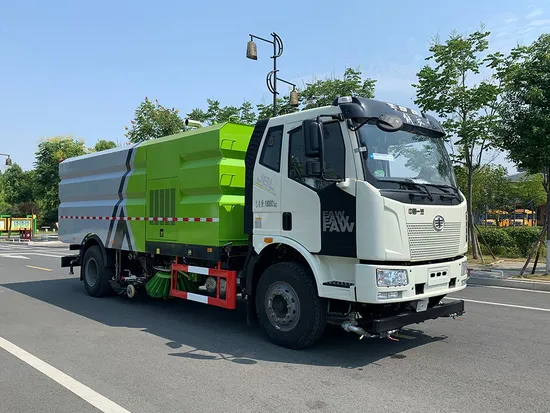
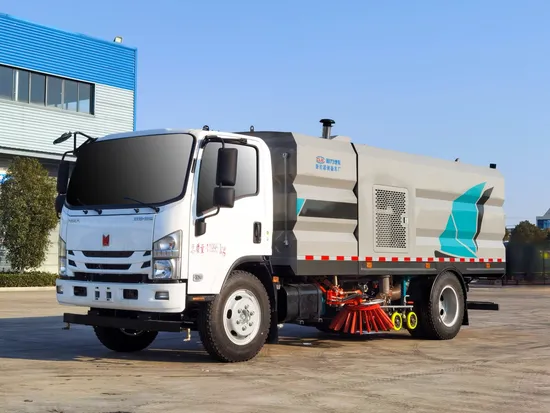
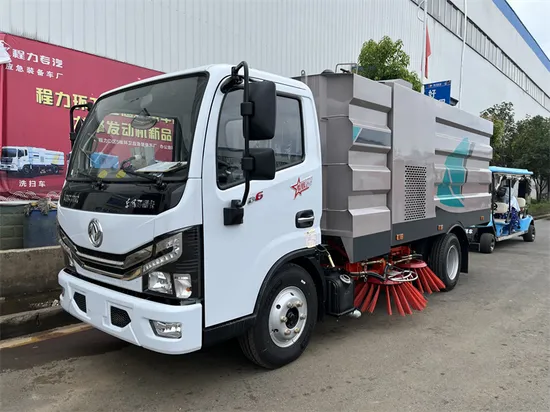
The Dongfeng 4x2 Small Vacuum Runway Street Sweeper Truck is a compact vacuum sweeper on a Dongfeng 4x2 chassis, available with left-hand or right-hand drive. It is powered by the CY4102-C3F four-cylinder engine and has a manual five-speed gearbox, air brakes and power steering, giving it a conventional, easy-to-service layout.
We offer it to airports, municipal cleaning teams, industrial estates and contractors who need to clear fine dust, loose stones and litter from runways, aprons and city streets. The overall length of 5,950 mm and width of 2,000 mm keep it small enough for tight working areas while still carrying a proper vacuum sweeping body.
Chassis, engine and drivetrain
The wheelbase is 3,300 mm and overall dimensions are 5,950 × 2,000 × 2,590 mm. The engine, model CY4102-C3F, is a water-cooled, inter-cooled four-stroke straight-four with a displacement of 3.707 L. The maximum speed is 90 km/h, which helps the truck travel between work areas quickly when the sweeping gear is switched off.
The gearbox has five forward gears and one reverse, operated manually. Air brakes and power steering reduce driver effort during long shifts. Axle ratings are 1.8 tons at the front and 3.5 tons at the rear, and the truck runs on 7.00-16 tyres with six fitted and one spare tyre supplied.
How a vacuum sweeper works
A vacuum sweeper draws dust and debris from the surface through an intake, using airflow created by a fan, and carries it into a collection hopper. This suits fine material such as sand, dust and small fragments that brooms alone tend to throw back into the air, and it is why vacuum models are preferred around runways and busy streets.
On a runway, the main concern is removing loose objects and grit that could be drawn into aircraft engines or damage tyres. Slow, overlapping passes with a full-length intake give the best result. We recommend emptying the hopper before it is full so that suction stays consistent along the entire pass.
Typical working routines
Crews generally plan sweeping in fixed circuits: runway edges, taxiway shoulders, apron areas, then roads and car parks. The small size of this truck lets drivers move around parked equipment and service roads without needing a wide turning area, and the left-hand or right-hand drive option lets the cab match your site traffic rules.
Daily checks should include tyre condition and pressure, air brake response, engine coolant level and the condition of the intake and hopper seals. A short test of the sweeping function before leaving the yard saves time on site and keeps the working shift productive from the first pass.
What to confirm before ordering
Please confirm whether you need left-hand or right-hand drive, the emission standard your area requires, and the hopper and water capacities you expect for your routes. Tell us whether the truck will work mainly on airfields or on public streets so that we can suggest a suitable equipment layout.
Our team will also confirm optional equipment, colour, lighting needs and any marking requirements for airside work. All of these points, together with the final power and weight figures for the chosen configuration, are stated in the quotation so that you can review a complete specification before you decide.
Request a current quotation for your selected configuration, quantity and delivery terms.