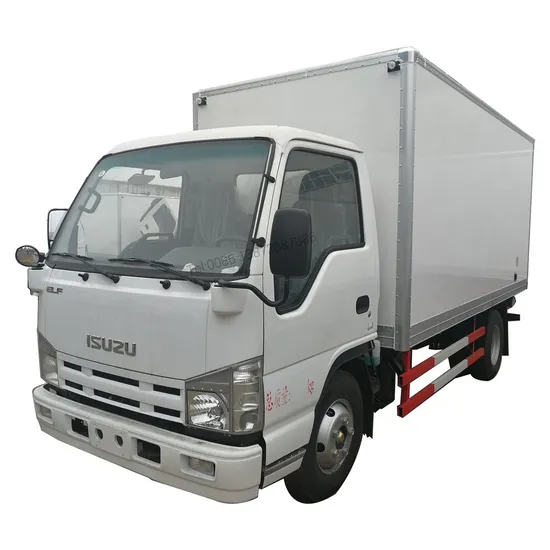
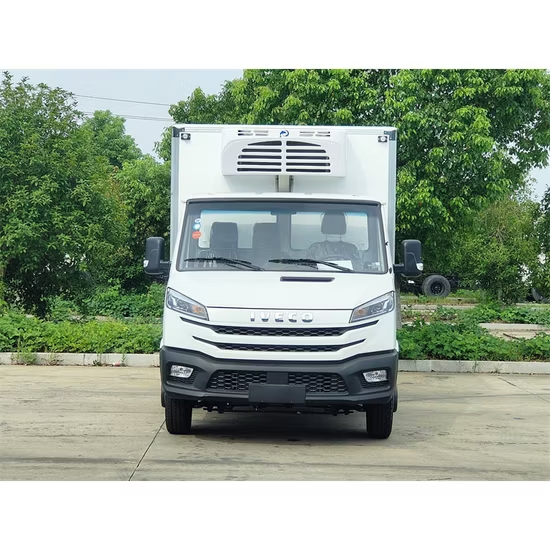
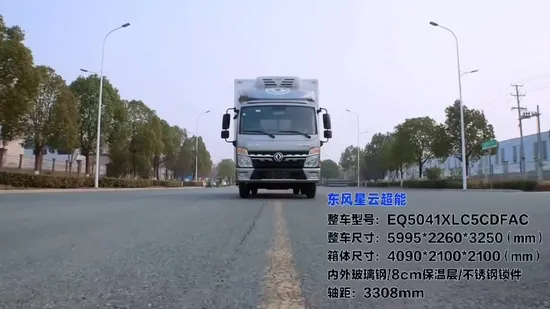
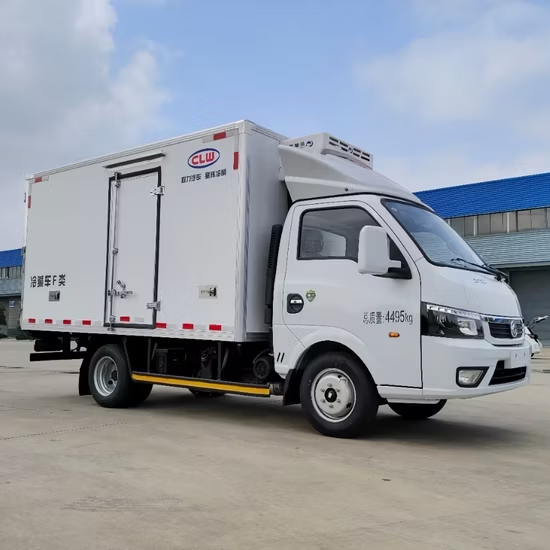
The Isuzu 100P Fiberglass Refrigerated Van Truck 4t Euro 4 is a 4x2 diesel van with a fibreglass insulated box, left-hand drive as standard and right-hand drive on request. It is built on the Isuzu 100P chassis and powered by the 4JB1CN engine rated at 98HP and 72 kW, with a displacement of 2.771 L and a five-speed manual gearbox. The box is 4150 × 1750 × 2230 mm, and the overall size of the truck is 5995 × 1930 × 3380 mm.
It is a mid-sized cold van for food sellers, wholesalers and caterers who need a closed, insulated space that is wide enough for pallets or stacked crates but still short enough to work in town. It has a 4 ton rating, and the paint can be white or yellow with the box colour chosen separately.
Why a fibreglass box
The box uses glass-reinforced plastic inside and outside with a polyurethane insulation layer. Fibreglass panels are formed in large sections, so there are fewer joints than on a box built from many small pieces. Fewer joints mean fewer places for moisture to enter, and a smooth inner face that is quick to wipe down after wet loads.
The refrigeration unit is a Hanyan, with a temperature that reaches minus 18 degrees Celsius, and the electrical system is 12 V. One tool box is included. Ask for the insulation thickness, because thickness affects both the cooling load and the internal space.
Care of a fibreglass box is simple but worth doing. Wash it with a mild cleaner, avoid hard scrapers that can scratch the gel surface, and check corners and door frames for impact marks after each busy week. A small crack should be repaired early, because moisture that reaches the insulation reduces its value and adds weight. Ask the factory what repair material is recommended and whether a repair kit can be supplied with the truck.
Chassis, engine and drivetrain
The wheelbase is 3360 mm and the curb weight is 2760 kg. The maximum speed is 98 km/h. The transmission is a five-speed MSB manual gearbox, and the steering is power assisted. The brakes are oil brakes with a vacuum pump. The front axle is rated at 2.5 tons and the rear axle at 4.8 tons, and the tyres are 7.00-16, six fitted plus a spare.
In the cab, an air container is fitted, and a sound system and parking sensors are standard. The engine is under 150 horsepower, which suits a light truck that spends most of its time on town roads and short trunk routes.
Matching the truck to your job
A 4 ton rating sounds generous, but cold cargo is often volume-limited. A box 4150 mm long and 1750 mm wide holds only a limited number of standard pallets, so count what you actually carry. If your product is dense, such as bottled drinks or frozen meat, weight will be the limit. If it is light, such as bread or leafy produce, volume will be the limit.
Think too about the pattern of stops. A route with many drops needs a unit that recovers quickly after each door opening. A route with a few large drops needs a floor that can take pallet trucks without damage and a rear door wide enough for the load.
Maintenance and daily checks
Start the refrigeration unit before loading, and check that the box reaches its set temperature. Look at the door seals and latches and keep the drain clear. On the chassis, check engine oil, coolant, brake fluid, tyre pressure and lights every day. Wash the interior after use, and leave the doors open for a time so that the box dries.
What to confirm before ordering
Load capacity depends on the configuration and is confirmed in the quotation.
Also confirm the drive side, the insulation thickness, the refrigeration unit brand and capacity, the lowest temperature you need, the door layout, the interior floor and the colour of the cab and box.
Request a current quotation for your selected configuration, quantity and delivery terms.