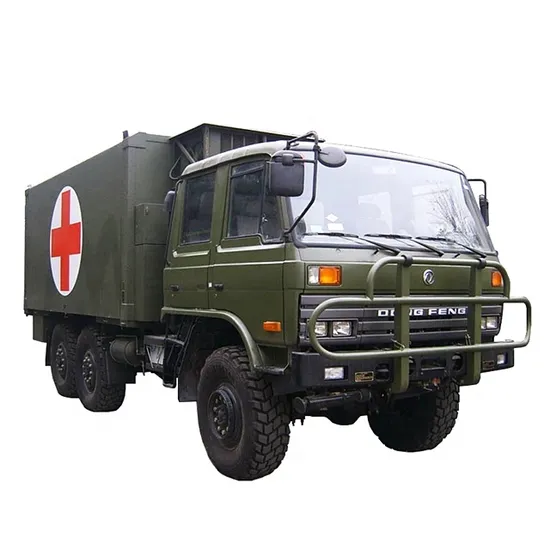
The Dongfeng 4x4 6x6 Box Type Ambulance LHD RHD is a heavy-duty, all-terrain ambulance built as a separate box body on a Dongfeng chassis. It is offered with four-wheel or six-wheel drive and with either steering side. The listed engine is a Cummins B170-33 with a displacement of 5900 ml, paired with a manual gearbox, and the vehicle is listed without medical equipment.
This is a vehicle for crews that must operate well away from paved roads. It suits field hospitals, mobile clinics, disaster response teams, expedition support and remote works camps, where a patient cabin has to travel over sand, mud or broken ground.
Where this truck is used
A box ambulance is different from a van conversion. The patient compartment is a self-contained cabin mounted on the chassis, and its size is closer to a small treatment room than to the rear of a van. That makes the vehicle useful as a mobile treatment point: a doctor can examine, stabilise and prepare a patient for onward transport inside a protected, level space, rather than at the roadside.
Typical roles include casualty collection after floods or earthquakes, medical support for construction and mining sites, border and patrol posts, and large outdoor events with unmade parking areas. In each case the same logic applies: the vehicle must reach the patient first, and the cabin must keep working once it gets there.
Chassis, engine and drivetrain
The drive is listed as 4x4 or 6x6. The 6x6 layout puts power on three axles, which spreads traction and helps to cross soft ground, while the 4x4 layout is lighter and simpler to maintain. Which one suits you depends on how bad the ground is and how heavy the finished vehicle will be.
The engine is a Cummins B170-33 of 5900 ml. The emission standard is shown as Euro III, which suits areas where fuel quality is variable. The gearbox is manual. Tyres are 12.5R20, a large size chosen for cross-country work. The top speed is listed as 90 km/h, and approach and departure angles are specified, which matters when the vehicle has to climb out of a ditch or drive onto a ferry ramp.
The overall dimensions are 6500 × 2470 × 3550 mm. The height is worth noting if the vehicle will pass under bridges, power lines or covered gates, and the width should be compared against narrow tracks and ferry ramps on your routes.
Box body and interior
The box dimensions are listed as 3545 × 2294 × 2480 mm. Inside, the equipment list shows an emergency room with a non-slip floor, supplied as one set. The specification does not describe the rest of the interior, because the vehicle is listed without medical equipment.
That gives you the freedom to plan the cabin around your protocols. A typical layout might include a stretcher with locking fixtures, an examination light, a wash basin, cabinets, oxygen supply, a fixed seat for the attendant, and a mains connection for equipment when parked. In hot climates, cabin insulation and air conditioning deserve careful thought; in cold climates, heating does.
A non-slip floor is the right starting point, because wet boots, blood and fluids are common in emergency work. Ask also about wall surfaces that can be washed down easily, and lighting that can be switched between white and a dimmer setting for night work.
Matching the truck to your job
Compare the demands honestly. If your route is mostly a graded dirt road, a 4x4 ambulance on a lighter chassis may be enough and will cost less to run. If your work involves deep sand, swamp or repeated crossings, the extra axle of a 6x6 is the better tool. A heavy box ambulance also needs a place to park and a way to be recovered if it gets stuck, so think about recovery equipment, such as a winch point and tow hooks.
Think also about fuel range, since heavy off-road vehicles use more fuel than a van, and about the tyre supply you can rely on for the 12.5R20 size.
What to confirm before ordering
Several items depend on the configuration and are confirmed in the quotation: the number of driven axles, the steering side, the fuel type, the engine power rating, the axle count and the gross, kerb and payload weights. Please also confirm the interior layout, the electrical system for medical devices, ventilation, and any extras such as a winch, roof lights or a generator.
Request a current quotation for your selected configuration, quantity and delivery terms.