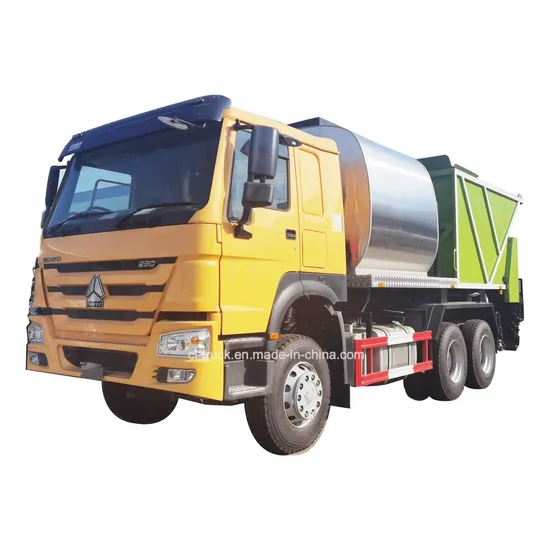
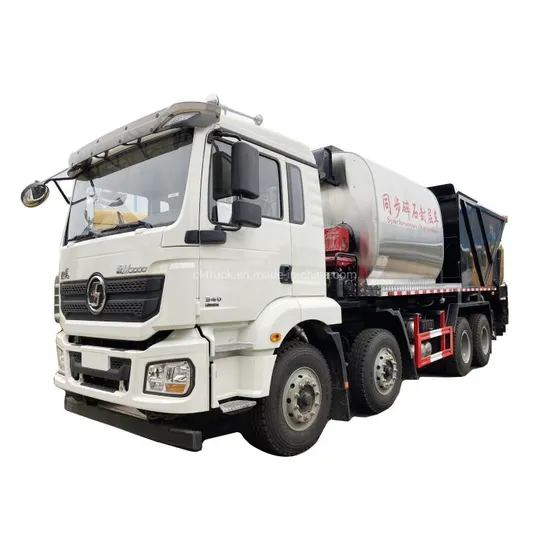
A synchronous chip sealer truck combines binder application with total spreading. Its purchase specification should therefore describe two material paths, not just one tank and a chassis. Identify asphalt storage, total storage, both distribution systems and the controls coordinating the selected configuration.
Specify the asphalt tank separately
The HOWO Chips Bucket Asphalt Chip Sealer has an 8 m³ tanker-volume entry in its detailed equipment table. Its summary has different capacity wording. Ask the supplier to identify the tank actually included in the offer rather than combining those entries.
State the binder type and required supply conditions. Request the selected tank material, insulation, heating equipment, pumping arrangement and relevant documentation. The capacity entry alone does not specify all those components.
Give the total hopper its own capacity field
The Shacman synchronous surface chip sealer names an 8,000-liter asphalt tank and 12,000-liter gravel tank in its title. Those describe different storage functions. In volume units, they are 8 m³ and 12 m³ respectively; they should not be added into one asphalt capacity.
The same title also contains “14cbm,” while the detailed table lists an 8 m³ tanker. Request a selected asphalt and total capacity schedule that resolves the configuration. Do not infer total carrying mass from hopper volume without the relevant material and vehicle loading information.
Define the two distribution systems
The HOWO 6X4 synchronous chip sealer lists a 4 m distribution-width entry, 950 L/min flow and a 0.8 MPa pressure entry. Ask which component and operating conditions each figure describes. Those entries do not establish the aggregate spreading rate.
For the binder side, request pump, spray-bar and nozzle details. For the total side, request hopper feed, outlet and spread-control details. Describe the required width and material application requirements separately. A single headline width should not be assumed to define every operating mode.
Ask how the controls coordinate the selected equipment
Request the control-system description, selectable functions and documentation for the exact machine. The listings include a “±2%” entry with an unclear field label. It should not be presented as a universal accuracy guarantee for both materials. Ask the supplier what measurement it concerns and under which conditions.
Identify the chassis configuration in the same offer. The Shacman page contains differing drive-layout entries, so its final drawing should state the selected axle layout and installed equipment. A general synchronous-sealer label is not a complete configuration record.
Plan two replenishment streams
Tell the supplier where binder will be supplied and how total will be loaded. Include travel distances, available loading equipment and the intended work sequence. The material that requires replenishment first may determine the next service stop. The two storage volumes do not imply equal operating duration.
For your road project, submit the binder, total size description, application requirements, working width, supply arrangements and site access. Ask Chengliwei for a quotation with separate asphalt and total capacity fields, separate distribution equipment lists and one clearly identified control package. That provides a practical basis for ordering the complete chip sealer.