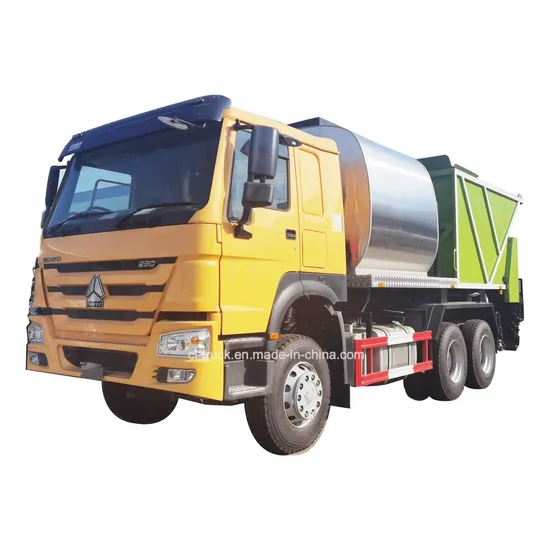
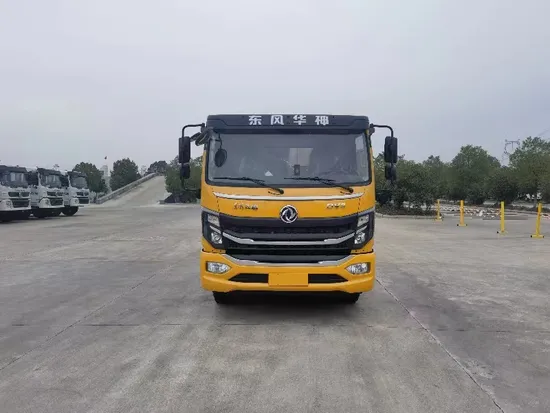
The HOWO 6x4 Chip Sealer Truck for Road Maintenance is a synchronous chip sealer on a six-wheel-drive-class heavy chassis, with a WD615.69 engine rated at 247 kW (336 hp). It sprays bitumen and spreads aggregate in one pass, so the chips are placed while the binder is still hot. It suits road maintenance crews who apply surface seals on rural and secondary roads.
The truck is listed in white and measures approximately 10200 × 2500 × 3563 mm, with a curb weight of 17600 kg. Its wheelbase is 4600 + 1500 mm. The heavy axles and the long frame are there to carry both a bitumen tank and aggregate and to remain stable while the spreader operates.
Typical working routines
A chip sealing job follows a fixed order. Binder is sprayed across a 4 m distribution width, and aggregate is dropped on it within moments, before the binder cools. Rollers then follow to press the chips in. Doing both jobs from one vehicle shortens the interval between the two steps.
The crew needs to coordinate truck speed, binder rate and aggregate feed. Practice on a test strip helps set these correctly. Aggregate supply trucks should be ready to refill the hopper without long gaps, because a pause leaves bare binder that cools and stops holding chips well.
Chassis, engine and drivetrain
The engine is a six-cylinder in-line, water-cooled, intercooled unit with a displacement of 9.726 L. Drive passes through a dry single-plate clutch with hydraulic booster to an HW15710 manual transmission with ten forward gears and two reverse gears. Steering is ZF8098.
The drive axles are rated at 13 ton each and the front axle at 7 ton. Tyres are 12.00R20 14PR, ten fitted plus one spare. Approach and departure angles are 16 and 14 degrees, and the front and rear overhangs are 1500 and 2750 mm. Check these when planning access to rough shoulders.
Binder and aggregate systems
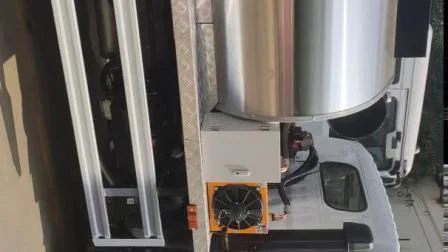
The bitumen spraying section lists a flow of 950 l/min, a pressure of 0.8 MPa, a rated speed of 584 r/min and a heating efficiency of 2 × 10^4 kcal/h. The distribution width is 4 m. The aggregate spreading section lists a metering accuracy of ± 2%.
Keep the spray nozzles and aggregate gates clean, and flush the binder lines after each shift. Inspect the aggregate hopper for wear and make sure the metering gates open evenly. A small blockage in one nozzle can leave a stripe without binder, which is obvious on the finished surface.
What to confirm before ordering
The tank capacity, the aggregate hopper capacity, the weights, the drive layout of the finished chassis and the emission standard depend on the configuration and are confirmed in the quotation. Ask for each of these in writing so that your refill planning and route permits are based on the right numbers.
Also confirm the drive side, the heating and circulation arrangement, nozzle control, and any optional equipment such as warning lights or a hand lance. Describe the binder and aggregate sizes you plan to use, so the factory can check that the spreader and spray bar suit your sealing method.
Request a current quotation for your selected configuration, quantity and delivery terms.