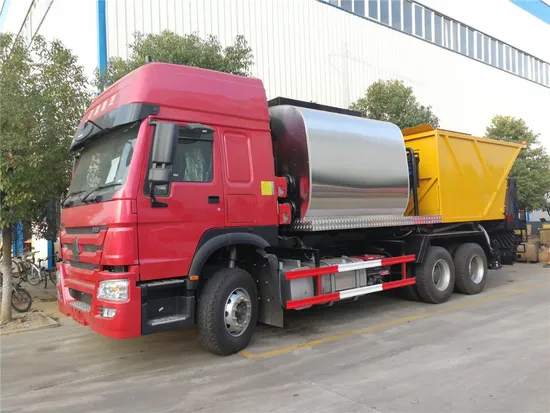
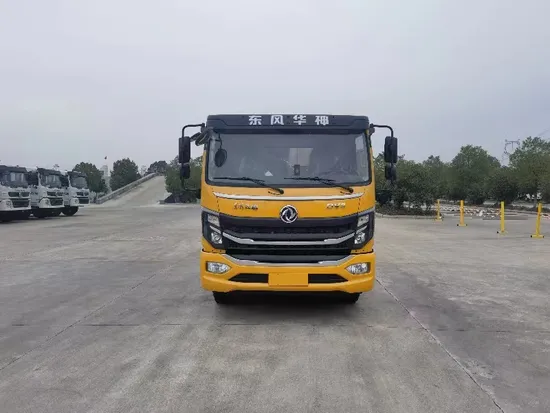
The HOWO 4x2 Synchronous Bitumen and Chip Sealing Truck is a combined binder and aggregate applicator for road surface treatment. It is a HOWO truck with a left-hand-drive cab, and it carries an 8 m³ bitumen tank, a WD615.69 diesel engine rated at 247 kW (336 hp) and a ten-speed manual gearbox.
Road agencies and contractors choose this type of truck when they want to seal a road in one pass, with bitumen going down and stone chips immediately on top of it. The synchronous method suits long, uninterrupted stretches of rural and secondary road.
Typical working routines
The truck is loaded with hot bitumen and a stock of clean, graded aggregate. At the work site it moves at a steady, low speed along the lane. The spray bar lays a uniform film, the chip spreader follows within a short distance, and a roller comes behind to press the chips into the binder. Any delay between binder and chips reduces bonding, which is why the machine does both jobs itself.
A good crew prepares in advance: the surface is swept, the treatment width is marked, and the roller is in position behind the truck. Trucks of this size work best when refilling points are close to the job, because a stop for reloading means a cold joint in the seal.
Tank and spraying system
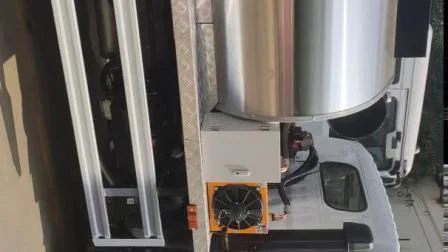
The bitumen tank holds 8 m³. The spray system is rated for a flow of 950 litres per minute at a pressure of 0.8 MPa, with the pump listed at 584 r/min and a distribution width of 4 m. The heating capacity is shown as 2 × 10^4 kcal/h, and the aggregate spraying entry lists ±2%.
It helps to run a short calibration test before a large job. Spray a measured quantity of binder over a known area, check that the film is even across the full width, and adjust the pump speed or the travel speed until the rate matches your specification. The same check on the chip spreader, using a tray on the road surface, shows whether the aggregate is falling evenly.
Tank size alone does not say how much road the truck will treat. Coverage depends on the application rate, the width sprayed, and the amount of aggregate carried, which is why the aggregate hopper capacity should be requested together with the tank volume.
Chassis, engine and drivetrain
The WD615.69 is a six-cylinder in-line diesel with water cooling and an intercooler, displacing 9.726 litres. A dry single-plate clutch with hydraulic booster is fitted, and the gearbox is an HW15710 with ten forward gears and two reverse gears, operated manually. Steering is by ZF8098.
Axle ratings are 7 tons at the front and 13 tons for each of the rear drive axles, and the tyres are 12.00R20 14PR with a spare. The overall dimensions are 10200 × 2500 × 3563 mm and the wheelbase is 4600 + 1500 mm. Front and rear overhangs are 1500 mm and 2750 mm, with a front track of 2022 mm and a rear track of 1830 mm.
Maintenance and daily checks
Chip sealing is hard on equipment because hot bitumen and abrasive stone meet in the same machine. Before each shift check engine oil, coolant and tyre condition, test the brakes and lights, and inspect the spray bar nozzles for blockage. After each shift flush the bitumen pump and lines as recommended, empty and clean the aggregate hopper and check the spreader gates and feed mechanism for wear.
Keep a log of nozzle replacements and calibration checks. A spray bar that has drifted out of calibration wastes binder and gives uneven seals.
What to confirm before ordering
The drive configuration, load rating, gross and kerb weights, emission standard, and the capacity of the aggregate hopper depend on the configuration and are confirmed in the quotation. Please state the binder type, the aggregate size, the treatment width and the application rate you plan to use. Ask for the heating and circulation details and the control system specification, and confirm the loaded weights with both materials aboard.
Request a current quotation for your selected configuration, quantity and delivery terms.