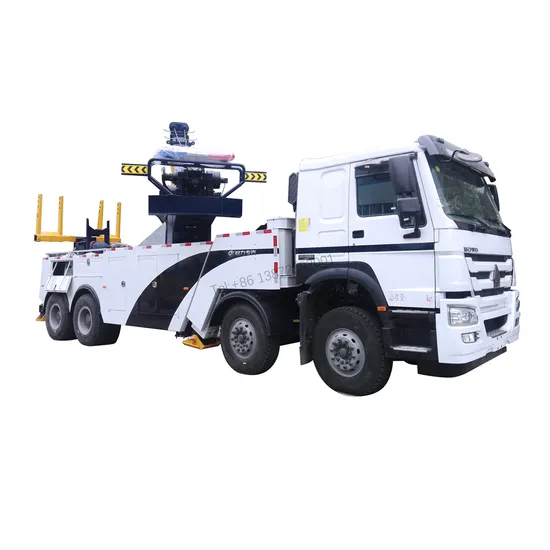
The Sinotruk HOWO 8x4 Heavy Duty Rotator Wrecker Truck 50t is a four-axle recovery vehicle with a rotating lifting boom, built on a Sinotruk HOWO 8×4 chassis with a 371 HP WD615.47 diesel. It carries two 15-ton winches, a three-section lifting boom, a three-section supporting boom set and towing forks, and the boom rotates through a full 360 degrees. Left-hand drive is standard and right-hand drive is available on request.
This is a truck for heavy recovery contractors, highway operators, mining and quarry companies, bus and truck fleets and emergency services that must right, lift and move vehicles far heavier than a car, such as loaded trucks, buses and construction machinery.
How a rotator recovery truck works
A rotator is a recovery crane mounted on the truck frame. Its boom can swing around in a full circle, so the operator can place the hook over a casualty that lies beside or behind the truck without moving the truck itself. The supporting booms provide stability during a lift, and the lifting booms, which extend in sections, carry the load. The two winches pull a vehicle upright or drag it back onto the road, and the towing forks lift one end of a vehicle for towing.
The common jobs are righting an overturned truck, lifting a vehicle out of a ditch, clearing a crash scene on a highway and pulling a stuck machine out of soft ground. The truck is equipped with five sets of towing forks and one fork support, which gives the crew some choice in how to hold different vehicles.
Chassis, cab and drivetrain
The wheelbase is 1800 + 4600 + 1350 mm and the overall dimensions are 11460 × 2500 × 3270 mm. Gross vehicle mass is 31000 kg and curb weight 24870 kg. The WD615.47 is a six-cylinder, four-stroke, water-cooled diesel with a displacement of 9.726 litres and an output of 273 kW, which matches the 371 HP rating. Emission standard is Euro 2.
The HW19710 gearbox is a manual unit with ten forward gears and one reverse. The steering is a ZF8098 unit, brakes are air operated, the front axle is HR9 and the rear axle AC16. The truck runs on 12.00R20 tyres, with ten in use and one spare.
The cab is HW76, with a full steel skeleton structure covered by double layer steel plate. It can be tipped forwards for engine access, and it carries air conditioning. On a recovery job, the operator may spend long hours in or beside the cab, and a cab with a tilting mechanism makes routine engine checks much easier than one that needs ladders or a hoist.
Winches and lifting equipment
The winch package is two 15-ton winches, each with 45 m of steel rope. The lifting booms have three sections with a six hexagon profile, and the supporting booms also have three sections. When two winches are used together, the pulling force is higher, but the rope angle and the anchor points must be set up carefully, and the load must stay within the ratings of the winches, ropes, hooks and boom.
The lifting capacity chart, boom reach at various angles and the maximum lifting height are confirmed in the quotation. They define what the rotator can safely do in practice.
Maintenance and daily checks
A heavy rotator is only as safe as its inspection routine. Before each job, check the hydraulic oil level, look along the boom sections for leaks and cracks, and inspect both winch ropes for broken wires and kinks. Check the hooks, shackles and the safety latches, and make sure the supporting booms extend and lock properly on firm ground.
On the chassis, check the air brake pressure build-up, the tyre condition on all ten road wheels and the engine oil and coolant. Keep a written log of boom and winch inspections so that wear is spotted early.
What to confirm before ordering
The towing capacity of 50 tons follows the model name, and the final rating, box and fork dimensions and cab features are confirmed in the quotation.
Also confirm the lifting chart, the drive side, the number of winches, the rope length, the fork set and the colour.
Request a current quotation for your selected configuration, quantity and delivery terms.