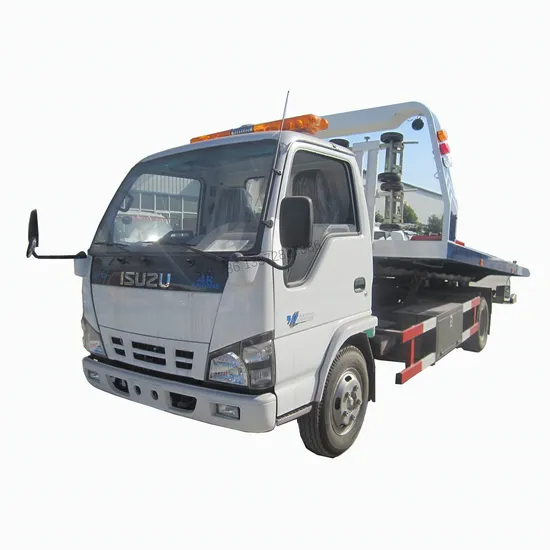
The Isuzu 600P 4t Sliding Rotator Tow Truck Wrecker is a 4×2 recovery truck built on an Isuzu 600P light truck with a single-row Isuzu cab. Under the cab sits the 4KH1CN5HS diesel, rated at 130 HP, and behind it a 5600 × 2300 mm flat deck with a 4-ton winch. The truck is left-hand drive as standard, with right-hand drive available on request, and it has a Euro 2 engine and a manual gearbox.
It is a sliding rotator recovery truck with a body that slides and rotates, aimed at the same group of customers as other light recovery trucks: towing firms, garages, dealerships and municipal fleets in crowded urban areas.
Where this truck is used
Urban recovery is a game of limited space. A broken-down car may be hemmed in by parked vehicles, or a vehicle may be in a lane where a long truck cannot reverse. A light truck with a deck of 5600 mm is easier to place in these situations than a heavy recovery vehicle, and a sliding body, by its design, moves the deck rearwards toward the casualty so that less pulling distance is needed.
The truck covers typical jobs such as moving a vehicle that has failed an inspection, removing a damaged car from a collision, transferring cars between workshops and clearing vehicles that block a driveway. Smaller vans can also be handled within the winch rating.
Understanding the sliding rotator name
The sliding rotator name combines two functions. A rotator in recovery terms is normally a boom that turns, while a sliding body is one that moves back along rails. Because these are different mechanisms, the stroke length, locking method and operating controls of this truck are confirmed in the quotation.
Chassis, cab and winch equipment
The chassis has a wheelbase of 3815 mm, a gross vehicle weight of 7460 kg and a curb weight of 5495 kg. Overall dimensions are 7420 × 2300 × 2540 mm. The engine is a four-cylinder inter-cooled diesel of 2.999 litres with a maximum output of 96 kW. The five-speed manual gearbox has a reverse, steering is power assisted and the brakes are air operated.
Front and rear axles are rated at 2.5 and 4.8 tons. The truck uses 7.00R16 tyres, six on the road and a spare, and the top speed is 90 km/h. The cab includes air conditioning.
A single 4-ton winch carries 21 m of steel wire rope. The truck also has a rear drag arm lift of 2.5 tons, bilateral linkage controls, a tool box, an alarm lamp, two auxiliary small round items and four bandages. The hydraulic valve is imported. The drag arm gives a second way to move a casualty when the deck cannot be tilted, which is useful where the roadway is narrow or the vehicle is on a ramp.
Daily routine and care
A sliding deck works through guides, rollers and cylinders that collect road dirt, so wipe and grease them on a regular schedule and look for scoring or play. Before the shift, move the deck through its full travel with nothing on it, listen for noise, and watch for any hesitation that could point to low oil or air in the lines.
When winching, pull straight, keep bystanders away from the rope and stop if the rope begins to stack unevenly on the drum. With a light chassis, add the weight of the casualty to the curb weight of 5495 kg and compare the total with the gross vehicle weight of 7460 kg before you set off. Keep the tyres at the pressure the chassis maker recommends for a loaded truck.
What to confirm before ordering
Ask for the load limit of the finished truck. It is a 4t class truck with a 4-ton winch, and the final towing rating is confirmed in the quotation.
Also confirm the sliding and rotator functions, the deck size, the drive side, the make of the hydraulic valve, the contents of the kit and the colour.
Request a current quotation for your selected configuration, quantity and delivery terms.