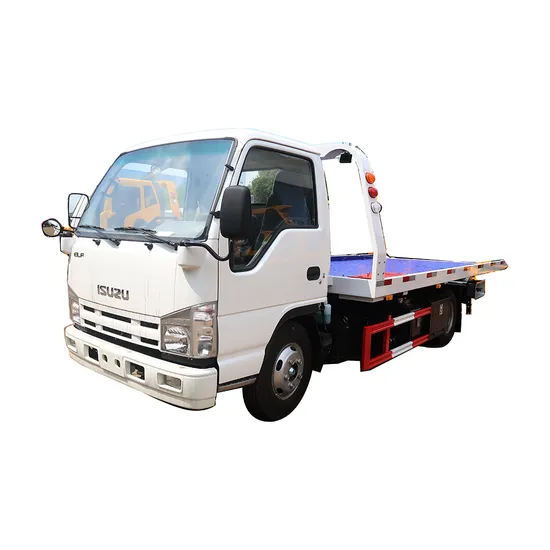
The Isuzu 4x2 Wrecker Recovery Truck 3-4t is a small recovery vehicle built on an Isuzu single-row cab chassis with a 3815 mm wheelbase. It is a 4×2 truck with left-hand drive, and right-hand drive is available on request. The gross vehicle weight is 7460 kg, and the engine is the Isuzu 4KH1CN5HS rated at 130HP.
It suits breakdown services, garages, parking operators and municipal crews that move cars, vans and light commercial vehicles over short distances. The compact 7420×2300×2540 mm body fits narrow streets and car parks, and the 90 km/h maximum speed is enough for urban towing runs. Air conditioning is part of the standard cab configuration.
Recovery equipment
The truck uses bilateral linkage operation, which means the controls can be reached from either side of the vehicle so the operator can watch the casualty while working. The equipment includes one 4 ton winch, a rear drag arm lift of 2.5 tons, a 21 m steel wire rope, two auxiliary small wheels, four bandages, a tool box and an alarm lamp.
The winch pulls a damaged vehicle into position, and the rear drag arm then lifts one axle so the car can be towed on its remaining wheels. Auxiliary small wheels support the lifted end where needed. Because the arm is rated at 2.5 tons, match the job to that figure, and use the winch only for straight pulls as much as possible.
Chassis, engine and drivetrain
The 4KH1CN5HS is a straight four-cylinder, four-stroke, water-cooled engine with intercooling, a displacement of 2.999 L and an output of 96 kW. Power passes through a five-speed manual gearbox with one reverse gear, and steering is power assisted. These specifications suit a light truck that spends much of its time idling at roadsides.
The front axle is rated at 2.5 tons and the rear at 4.8 tons, with 7.00R16 tyres, six fitted plus one spare. The curb weight is 5495 kg, which leaves limited margin below the 7460 kg gross vehicle weight, and the box size is 5600×2300. Respect those limits when carrying tools or a casualty on the body.
Using and maintaining the truck
Start each shift by checking the winch rope for broken strands, the hydraulic hoses for seepage and the alarm lamp for operation. Test the drag arm lift without a load and confirm the bandages and tie-down points are intact. Light recovery trucks work every day with shock loads, so small faults left unattended develop quickly.
When loading, set the parking brake, switch on the alarm lamp, and keep bystanders clear of the rope line. Pull slowly and straight, and secure the casualty with the bandages before moving off. Drive with the weight in mind, because a lifted axle at the rear changes braking distance and steering feel compared with the empty truck.
What to confirm before ordering
The name gives a 3-4t class, but the winch is 4 tons and the rear drag arm lift is 2.5 tons, so the real capacity depends on the configuration and is confirmed in the quotation. Ask our team to state the exact brake type and its parking brake arrangement.
Also confirm the drive side, the emission standard, the colour, and the exact contents of the tool kit and the hydraulic components. Tell our team the heaviest vehicle you plan to tow, together with the typical distance, so the lift and winch ratings can be checked against your work.
Request a current quotation for your selected configuration, quantity and delivery terms.