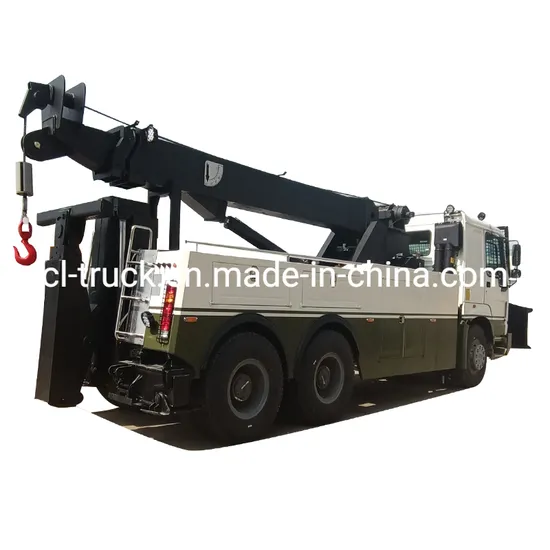
The HOWO 25t Heavy Duty Rotator Wrecker Tow Truck is a heavy recovery vehicle built on a HOWO chassis with a Weichai engine. It is sold as the HOWO wrecker truck model, and its rotator equipment is intended for lifting and recovering large vehicles that cannot be moved by a simple tow bar or flatbed.
It suits towing companies, highway rescue operators and fleet depots that handle buses, trucks and heavy equipment after breakdowns or accidents. A 25-ton class is a serious commitment, so the sections below explain what the configuration tells you and which points need to be settled before you choose this model for your yard.
Where this truck is used
Rotator recovery is typically needed when a vehicle has rolled onto its side, left the carriageway or become wedged in a position where straight pulling would cause more damage. A rotating boom allows the operator to lift the casualty, swing it, and set it down upright, working from the side of the carriageway rather than in line with the wreck.
Heavy recovery companies also use this class of truck in depots and quarries, where large machines and loaded trucks may need to be righted or repositioned. Because the work is slow and load-sensitive, a crew should plan each lift, set the truck up on firm ground and keep bystanders clear of the swing area throughout.
Chassis, engine and drivetrain
The recorded overall dimensions are 11460 × 2500 × 3270 mm with a curb weight of 27870 kg, which places this firmly among the largest wreckers in the range. The wheelbase is listed as 1800+4600+1350 mm, a three-part figure, and the engine manufacturer is Weichai Engine Power Co.,Ltd. Plan yard access and bridge limits accordingly.
Axle loads are listed as 6500 / 7000 / 16000 / 16000 kg, and track widths as 2022 / 2041 / 1830 / 1830 mm. Rear ground clearance is 500 mm, and the approach and departure angles are 16 and 10 degrees. These figures help you judge whether the truck can reach a recovery site over uneven ground, so check them against the routes your crew uses.
Cab and body details
The cab specification mentions air conditioning together with a CD player and radio, which matters on long recovery shifts where the crew may wait at an incident for hours. Tool boxes are installed on both sides of the body, so recovery chains, straps and hand tools can be reached from either side of the truck.
Operation handle boxes are also fitted on both sides. Placing the controls on each side lets the operator stand where the casualty vehicle is visible, instead of working around the truck. Whoever runs the equipment should be trained on the control layout and agree hand signals with the ground crew before any lift begins.
What to confirm before ordering
The drive system is listed as left hand or right hand, so state the steering side you need when requesting the quotation. Also confirm the emission standard of the engine, the lifting and towing ratings of the rotator at the working radius, and the exact boom and winch equipment included in the standard package.
Ask for a load chart that shows capacity at different boom angles and extensions, because a nominal 25 ton rating applies only under defined conditions. Confirm the colour, any extra lighting or warning equipment, and the tool kit. Written confirmation of these items avoids surprises when the truck is put to work.
Request a current quotation for your selected configuration, quantity and delivery terms.