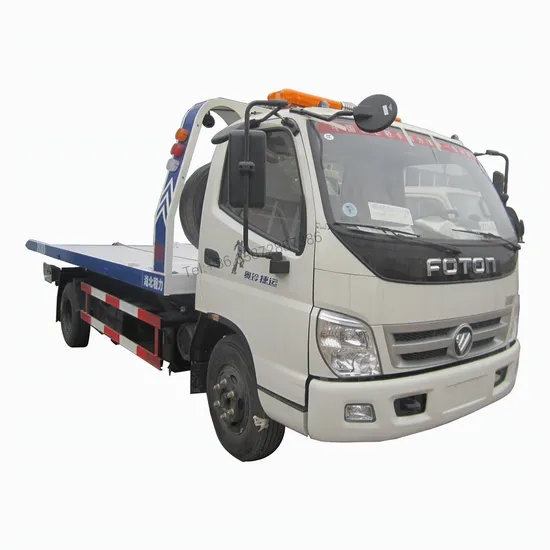
The Foton Aoling Flatbed Wrecker Towing Truck 3-4t Euro 4 is a flatbed recovery truck built on the Foton Aoling light truck chassis, with a 4×2 layout and a flat deck of 5600 × 2300 mm. Left hand drive is standard, and right hand drive is available on request. Power comes from an EISF3.8s4R154 diesel of 3.76 litres and 115 kW, mated to a six-speed manual gearbox. A 4-ton hydraulic capstan, which is the winch, pulls the casualty onto the deck.
The truck suits towing companies, motor clubs, breakdown contractors and fleet owners who want a recovery vehicle on a light chassis with a 115 kW engine and six forward gears, and who mostly handle cars, small vans and light trucks.
Typical working routines
A recovery crew spends much of its time on the winch, so the details of the winch matter. This truck has one winch with a 4-ton capstan, 21 m of steel wire rope and a rope speed of 8 metres per minute. At that speed, a full length of rope takes a little under three minutes to wind in, which is a useful guide when you estimate how long a loading job takes at a roadside. In practice the pull is slower when the casualty is heavy or the deck angle is steep.
Once the casualty is on the deck, the operator secures it with the four bandages in the kit, checks that the alarm lamp is working, and drives away. The tool box holds the loose items needed during a recovery, and the two auxiliary small round items are part of the kit.
Chassis, engine and drivetrain
The wheelbase is 3800 mm, the gross vehicle weight is 7495 kg and the curb weight is 5000 kg. The engine is a four-cylinder, in-line, water-cooled diesel, and the gearbox has six forward gears and one reverse. Steering is power assisted and the brakes are air operated. Axle ratings are 2.2 tons at the front and 5 tons at the rear, and the truck uses 8.25R16 tyres, six in use and one spare. The top speed is 90 km/h.
The cab is a single-row design, and the standard configuration includes air conditioning and a sound system. The six-speed box helps on mixed routes, where the truck runs empty on the highway to a call-out and then returns with a casualty on the deck.
Deck and recovery equipment
The operating gear is bilateral linkage, so the controls can be reached from either side of the truck. The equipment includes one winch, one tool box, one alarm lamp, two auxiliary small round items, four bandages and the 21 m wire rope. The deck measures 5600 × 2300 mm, and the final deck length and width are confirmed in the quotation for the vehicles you plan to carry.
Maintenance and daily checks
Treat the winch rope as a wear item. Unwind it fully at regular intervals, look for flattened or broken strands, and rewind it under light tension so that the layers sit evenly on the drum. Check hydraulic oil and hoses before each shift, because the capstan and the deck movement depend on the same oil supply.
On the chassis, follow the routine for a light truck with air brakes: let the system build pressure before moving off, drain moisture from the air tank, and check all seven tyres, including the spare. A recovery truck often parks on road shoulders, so test the alarm lamp every day.
What to confirm before ordering
The emission standard is Euro 4. The towing tonnage, the winch rating, the overall width and the chassis make are confirmed in the quotation.
Also confirm the drive side, the deck size, the colour and the equipment you want fitted.
Request a current quotation for your selected configuration, quantity and delivery terms.