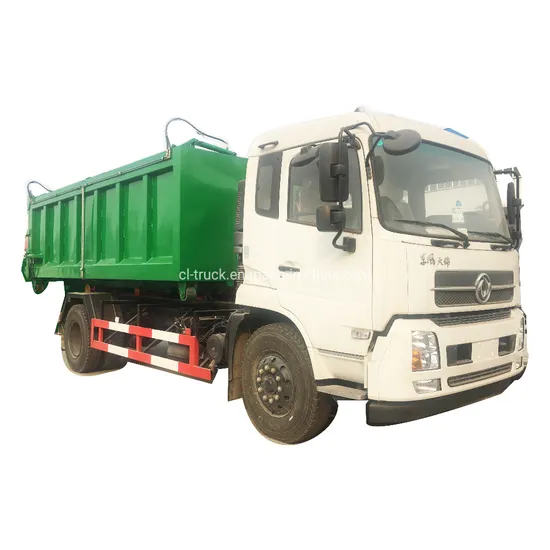
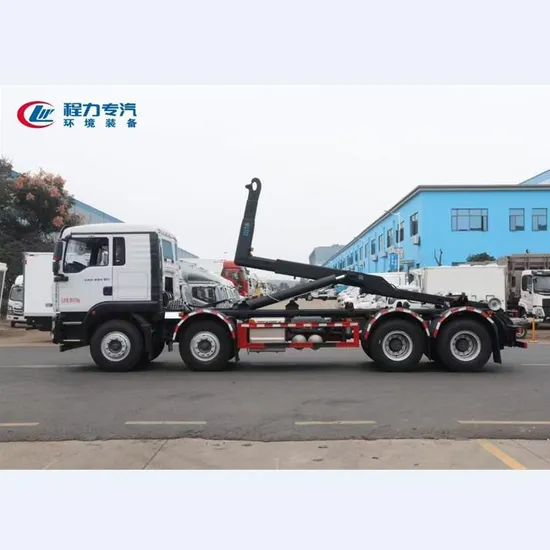
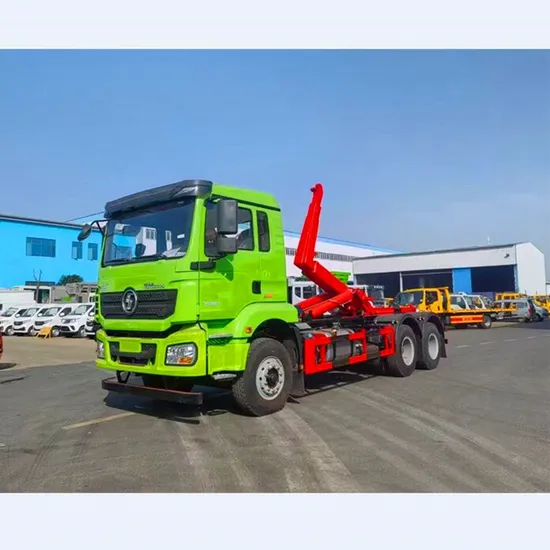
The Dongfeng 4x2 Hooklift Truck 10-12m³ Containers is a hook-lift garbage truck built on a Dongfeng Tianjin cab and chassis. It carries detachable containers rather than a fixed body, so one chassis can serve several container positions. The container sizes are 10 and 12 m³, and the layout is a 4×2 left-hand-drive truck, with right-hand drive available on request.
It suits municipal sanitation teams, building contractors, markets and industrial sites that fill containers faster than one compactor truck could empty them. A driver leaves an empty container, lifts the full one and drives to the disposal point, which keeps every loading point supplied with a container while collection continues elsewhere on the route.
How a hook-lift system works
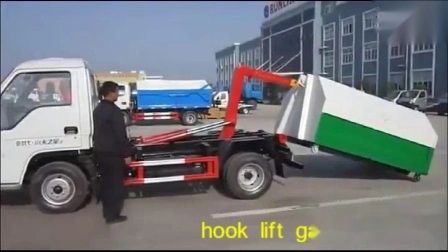
A hook-lift arm slides along rails on the chassis, hooks the front bar of a container and pulls it up and back onto the frame. Reversing the motion sets the container down on the ground. Because the container is separate from the truck, the same vehicle can carry open-top, closed or specialised bodies, provided the hook height and rail spacing match.
Loading and unloading depend on level, firm ground and enough clear length behind the truck to roll a container off. Drivers should check the hook lock and the container rear stops before moving. Wet or sloping ground and loose material that shifts during tipping are the usual causes of delays at collection points, so plan the approach to each site in advance.
Chassis, engine and drivetrain
The chassis is a 4×2 with a 4500 mm wheelbase and a Dongfeng cab. The engine is a B190 33, a straight four-cylinder diesel of 5.9 L displacement, rated at 190HP and 140kW. Power goes through a manual gearbox with six forward gears and one reverse, and the truck has power steering.
Axle ratings are 4.5 tons at the front and 9 tons at the rear, and the wheels are 10.00-20 tyres, six fitted plus one spare. Top speed is 90 km/h. Treat that as a design figure rather than a working speed, since a loaded hooklift behaves differently from an empty one in corners and under braking.
Containers and configuration choices
Container volume is 10 or 12 m³. Overall truck dimensions and weight figures are confirmed in the quotation. Choose the container by the density of the material: light bulky waste fills a large volume quickly, while debris reaches the weight limit sooner.
Air conditioning for the cab is optional, and the colour can follow the customer's requirement. If you already own containers, send drawings showing hook height, rail spacing, length and loaded weight. Our team can then check whether your existing containers fit the lifting frame before the truck is built, which is especially useful for mixed fleets.
What to confirm before ordering
Ask our team for the final weight sheet, the rated lifting capacity of the hook arm and a dimensioned drawing, and base payload and clearance calculations on those rather than on a summary line. Do the same for the container volume you intend to use.
Also confirm the steering side, the emission standard you require, whether air conditioning is fitted, the container size and any extra equipment such as a cover system or work lighting. Give our team your route conditions, number of container positions and typical load so the quotation matches the real duty rather than a generic specification.
Request a current quotation for your selected configuration, quantity and delivery terms.