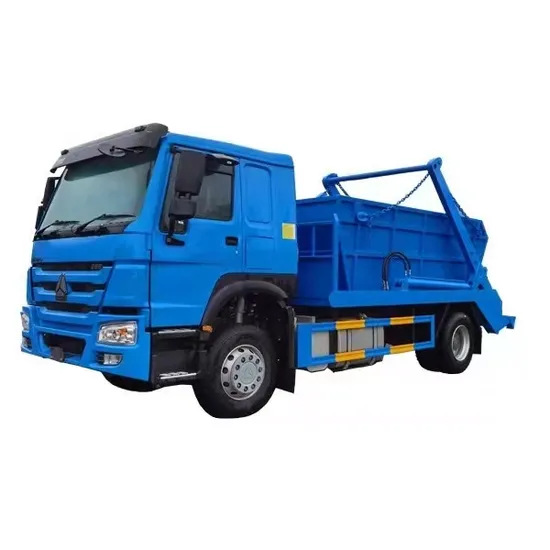
Choose between a hooklift and a skip loader by checking three things: the containers you have, the space you work in, and the way you collect waste. Box volume alone will not settle the question.
Picture a contractor who collects building waste from several sites. The containers stay on site while customers fill them. The truck drives between the sites and the disposal point. The useful question is which complete truck-and-container package can make those visits reliably.
Start with the containers you already own
If you own containers, prepare a list before you ask for prices. Add photos, the plate details, the outside size, the empty weight and any drawings you have. Mark damaged or modified containers separately. A familiar container name does not prove that it fits a new truck.
For a hooklift package, the supplier must check the hook connection, the support frame and the locking arrangement. For a skip loader, send the lifting point details and the way the skip sits on the truck. Do not assume that containers from the two systems can be swapped. If you have no containers yet, ask for them as part of the same offer, and ask the supplier to name the exact combination.
Compare the same collection job
| Decision | Hooklift offer | Skip-loader offer |
|---|---|---|
| Container fit | Match the hook, the supports and the locking arrangement. | Match the skip lifting points and the lift arrangement. |
| Site access | Check the route and the full container handling space. | Check the route, the arm movement and the stabiliser space. |
| Load information | Keep container volume, empty weight, waste mass and equipment rating apart. | Do the same. Bin size does not prove lifting capacity. |
| Daily work | Plan the exchanges around filling and disposal times. | Plan pickup and drop-off on the same route plan. |
| What is included | List truck, body, containers and support separately. | List truck, lifting equipment, skips and support separately. |
A gate measurement is only the start
Do not stop at the width of the gate. Show the approach, the turning area, where the truck will stand and where the container will be placed. Add overhead wires, neighbouring activity and any hours when the truck may not come. Then ask for the handling width of the exact build you are buying. Vehicle size describes the truck. It does not describe the space used while handling a container.
Keep cubic metres and tonnes apart
A box volume tells you about space. It does not tell you the mass of the waste, the strength of the lifting gear, or the legal load of the finished truck. Rubble and packaging can fill the same space with very different weights. The empty container also adds weight. Ask for the selected box size and the final load information. Two volume options are not one confirmed capacity.
Turn the comparison into a buying brief
Write your container list. Write the site plan with the working space. Write the number of stops per day and the weight you expect. Write the truck, the body, the lifting gear and the containers as separate lines. Send the same brief to both suppliers, and compare their answers line by line. Then choose the system you can run every day.