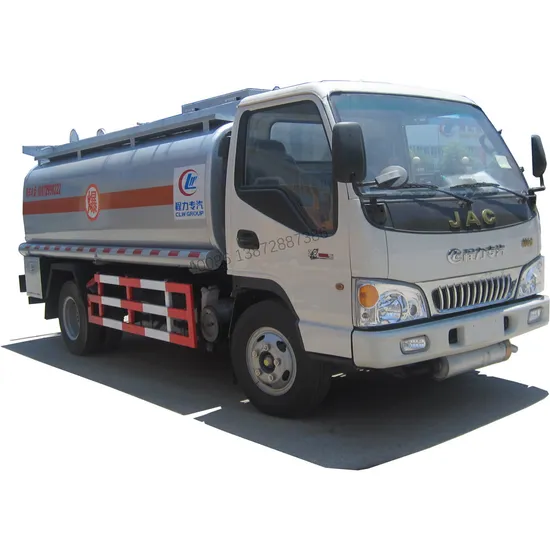
The JAC 4x2 LHD Fuel Tank Truck 4000-5000L is a compact refuelling tanker on a JAC chassis with a JAC cab and left-hand drive. A 112 hp four-cylinder diesel moves it through a five-speed manual gearbox, and the carbon steel elliptical tank carries a manhole, a walkway and hose reels for fuel delivery to separate sites.
At about 5990 mm long and 1860 mm wide it is small enough for tight depots, farms, workshops and building sites where a larger tanker cannot manoeuvre. Right-hand drive is available on request. The usable tank size depends on the configuration and is confirmed in the quotation, so state your daily volume when you enquire.
Chassis, engine and drivetrain
The engine is the HFC4DF1-2C2, a four-stroke, water-cooled, intercooled diesel with four cylinders in line and a displacement of 2.54 L. It produces 82 kW, which is listed as 112 hp. A manual gearbox with five forward gears and one reverse gear sends power to the rear axle, and power steering lightens the work at low speed.
The listed maximum speed is 80 km/h, and the unladen weight is 3300 kg on a wheelbase of 3308 mm. Tyres are 7.00-16 standard tyres in a six-plus-one arrangement, meaning six on the road and a spare. Those moderate dimensions and the light curb weight make the chassis easy to place on tight sites.
Tank and body fittings
The tank has an elliptical cross-section and is made of Q235 carbon steel. A DN500 manhole on top gives access for inspection and cleaning, and a skid-resistant walkway lets the operator move across the top of the tank safely. An oil pump handles transfer, and hose reels of 75 ft are fitted on the sides of the truck.
Optional configurations extend the basic truck. You can add the oil pump package, split the tank into compartments, or choose the fitting set that includes the sea valve, bottom loading, flow meter, manhole and oil vapour recovery. A fuel dispenser is also offered when you want metered delivery to customers or machines. Decide early which of these your site rules require.
Typical working routines
A typical day starts with loading at a depot, ideally by bottom loading if that option is fitted, then a drive to several customers. At each stop the operator connects the hose, starts the pump, watches the flow meter if one is fitted, and records the quantity delivered before moving on to the next site.
Because the truck is compact, the main limits are the weight of fuel carried and the surface at the delivery point. Keep the tank within the rated load, park on firm ground, and always allow for the swing of the hose. After each drop, close the valves and stow the hoses before driving away.
What to confirm before ordering
The tank volume depends on the configuration and is confirmed in the quotation, as are the loaded weight and the final dimensions. Please also state whether you need left-hand or right-hand drive, which emission level your registration requires, and which cab and tyre options you prefer, before the build is fixed.
Tell us which fuels you will carry, whether compartments are needed, and which pump, hose reel and fuel dispenser options you want. Also say if the product must be loaded through bottom connections or over the top, since this decides whether the sea valve and vapour recovery kit are included.
Request a current quotation for your selected configuration, quantity and delivery terms.