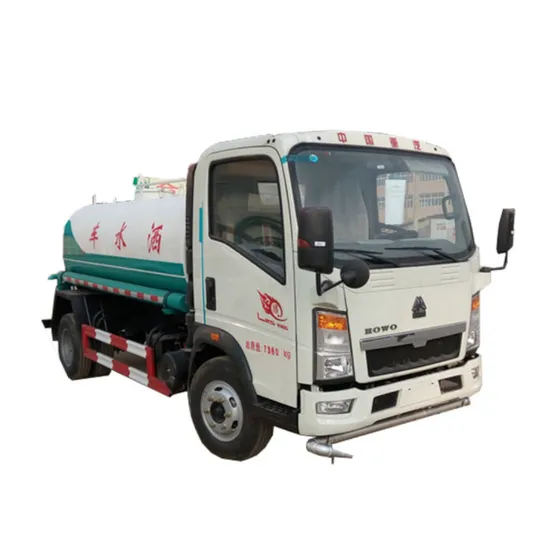
The HOWO 4x2 Fuel Tank Truck is a small rigid fuel tanker built on a HOWO 4×2 chassis and offered in left-hand or right-hand drive. A YN engine of 116 HP drives it through a five-speed manual gearbox, and the tank is made from Q235 carbon steel, with stainless steel or aluminium as alternatives. The tank volume is confirmed in the quotation.
A truck of this size suits carrying fuel to depots, construction sites, farms, generator sets and small filling points where a large tanker cannot manoeuvre. It is easier to park and simpler to drive than a heavy rigid tanker, which makes it a practical choice for fleet owners starting out in fuel distribution or for private sites with their own tanks.
Chassis, engine and drivetrain
The engine is the YN, a four-stroke, water-cooled, intercooled straight-four rated at 116 HP. The gearbox has five forward gears and one reverse, with manual operation. Maximum speed is 90 km/h. Tyres are 7.00R16, six fitted plus one spare. A straight-four on a short wheelbase suits stop-and-go work between a depot and nearby customers.
The wheelbase is 3,360 mm. Overall dimensions are 5,990 × 1,960 × 2,400 mm and the curb weight is 3,365 kg. These compact figures let the truck enter narrow yards and low gates. Check your own site access against the dimensions before ordering, particularly gate width and the height of canopies at filling points.
Tank and fittings
The tank has a DN500 manhole for inspection and cleaning. Tank material is Q235 carbon steel, with stainless steel and aluminium as alternatives. Choose the material according to the product you carry and the rules of your operation, and ask our team if you are unsure which suits your fuel.
Pumps, pipework, metering and any hoses or reels are fitted to the duty. We configure these with you so they match the fuel type, the flow rate you want and the number of customers served on each trip. Customisation is available, and the body colour can follow your requirement.
Daily checks and care
Before each trip, inspect the tank, manhole seal and all pipe joints for weeping, check tyre pressures including the spare, and test the air-operated brakes. Look at engine oil, coolant and belts. Because a fuel tanker is always a safety-sensitive vehicle, a leak or loose fitting should be repaired before the truck is loaded again.
Keep the tank clean and avoid mixing different fuels in the same tank without cleaning it. Record each fill and discharge so that you can spot losses early. Follow your own site rules for filling and discharging, and make sure drivers are trained in the handling of the particular fuel they carry.
What to confirm before ordering
Please confirm the drive side, left-hand or right-hand, and the emission standard required for registration. Confirm the tank volume you need and the tank material, as the overall weight and the loaded axle weights depend on them. Our team can check the figures against the limits that apply on your roads.
Tell us which fuel you carry, how it is loaded and discharged, and whether you need metering or hose equipment. The more precisely you describe the daily routine, the more accurately the quotation will match what you need.
Request a current quotation for your selected configuration, quantity and delivery terms.