Thicker panels do not, by themselves, prove that a refrigerated truck will perform better on your delivery route. Refrigerated truck insulation depends on the panel material and the complete box construction. Temperature control also depends on the cooling unit and how the vehicle is used. Read thickness as one specification within that system.
Start with the insulation material and layer description
The Isuzu 600P refrigerated truck describes glass-reinforced plastic on the inside and outside, with an 8 cm polyurethane insulation layer. Eight centimeters equals 80 mm. The same listing describes bonded composite construction.
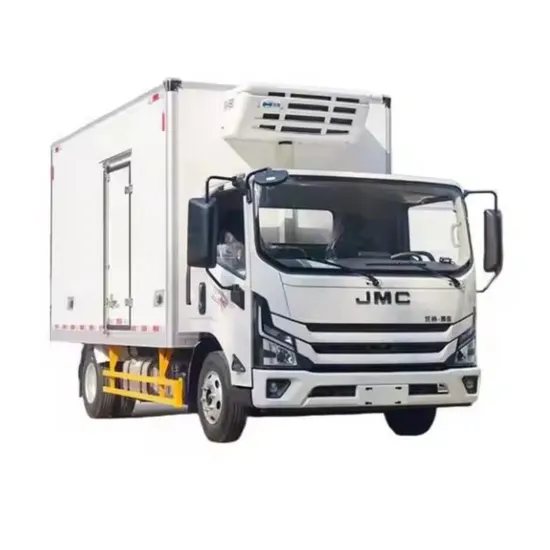
The JMC 5mt freezer truck also has an 8 cm insulation entry, with wording referring to XPS. Matching thickness does not establish matching material properties or identical box performance. Ask for a section drawing that identifies the insulation core, inner and outer skins, and the thickness of each relevant layer.
Clarify whether the number refers to the insulation layer or total finished panel thickness. A comparison becomes less useful if one supplier measures the core while another measures the complete wall.
Read material properties with their context
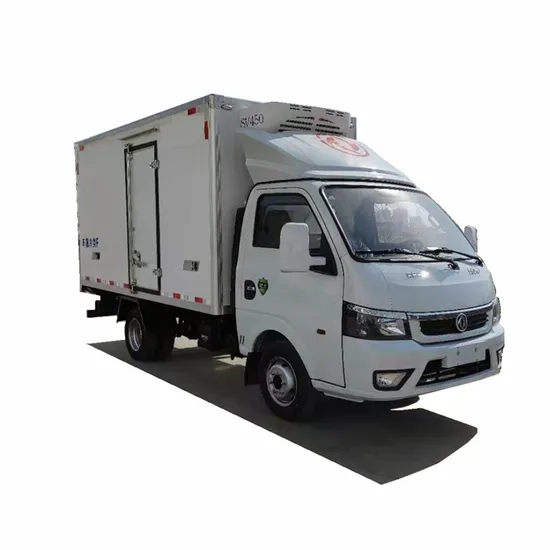
The Dongfeng mini refrigerated truck describes a polyurethane plate bonding structure and lists a thermal-conductivity value of no more than 0.028 W/mK. Its material table also includes density and compression-resistance entries. These are different types of information from panel thickness.
A material conductivity value is not a complete-vehicle cooling guarantee. Ask which insulation material the figure describes and request the test information for the offered panel assembly. Do not assign that value to the Isuzu or JMC box simply because all three vehicles are refrigerated trucks.
Include joints, floor details and door seals
A box is assembled from panels, edges, doors and a floor. Ask how the supplier joins those parts, finishes the corners and seals the doors. The Isuzu listing's bonded construction and the Dongfeng listing's enclosed panel structure provide useful starting points for that discussion. They do not specify every seal or junction.
Request a drawing or description of the door sealing arrangement and the treatment of panel joints. State whether you need side access, rear access or both. Frequent door opening changes the operating requirement even when the wall thickness remains unchanged.
Compare usable dimensions alongside insulation
The Isuzu page lists a box dimension of 4,100 × 1,800 × 1,900 mm. The Dongfeng page lists a van size of 4,100 × 1,840 × 1,820 mm. Confirm the measurement basis before using either as an internal loading envelope. For a fixed external box size, construction details affect the space available to goods.
Provide pallet or package dimensions and the intended loading arrangement. Ask the supplier to identify usable internal dimensions and space required for the selected refrigeration equipment and air circulation. A thicker-wall choice should be evaluated together with the cargo layout.
Match the cooling unit to the delivery pattern
The Isuzu listing names Hanya, Carrier and Thermo King as refrigeration choices and includes a temperature-to-minus-18-degree entry. The Dongfeng listing offers temperature options according to need. Those descriptions do not specify one identical cooling package for every order.
State the target temperature, goods' loading condition, journey duration and expected ambient conditions. For urban distribution, add the number and duration of door openings. Request the exact unit model and its stated performance conditions for the chosen box. Do not treat a listed temperature option as a promise under all loads and delivery patterns.
Prepare a complete insulation inquiry
Ask for the panel material and thickness, construction details at joints and doors, usable box dimensions and the matching cooling-unit specification. Send Chengliwei the cargo type, target temperature and opening frequency. Those details make the insulation discussion about your delivery duty rather than a single thickness number.