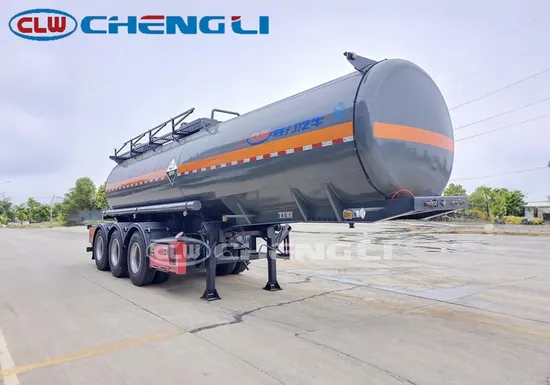
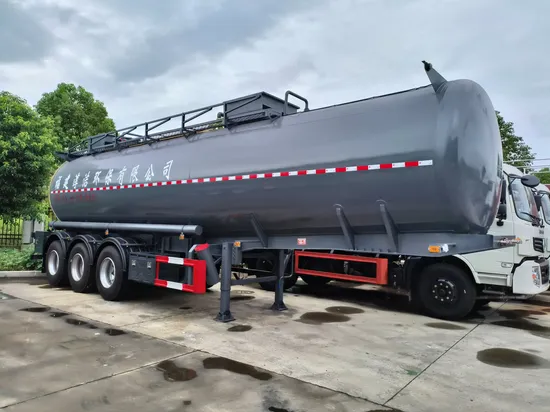
A chemical tanker truck is specified by four things: tank material and lining, tank capacity in litres or cubic metres, payload in kilograms, and the safety fittings on the tank. On the configurations listed on this site, tanks are Q235 or Q235B carbon steel (5 mm shell on the 2-axle trailers), stainless steel, or carbon steel lined with rubber or PE/PP plastic, and capacities run from 9,400 L on a 4x2 rigid truck to 24,000 L and 29 m3 on 3-axle semi-trailers. The right choice depends first on what the chemical does to the tank, then on its density.
| Configuration listed on this site | Type | Tank capacity | Payload | Tank material / lining | Listed fittings |
|---|---|---|---|---|---|
| Sinotruk HOWO 4x2 corrosive liquid tank truck | Rigid truck, 18,000 kg GVW | 9,400 L total, 8,970 L effective | 9,400 / 9,465 kg | Q235B carbon steel; rubber, PE/PP or stainless steel options | Emergency shut-off device, safety bottom valve, breather / pressure relief valve |
| 2-axle chemical tanker trailer | Semi-trailer, air spring | 25-35 m3, 3-5 compartments | 30,000 kg | Q235 carbon steel, 5 mm | Top manhole, ladder, top guard rail, 1 outlet valve, 2 x 4 kg fire extinguishers |
| CLW 3-axle carbon steel tank semi-trailer | Semi-trailer, 40,000 kg GVW | 24,000 L total | 32,600 kg | Q235B carbon steel | - |
| Chengli 3-axle chemical liquid semi-trailer | Semi-trailer | 29 m3 | 21-30 t class | Stainless steel or internal lining | - |
Tank material: start with the chemical
The tank shell and everything wetted by the cargo must resist the chemical being carried. Before comparing prices, send the supplier the chemical name, its concentration, its safety data sheet and the loading temperature. Material choice follows from that information.
Carbon steel
Q235 and Q235B are common structural carbon steels. They are strong and economical but corrode in contact with many acids and salts. Unlined carbon steel suits only cargoes that do not attack it. The 2-axle trailers above list a 5 mm Q235 shell.
Stainless steel
Stainless steel resists a wider range of chemicals and is easier to clean between loads. It is not resistant to everything; some acids and chlorides still attack certain grades. Ask which stainless grade is proposed and confirm it against the chemical.
Lined carbon steel
A carbon steel shell with an inner lining combines a strong outer tank with a chemically resistant inner surface. The HOWO 4x2 corrosive liquid tank truck lists rubber and PE/PP plastic linings as options. Each lining has its own temperature limit and list of compatible chemicals, so confirm both with the quotation. Gaskets, valve seats and hoses must also be compatible, not just the tank.
Capacity, payload and density
Tank volume and payload are separate limits. Which one you reach first depends on the density of the liquid.
- The HOWO 4x2 lists a 9,400 L tank and 9,400 kg payload. That balance suits a liquid of about 1.0 kg/L. A liquid at 1.3 kg/L would reach the weight limit at about 7,200 L.
- Its effective volume is 8,970 L, about 95% of the 9,400 L total. The difference leaves space above the liquid for expansion and surge.
- The CLW 3-axle semi-trailer lists 24,000 L total with 32,600 kg payload, which supports liquids up to roughly 1.35 kg/L at full volume.
Ask the supplier to size the tank for the density and fill level of your actual product, not just the largest number of litres.
Compartments
The 2-axle trailers list 3 to 5 compartments within 25-35 m3. Compartments let one trailer carry more than one product or partial loads, and baffles or divisions reduce liquid surge when braking. If you carry only one chemical in full loads, fewer compartments mean fewer valves and seals to maintain.
Safety fittings to check
Chemical tanks normally carry a standard set of fittings. Confirm the type, material and number of each in the quotation:
- Emergency shut-off and bottom valve: closes the outlet quickly if a hose or pipe fails. Listed on the HOWO 4x2.
- Breather and pressure relief valve: lets the tank breathe during loading and unloading and limits internal pressure. Listed on the HOWO 4x2.
- Manhole cover: for inspection and cleaning. The 2-axle trailers list one top manhole.
- Top guard rail and ladder: protect fittings and the operator on the tank top.
- Discharge valve and piping: number of outlets, size and material. The 2-axle trailers list one outlet.
- Fire extinguishers: the 2-axle trailers list two 4 kg extinguishers at the rear of the tank.
- Markings and grounding: hazard placards and static grounding requirements depend on the cargo.
Which fittings are required, and the rules for marking and documentation, depend on the chemical and the dangerous-goods regulations where the truck will operate. Check them with the local authority before ordering.
Chassis and running gear
- Rigid truck: the HOWO 4x2 lists 18,000 kg GVW, 8,405 kg curb weight, 80 km/h top speed and wheelbase options from 3,800 to 5,800 mm. Emission standard Euro 2 to Euro 6 to order.
- Semi-trailer: the 2-axle trailers list FUWA axles (BPW optional) rated 13 t per axle with 8 x 12R22.5 tires. The CLW 3-axle trailer lists a 24,000 kg axle group, 12R22.5 12PR tires and 9,800 x 2,500 x 3,600 mm overall size.
- Drive side: left-hand drive standard, right-hand drive on request.
FAQ
What is the difference between a chemical tanker truck and a chemical tank trailer?
A chemical tanker truck has the tank mounted on its own chassis, such as the 9,400 L HOWO 4x2. A chemical tank trailer is a semi-trailer pulled by a tractor and carries more, such as 24,000 L or 29 m3 on 3 axles.
Which tank material is best for a chemical truck?
It depends on the chemical. Carbon steel suits cargoes that do not corrode it, stainless steel resists a wider range, and rubber or PE/PP linings are used for many corrosive liquids. Confirm compatibility with the safety data sheet.
Why is the effective tank volume smaller than the total volume?
Space is left above the liquid for thermal expansion and surge. On the HOWO 4x2 the effective volume is 8,970 L of 9,400 L total.
How many litres can a chemical tanker carry?
On the configurations listed on this site, from 9,400 L on a rigid 4x2 truck to 24,000 L to 35 m3 on semi-trailers. Payload and liquid density may limit the usable volume.
Which safety valves should a chemical tank have?
Typically an emergency shut-off device, a bottom valve, and a breather or pressure relief valve, plus a manhole, guard rail and fire extinguishers. Required items depend on the cargo and local regulations.