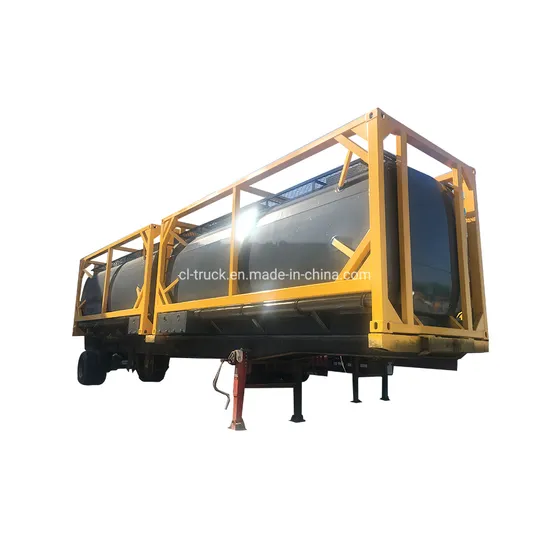
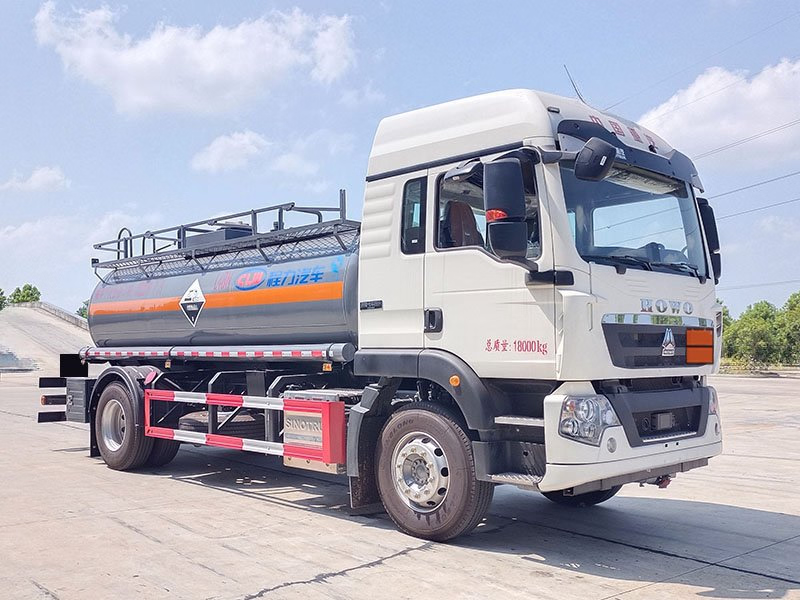
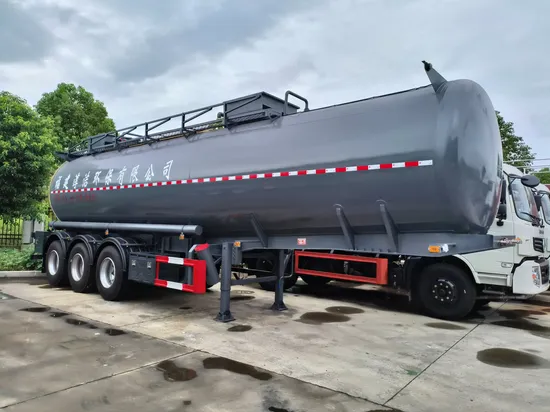
The 20ft 40ft Container Chemical Tank Semi-Trailer 25t is a two-axle, heavy-duty semi-trailer for carrying liquid chemicals in a container-style tank. It has a load capacity of 25 tons, a tank capacity of 35 to 50 m³, eight tyres and an ABS braking system, and it is not a self-dumping type.
It is meant for chemical distributors, logistics firms and plants that move liquid products in container tanks and want a trailer that carries the tank and connects to a standard tractor unit.
How a container tank trailer works
A container tank is a cylindrical tank mounted inside a rectangular steel frame that has the outer size of a standard 20 ft or 40 ft freight container. The frame carries the weight and lets the tank be lifted, stacked and fixed to a trailer in the same way as any other container. On the road, the container is held on the trailer by locks at its corners, and the trailer supplies the axles, brakes, king pin and lights.
Whether the trailer comes with the tank container, as a skeleton frame meant to carry a container the customer already owns, or with the tank built into the frame is confirmed in the quotation. This is the first thing to settle, because the answer changes what is quoted and what you must supply.
Running gear and frame
The trailer has two axles and eight tyres, with a multi-link type suspension and an ABS braking system. The wheelbase is 7000 to 8000 mm and the tread is 1820 mm. The grade is heavy duty and the construction is steel. The overall size is 10000 × 2500 × 3780 mm. The paint colour follows the customer requirement, and customisation is available.
A 20 ft container is about 6 m long and a 40 ft container about 12 m long. Ask our team how the 20 ft and 40 ft sizes are meant to be carried, and where the lock positions are for each size.
Matching the trailer to your loads
The tank capacity is 35 to 50 m³ and the load capacity is 25 tons. For liquid cargo, volume and weight interact. A dense liquid fills only part of a large tank before the weight limit is reached, while a light liquid fills the tank before the weight limit matters. Before you choose, write down the density of each product you carry and compare the tank volume with the permitted payload.
Think also about how the product will be loaded and unloaded. A container tank has its own filling and discharge connections, and the product, the pump and the receiving site decide what fittings are needed. Tell the factory which valves, hose connections and vapour arrangements you require.
Maintenance and daily checks
Before each trip, check that the container locks are fully engaged and that all four corners are secured. Look at the tank valves, caps and seals for leaks, and confirm that the earthing arrangement is intact. On the trailer, check tyre pressure and condition, wheel nuts, brake lining, air lines and ABS connections, the king pin plate and the landing gear.
After unloading, close and cap all valves, and rinse the tank according to the product rules. Keep records of cleaning, because the next product may not be compatible with the residue of the last one.
What to confirm before ordering
The tank material, number of compartments, safety fittings, payload and curb weight are confirmed in the quotation.
Ask for the full specification: whether the tank container is included, the tank material and thickness, the compartment layout, the lock positions, the king pin type, the axle brand and rating, the permitted payload and the colour.
Request a current quotation for your selected configuration, quantity and delivery terms.