Use the receiving facilities and route tasks to decide where an LPG tank trailer or bobtail belongs in your delivery network. A trailer proposal may be assessed for a defined replenishment route, while a bobtail proposal may be assessed for a defined customer-delivery duty. Neither role follows automatically from vessel size.
Map the network before selecting the fleet. Identify the source, any approved storage or supply points and the customer receiving installations. Keep the equipment and approval review attached to each link rather than assuming one vehicle format can serve every point.
Separate network tasks
Record the planned quantity and frequency for each route segment, using clearly identified units. Distinguish regular replenishment from smaller or variable customer orders. Add the receiving windows and known constraints.
A conceptual planning map can be written as source to receiving depot, then depot to customer installations. That describes a business flow only. It is not a transfer procedure or approval to move product between vehicles or facilities.
Compare receiving conditions
| Network question | Trailer proposal | Bobtail proposal |
|---|---|---|
| Destination of the trip | Defined receiving facility for the proposed combination | Defined customer receiving installations |
| Delivery pattern | Documented replenishment quantities and schedule | Documented customer quantities and stop pattern |
| Access | Complete tractor-trailer approach and standing-area review | Exact truck approach and standing-area review |
| Equipment scope | Trailer, compatible tractor and specified interfaces | Truck and specified delivery package |
| Documentation | Vehicle, vessel and destination requirements | Vehicle, vessel, delivery and destination requirements |
The table does not prescribe which configuration must serve a particular distance or customer size. The supplier and responsible LPG professionals need to assess the actual proposed duty.
Two product categories for the enquiry
The two-axle LPG propane tank trailer is listed as model CLW9310GYQ with a geometric volume of 40.5 m³. It provides a trailer-category starting point for the technical proposal.
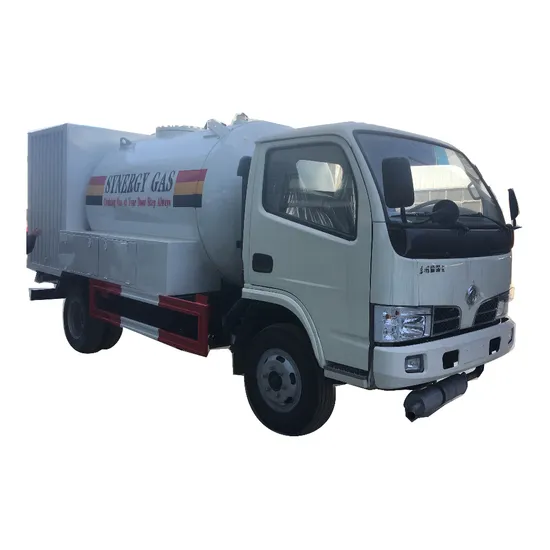
The Dongfeng 5000 L LPG delivery truck is listed as a 4×2 vehicle with catalogue overall dimensions of 5,900 × 2,045 × 2,600 mm. It provides a rigid delivery-truck starting point.
Neither geometric tank figure is an allowed filling quantity or transported mass. The entries also do not establish that the two vehicles can be used in an arbitrary transfer arrangement. Ask for separate supported duties within the planned network.
Include the tractor and fleet allocation
For a trailer option, identify the proposed tractor and request confirmation of the complete combination. Include tractor availability in the operating plan, especially if it is shared with other work.
For a bobtail option, record which customer routes it would serve and the access information needed for review. Do not assume every smaller-looking vehicle is suitable for every customer site; the actual dimensions and delivery arrangement still matter.
Do not infer economy from volume alone
A larger geometric volume does not automatically make a route cheaper. Compare the supported vehicle proposal with real demand, receiving arrangements, journey time and equipment scope. Keep any cost estimate tied to documented inputs.
If a receiving point cannot support the proposed vehicle or delivery arrangement, theoretical capacity is not usable business capacity. Revise the network proposal with the responsible parties instead of treating the largest vessel as the default choice.
Make approvals and interfaces visible
Have the relevant local advisers identify the requirements for each vehicle and receiving installation. Ask the equipment supplier to state which documents and interfaces are covered by its offer and which belong to the wider project.
Keep unresolved receiving-site questions in the plan. This article provides no dangerous-goods transfer instructions, filling limits or blanket operating approval for a destination market.
Compare complete route assignments
Prepare a schedule showing which proposed vehicle serves each route segment, the receiving point and the basis for the assignment. Where demand is uncertain, separate the forecast from confirmed work and identify the effect on the fleet proposal.
Send Chengli that network brief with the destination, facility information and available tractor details. Request trailer and bobtail proposals against their distinct duties. The resulting comparison should explain how each vehicle fits the receiving conditions, rather than simply ranking tank volumes.
Related reading: LPG semi-trailer and tank trailer capacity: tonnes, cubic metres and axles