
When a contractor says "concrete truck", two quite different machines can be meant: the mixer truck, which carries concrete in a rotating drum, and the pump truck, which pushes concrete through a boom to where it is needed. Some jobs need only a mixer, some need only a pump, and many need both. This guide helps you decide, and it is plain about what we supply.
What we supply
We supply concrete mixer trucks. We do not publish pump truck models on this site. If you need a concrete pump truck or boom pump, send us your requirements and we will quote on request. We make no model claims here for pumps, and we confirm any pump specification in the quotation. For mixers, browse the concrete mixer truck category.
What a mixer truck does
A mixer truck carries ready-mixed concrete from the batching plant to the site, turning the drum slowly so the concrete stays workable. At the site it discharges down a chute. The concrete then goes into the formwork by wheelbarrow, hoist, crane skip or by hand. That is enough when the pour is close to where the truck can stand: slabs on the ground, foundations, kerbs, drains and driveways.
Our guide to cement mixer trucks and readymix trucks explains what to specify, and the concrete mixer trucks for sale page shows the range.
What a pump truck or boom pump does
A pump truck has a hydraulic pump and a folding boom mounted on a truck chassis. A mixer tips concrete into its hopper, and the pump pushes it through the boom to the pour point. The boom can reach over a wall, up to a high floor or across a gap. Concrete is placed faster and with less labour, and the mixer truck does not need to get close.
When a mixer alone is enough
- The pour is at ground level and the truck can stand beside it.
- The job is small, so hiring or buying a pump is not worth it.
- You have labour, hoists or a crane on site to move the concrete.
- The site has soft ground or narrow access where a heavy pump truck cannot stand.
When to add a pump
- Height: upper floors, columns and roof slabs, where raising concrete by hand is slow.
- Distance: pours that the mixer cannot reach, such as behind buildings or across ditches.
- Volume and speed: large slabs where continuous placing helps the finish and avoids cold joints.
- Labour: sites where fewer workers must place more concrete.
Ask your engineer or concrete supplier how far the concrete must travel horizontally and vertically, then choose the pump that fits. If you can place concrete without a boom, a mixer alone costs less to buy and run. Many small contractors start with a mixer truck and hire a pump for the few jobs that need one, and add their own pump only when those jobs become frequent.
Site checks before you choose a pump or a mixer
Walk the site before you decide, because the site often settles the question. Check the access width and any gate, overhead cable or low branch that a truck and boom must pass. Check the ground: a loaded mixer or a pump with its outriggers down puts heavy loads on a small area, and soft or wet ground may need boards or a prepared hardstanding. Find out where water and power are available, since both are needed for washing out and for site equipment. Finally, work out the volume of concrete for each pour and whether it must be placed in one go.
Our mixer trucks
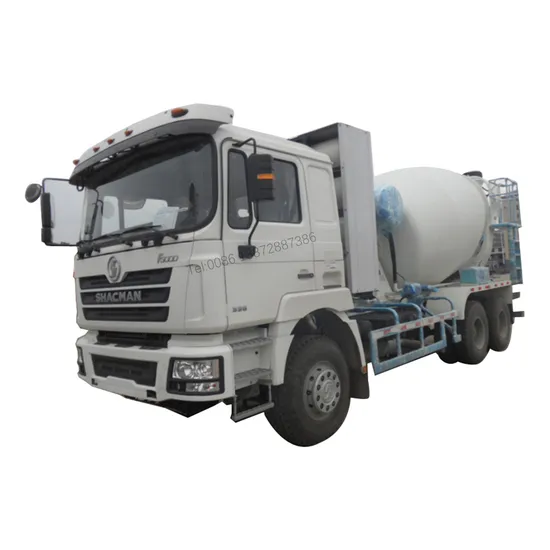
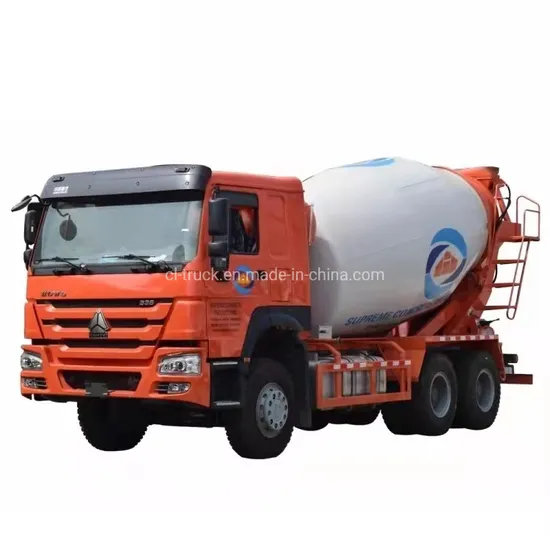
We can show two mixer trucks as examples.
- Shacman F3000 CNG 6x4 concrete mixer, 10 m3: WP10NG350E40 engine, 350HP, Euro 4 and a 9JS135 nine-speed gearbox. The fuel is stored in 8 cylinders, and the total gas capacity is confirmed in the quotation. The drum is Q345 steel with a 5 mm body and a 6 mm head, and gross vehicle weight is 25,000 kg.
- HOWO 10-wheel mobile concrete mixer: an about 10 m3 class mixer on a 6x4 chassis with a HOWO cab, a 336HP WD615.69 engine and a HW19710 ten-speed gearbox. The drum is Q345 steel, and there is a 400 litre water tank.
How the two machines work together
On a big pour, several mixers queue to feed one pump. The number of mixers depends on the distance from the plant, the pump rate and the traffic. Plan the cycle time of each mixer so the pump never waits, because a pump that stops can leave concrete setting in the line. Speak to your concrete supplier about the delivery rate that the job needs.
Running the pour: who does what on site
On the day, the pump is set up first, with its outriggers on firm ground and the boom clear of obstructions. The first mixer reverses to the hopper, and the pump operator and the person placing the concrete agree simple hand signals or radio calls. Each mixer discharges steadily into the hopper while the next waits in line, so the truck that has just emptied can leave and the next can move up without a gap. When the pour ends, the line is cleared and every drum and hopper is washed out in a proper wash-out area, not into drains or open ground.
Questions to ask before ordering
- How high and how far must the concrete go?
- Can the site take a heavy truck, and is the ground firm?
- How many cubic metres per hour must be placed?
- Do I need a mixer only, a pump only, or both?
- Where is the nearest batching plant or water supply?
- Left-hand or right-hand drive? Left-hand drive is standard and right-hand drive is available on request; see steering side by country.
Next steps
For reference, read the concrete mixer truck price guide and the CNG and LNG trucks guide if you are considering a gas-fuelled mixer. Then send us your requirements: pour height and reach, volume per hour, country and drive side, and we will reply with a quotation for mixers, or a quotation on request for a pump truck.