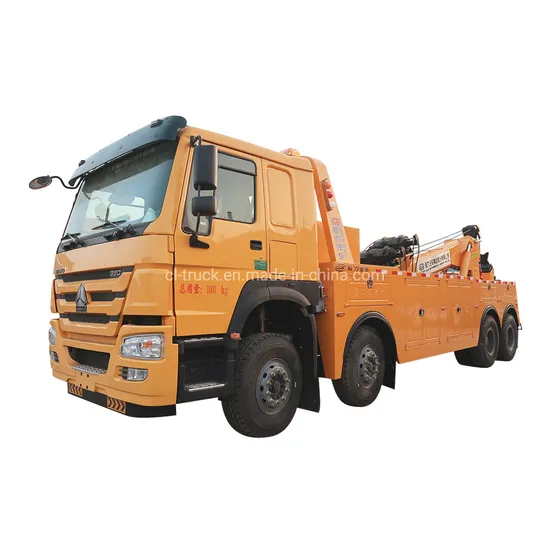
The HOWO 8x4 Heavy Duty Wrecker Truck 30-50t is a four-axle recovery vehicle on a Sinotruk HOWO chassis, powered by the WD615.47 engine at 371HP. It carries two 15 ton winches, a three-section lifting boom and a 360 degree rotation. The truck is left-hand drive as standard, with right-hand drive available on request.
It is intended for recovery operators and heavy haulage fleets that must clear overturned trucks, buses, cranes and construction machinery. The 8×4 layout spreads the weight of the structure over four axles, which helps stability when a load hangs from the boom. The cab is the HW76 type with air conditioning, and it can be tipped forward for engine access.
Boom, winches and towing gear
The lifting boom has three sections of six-sided (hexagon) profile, and the supporting booms also have three sections. Rotation is 360 degrees all around. This lets the operator stand the truck beside the casualty, extend the boom over it and swing the load into line with the chassis before lifting and towing.
The truck has two winches of 15 tons each, with a 45 m steel rope. Towing gear includes five sets of towing fork and one set of fork support, giving different ways to hold axles or wheels. Matching the fork set to the damaged vehicle is a key part of a safe recovery, so keep every set clean and complete.
Chassis, engine and drivetrain
The WD615.47 is a straight six-cylinder, four-stroke, water-cooled diesel with a displacement of 9.726 L and an output of 273 kW. The emission standard is Euro 2. The wheelbase is 1800+4600+1350 mm, and the gross vehicle mass is 31000 kg against a curb weight of 24870 kg.
The HW19710 gearbox is a manual ten-speed with ten forward gears and one reverse. Steering is ZF8098, brakes are air operated, and the axles are HR9 at the front and AC16 at the rear. Tyres are 12.00R20, ten fitted plus one spare. The overall size is 11460×2500×3270 mm, so route planning matters.
Cab and operating routine
The HW76 cab has a full steel skeleton covered with double-layer steel plate, shock absorbers, air conditioning and a one-piece instrument desk with digital meters. Wrecker crews spend long hours waiting at scenes, so a comfortable, clearly laid out cab helps. The forward-tipping design also makes engine checks and repairs easier.
At a scene, park on firm ground, assess the weight and position of the casualty, then plan the lift before moving the boom. Recovery of heavy vehicles often involves several winch pulls, so keep rope angles low and use the fork support. Inspect rope, hooks and hydraulic hoses before each job, and test the rotation without a load afterwards.
What to confirm before ordering
The 30-50t class in the name is a guide. The usable towing and lifting capacity depends on the configuration and boom position, so ask for the lifting and towing chart in the quotation.
Also confirm the drive side, the emission standard, the length of the winch rope, the number of fork sets, the paint colour and any extra lamps or tool storage. Describe the heaviest vehicles you recover so our team can check the winch, boom and axle layout against your work. Compare the final specification sheet with your needs before the order is confirmed.
Request a current quotation for your selected configuration, quantity and delivery terms.