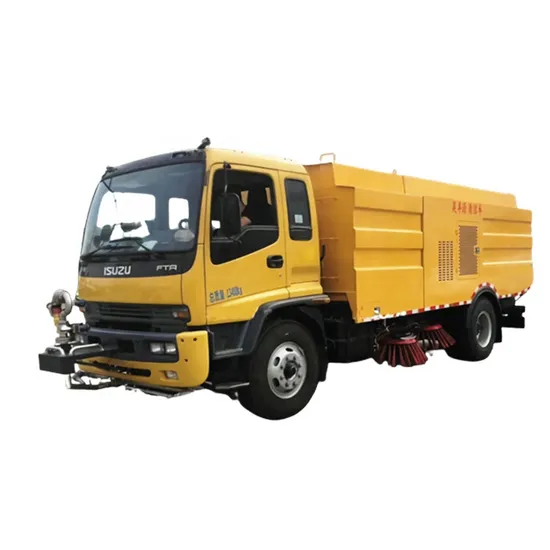
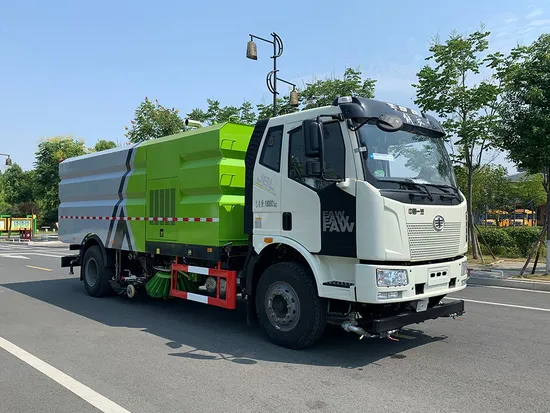
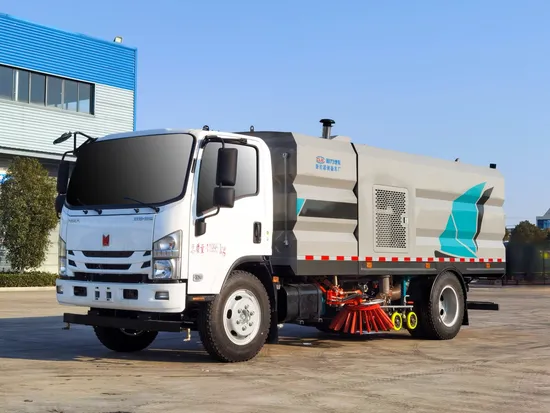
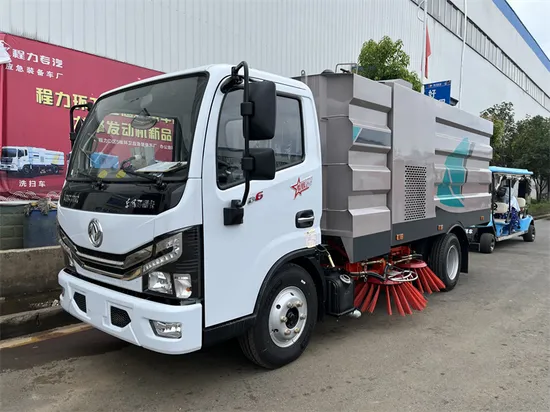
The Isuzu FTR Road Sweeper Truck Euro 5 is a large sweeping and suction truck on an Isuzu FTR chassis with a 4,500 mm wheelbase, a six-speed manual gearbox and an air-conditioned cab. Left-hand drive is standard and right-hand drive is available on request. It is offered in three separate equipment packages, so the name covers a family of configurations rather than one fixed machine.
It is intended for municipal cleaning departments and contractors that run long routes on main roads and need a high-capacity debris tank.
Three equipment packages
The road sweeper package has a 4 m³ water tank and an 8 m³ dust tank, the vacuum sweeper package has a 2 m³ water tank and an 8 m³ dust tank, and the cleaning sweeper package has an 8.5 m³ water tank and a 7 m³ dust tank. These are alternatives, not capacities to add together. Each package belongs to a different working style.
The road sweeper package uses a centre set of four sweeping discs with a Sanyo cycloidal motor, a Schneider control switch and a solenoid valve group. The vacuum package uses a centre suction cup with similar control parts and a maintenance-free clutch. The cleaning sweeper package has two sweeping discs and a Cummins auxiliary engine, whose power rating is confirmed in the quotation. Choose according to whether your main task is brushing, vacuum pick-up or a combination of washing and sweeping.
Chassis, engine and drivetrain
The engine is a diesel of 5.193 L with a maximum output of 151 kW, rated at 205 hp. The gearbox is a six-speed manual with one reverse gear, steering is power-assisted, and the brake type is an air brake. ABS is included. The axles are rated at 6.3 tons at the front and 13 tons at the rear, and the tyres are 10.00R20 with six fitted plus one spare.
Overall dimensions are about 8500 × 2490 × 3350 mm and the curb weight is approximately 8500 kg. The cab is the FTR cab in a one-and-a-half row layout, with air conditioning and electric windows fitted. Body colour is optional, and customisation is available.
Using the truck on long routes
A large dust tank lets the crew cover more road before returning to unload, which reduces non-productive travel. A realistic shift plan considers where the water filling point is, where the debris is tipped, and how long the round trip takes. The larger the water tank, the longer the sweeper can suppress dust without stopping to refill.
The cab layout matters on long shifts. Air conditioning and electric windows reduce driver fatigue, and ABS gives some control on wet roads. Check that the mirrors and any rear camera you choose give a clear view of the brushes and the road edge.
Maintenance and daily checks
Before each shift check the sweeping discs or suction cup, the fan, the valve group and the control switch. Look at the auxiliary engine oil and coolant, the fuel level, the water tank filter and the debris door seals. Inspect the air brake system and drain moisture from the reservoirs, check tyre pressure on all seven tyres and verify that lights and warning beacons work.
At the end of the shift, empty the debris tank, rinse out the interior and clean the intake so that residue does not dry onto the surfaces.
What to confirm before ordering
The water and debris tank sizes for your package, the payload and the auxiliary engine power are confirmed in the quotation.
Also confirm which of the three packages you want, the working width, the pump and fan specification, the completed vehicle weight, the emission standard and the unloading height at your depot.
Request a current quotation for your selected configuration, quantity and delivery terms.