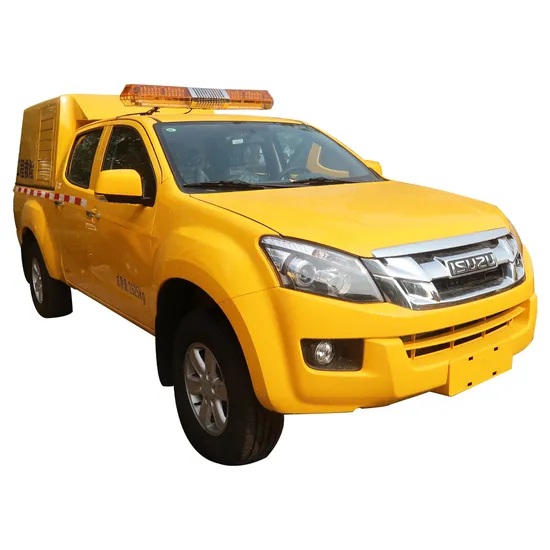
The Pickup Emergency Rescue Vehicle with Power Cart is a compact pickup-style vehicle prepared for emergency and rescue work, carrying a power cart that supplies electricity at the scene. It runs on a CLW brand chassis with a diesel engine under 150HP, a manual gearbox and a 3050 mm wheelbase, a size that copes with congested roads and tight access.
We design it for fire and rescue teams, utility emergency crews, site safety officers and organisations that must power lights and tools where mains power is cut off. The compact base lets a small crew reach an incident quickly, while the power cart keeps equipment running after they arrive. Customisation is available, and our team can discuss it with you.
Chassis and drivetrain
The chassis carries the CLW brand and uses a diesel engine rated under 150HP, matched to a manual gearbox. The vehicle meets the Euro 5 emission standard. A wheelbase of 3050 mm gives a balance between stability and manoeuvrability, which helps when the vehicle must turn in narrow lanes, yards or around parked cars.
Payload and body dimensions depend on the final configuration and are confirmed in the quotation, because the equipment carried differs from one customer to the next. Add up the weight of the power cart, tools and crew gear before ordering, so that the chassis is not overloaded and handling stays predictable on the way to a call.
How the power cart is used
A power cart is a mobile source of electricity. At an incident it is positioned close to the work, connected to lights, tools, pumps or communication equipment, and started before crews need it. Because it travels with the vehicle, the team does not depend on long cables run from distant buildings or fixed supplies.
Good practice is to keep the cart fuelled and test-run it on a schedule, store cables neatly so they can be deployed quickly, and place the unit where exhaust cannot drift toward people. We can discuss what outputs and sockets you need, so the cart matches the tools you plan to use.
Matching the vehicle to your job
Think about the first ten minutes at a scene: what must be unloaded, who carries it and where it is placed. A pickup layout gives quick access to the load area, which helps when equipment must come out in a hurry. List your tools and their weights so we can check that they fit.
If your calls often involve rough ground, narrow lanes or standing water, tell us. These conditions can affect tyre choice, underbody protection and the way equipment is secured. We will review these points with you rather than assume, and write the agreed arrangement into the quotation.
What to confirm before ordering
Please confirm the drive side, the emission standard, the payload you need, the colour and the equipment to be fitted. Customisation is available, so the body, the storage layout and the power cart arrangement can be discussed with our team, and the agreed details are recorded in the quotation.
Also confirm the power output and socket types needed, whether warning lights or other signalling equipment are required, and how many crew members will ride in the vehicle. This keeps the quotation matched to your emergency routines and avoids changes once the configuration is fixed.
Request a current quotation for your selected configuration, quantity and delivery terms.