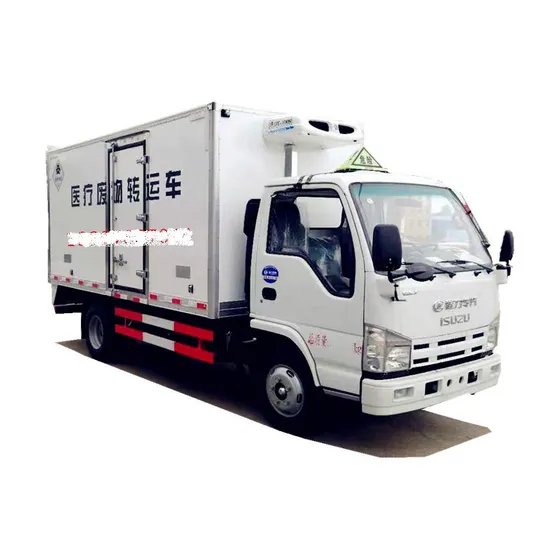
The Isuzu Refrigerated Biohazard Waste Disposal Truck Euro 4 is a closed, refrigerated van on an Isuzu light-duty chassis, under the model number JHW5040XYYQ. It uses the 4KH1CN5LS diesel engine with a rated power of 72 kW, a manual gearbox and a two-axle layout with six tyres. The overall size is 5995 × 2140 × 3110 mm.
It is built for hospitals, laboratories and licensed handlers that move biohazard waste in sealed containers. The enclosed cargo box has a fixed roof, and the refrigeration function allows the load to be held cool between collection and treatment.
Body and cargo box
The cargo box measures 4180 × 1980 × 2000 mm. The top of the carriage is closed and cannot be opened, a side door is optional, and side protective material is a further option. A closed roof keeps the load out of sight and sheltered, but it also means loading must take place through the doors, so the door position matters.
The target temperature, the make of the refrigeration unit and the lining material are specified when ordering. The cooling unit needs to be sized to the box volume and the heat load of the route, and the lining should be easy to clean and disinfect.
Chassis, engine and drivetrain
The wheelbase is 3360 mm, and the front and rear suspension lengths are 1015 and 1620 mm. The axle loads are 1805 and 2690 kg, the maximum speed is 80 km/h, and the two-axle chassis has six tyres of size 7.00R16 8PR. The engine has a displacement of 2771 ml and is made by an Isuzu engine company. The leaf springs come in several groupings, and the chassis alone measures 5900 × 1860 × 2180 mm.
The vehicle mass is 4495 kg in total and 3010 kg for the curb weight. Together with the axle loads, these figures set the working limits of the truck, so the load you plan to carry has to fit within them.
Matching the truck to your job
A van of this size suits multi-site collection rounds with a moderate volume, such as a group of clinics feeding a single treatment site. It is easier to manoeuvre in hospital yards and loading bays than a larger refrigerated truck, and its lower weight keeps running costs down.
For high-volume routes, count the containers per trip and compare that with the cargo box size and the load rating. Biohazard waste is usually packed in sealed, labelled containers, and each one needs a place where it can be secured. A load that is allowed to shift is a safety risk as well as a cleaning problem.
Daily checks and cleaning
Before each round, check the refrigeration unit starts and holds its setting, look at the door seals and latches, and make sure the floor of the box is clear and dry. After unloading, wash the interior with a suitable disinfectant, rinse it, and let it dry with the doors open. Record the cleaning so that the next crew knows the box is ready. On the vehicle side, check engine oil, coolant, tyre condition and the brakes, since a small van that stops often wears its tyres and brake linings faster.
What to confirm before ordering
Please confirm the payload, the emission standard and the approach and departure angles with our team. All of these depend on the configuration and are confirmed in the quotation.
Also ask about the drive side, the temperature range, the refrigeration unit, the door arrangement, the floor and wall lining, the drainage and the washing method. Ask for the finished load rating on the plate, since that governs how much waste you can carry legally.
Request a current quotation for your selected configuration, quantity and delivery terms.