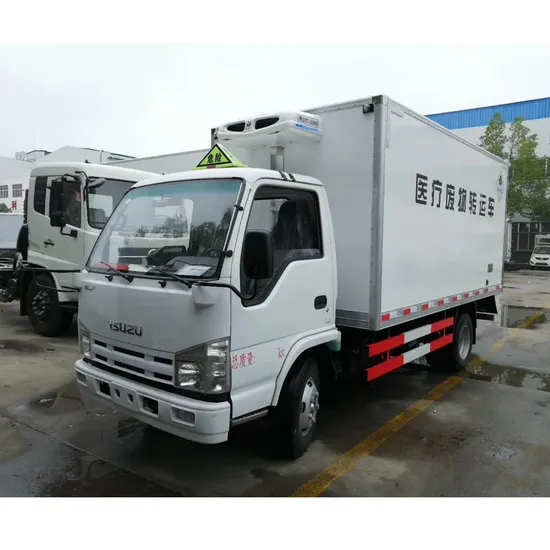
The Isuzu Elf 100P Medical Waste Transfer Refrigerated Truck is a diesel light-duty van with a closed, refrigerated cargo box for moving hospital and clinical waste. It is built on the Isuzu Elf 100P chassis and uses the 4KH1CN5LS engine rated at 72 kW, with a displacement of 2771 ml and a manual gearbox. The overall size is 5995 × 2140 × 3110 mm, and the van has two axles and six tyres.
It is intended for hospitals, clinics, laboratories and waste handlers who need a compact refrigerated vehicle for collecting clinical rubbish from several sites and bringing it to a treatment point. A van of this size fits into hospital yards and service lanes where a larger refrigerated truck would be difficult to handle.
Where this truck is used
Medical waste moves in a chain: it is gathered in wards, treatment rooms and laboratories, sealed in labelled containers, stored temporarily, and then carried to a treatment plant. The van covers the carrying stage. Its job is to keep sealed containers upright, contained and cool during the trip, and to be easy to clean afterwards.
Typical customers are hospital groups running their own collection, private contractors serving clinics, and municipal health departments. Because the round is repeated daily on fixed routes, small details such as door height, step height and the layout of the floor save time every day.
Body and cargo box
The cargo box measures 4180 × 1980 × 2000 mm. The top of the carriage is closed and cannot be opened, a side door is optional, and side protective material is a further option. All loading therefore goes through the doors, and a side door can make it easier to handle containers at kerbside pick-up points.
The target temperature, the make of the refrigeration unit and the lining material are agreed with our team before the order. A smooth, sealed lining is much easier to wash than bare panels, and the refrigeration unit should be sized to the box volume and the number of door openings.
Chassis, engine and drivetrain
The wheelbase is 3360 mm and the axle loads are 1805 and 2690 kg. The front and rear suspension dimensions are 1015 and 1620 mm, the rear track is 1425 mm, and the tyres are 7.00R16 8PR. The maximum speed is 80 km/h. The chassis alone measures 5900 × 1860 × 2180 mm, and the fuel is diesel. The engine is made by an Isuzu engine company, and the horsepower is below 150.
The total mass is 4495 kg and the curb weight is 3010 kg. These two numbers define how much weight the van can add as cargo, refrigeration equipment and body fittings, so ask for the final plate figures for the finished vehicle.
Typical working routines
A typical day begins with a check of the refrigeration unit and a clean, dry box. The driver collects sealed containers from each site, logs them, secures them inside the van and moves to the next stop. At the end of the round, the load is handed over at the treatment point, and the box is washed and left open to dry.
Containers should be loaded so that heavier ones sit at the bottom and nothing can shift on corners. A fixation device inside the box, or load bars, can be discussed with the factory if your containers are not boxed on pallets. Keep a spill kit and spare bags with the driver.
What to confirm before ordering
The payload, the emission standard and the approach and departure angles depend on the configuration and are confirmed in the quotation.
Also confirm the drive side, the working temperature, the make and model of the cooling unit, the side door, the interior lining and the drainage. Ask whether the box can be supplied with washable floor and wall surfaces, and how the door seals are protected from damage during loading.
Request a current quotation for your selected configuration, quantity and delivery terms.