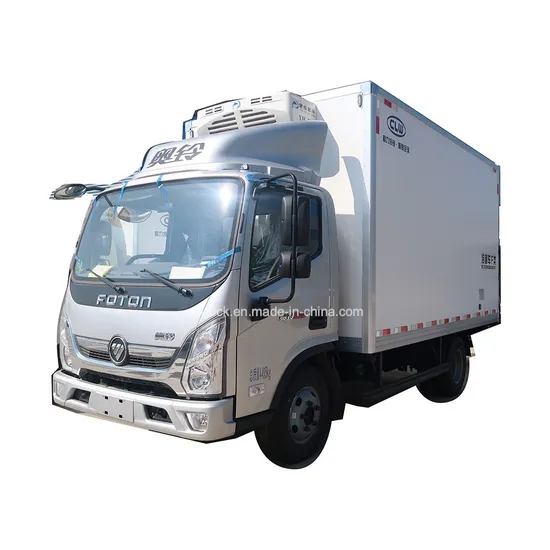
The Foton Aumark E33 Medical Waste Refrigerated Truck 5-7t is a van-type refrigerated truck for carrying medical waste at a controlled temperature. It is built on the Foton Aumark E33 chassis with a single-row cab for three people, a manual gearbox, a diesel engine and the Euro 5 emission standard, with left-hand drive as the standard layout.
It suits hospital groups, clinical laboratories and licensed waste carriers that collect over longer routes and cannot let the load warm up in the box. The 3360 mm wheelbase keeps the truck short enough to reach clinic yards and loading bays, while the sealed composite body keeps the cargo space closed during the trip.
Chassis, engine and cab
The vehicle model code is AUMARK-E33 and the gross vehicle weight is 7,500 kg. The diesel engine displaces 2.771 L, is rated at 80 kW and gives 280 N·m of maximum torque through a manual gearbox. Engine output stays below 150 hp, a sensible level for a truck of this size working on urban and regional roads.
The rear suspension is a leaf spring set of 8+6, and the wheels and tyres are 7.00R16 in a 6+1 layout with a spare. A gas-operated parking brake is fitted, with an engine exhaust brake as the auxiliary brake. Right-hand drive is available on request, and the body colour follows your requirement.
Refrigerated box construction
The box envelope uses a plastic composite plate structure. The inner and outer surfaces are glass reinforced plastic, and between them sits an 8 cm polyurethane extruded insulating layer, or XPS. If the truck is built as a plain van instead of a refrigerated box, the box is made of colour plate. The cooling range reaches down to -15 °C.
The four sides are glass reinforced plastic and polyurethane glue foam bonded together to form a closed section. The panels are assembled with strong adhesive and fastened by high-strength screws buried on the inside. The result is a box that behaves as one closed shell, with few exposed fasteners on the walls to collect residue when the interior is washed.
Typical working routines
A normal run starts by cooling the empty box to the required temperature before the first pick-up, so the first bags do not warm the cargo space. Staff then load sealed containers quickly, close the doors and keep door openings short at each stop, which reduces the work the refrigeration unit has to do.
At the end of the shift the box is emptied, washed and left to dry with the doors open. Keeping a simple log of loading time, box temperature and unloading time helps you show that the waste was kept cold throughout. A short, planned route with few stops will always hold temperature better than a long, irregular one.
What to confirm before ordering
Please confirm the payload class and the box length you need, since the exact payload depends on the configuration and is confirmed in the quotation. Also tell us the drive side, the refrigeration unit you prefer, the temperature you must hold, and whether you want a refrigerated box or a plain van body.
Share the type of containers you load and how they should be restrained, plus the colour you want and any extra equipment such as shelving or washable floor details. With this information we can prepare a quotation that matches your waste stream and avoids changes after the drawings are agreed.
Request a current quotation for your selected configuration, quantity and delivery terms.