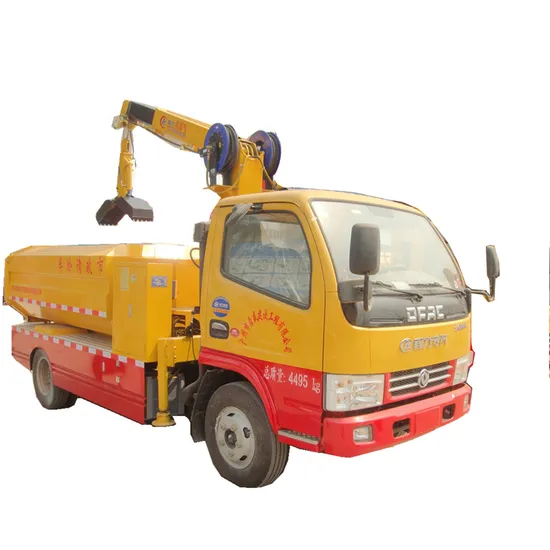
The Dongfeng Dredging Truck with Silt Hydraulic Grab 4-6t is a 4x2 truck fitted with a straight-arm crane and a hydraulic grab for lifting silt, mud and loose material. It is meant for drainage maintenance, pond and ditch clearing, and riverside work, where material must be lifted out of a channel and loaded onto the truck for removal.
The truck is offered as left-hand drive, and right-hand drive is available on request. It has a two-axle chassis with a wheelbase of 3,360 mm and a single row cab. Crane lifting height is below 10 m, so the truck suits work at banks and culverts rather than deep shafts or tall structures.
Crane and grab
The crane is a straight-arm type with a three-section jib, and it works with a hydraulic grab. The grab closes around the material, the crane lifts it clear of the water, and the operator swings it over the truck body to release it. Slow, steady movements work best with wet silt, which is heavy and can slide.
The rated lifting capacity of the crane, the grab size and the jib length depend on the configuration and are confirmed in the quotation. The model name refers to a 4-6 t class of truck. Tell us the density of the material you move and the distance from the truck to the digging point, because these set the load on the crane.
Chassis, engine and drivetrain
The chassis is a 4x2 with a wheelbase of 3,360 mm and a kerb weight of 4,560 kg. The engine is a turbocharged, intercooled in-line four-cylinder diesel with a displacement of 2.999 L, giving up to 88 kW at 2,900 rpm and a maximum torque of 290 N·m between 1,500 and 2,900 rpm.
The gearbox is manual with five forward gears and one reverse. Brakes are oil operated and steering is power assisted. The front axle is rated at 2.5 tons and the rear axle at 4.8 tons. Tyres are 7.00-16, six fitted plus one spare. Rated payload and body size are confirmed for your configuration.
Typical working routines
A normal job begins with positioning the truck on firm ground as close as possible to the water edge without risking the bank. The operator then swings the crane out, lowers the grab and lifts material into the body. When the body is full, the truck drives to a disposal point and unloads.
Because silt is wet and abrasive, cleaning matters. Wash the grab and the crane at the end of each shift, check hydraulic hoses and pins for wear, and grease the moving joints. Keep people clear of the swing area and the area under the load while the crane is working.
What to confirm before ordering
Please confirm the crane capacity and jib arrangement you need, the grab type and size, the drive side and the body dimensions. If you work on soft ground, tell us so we can discuss the suitability of the setup. Emission level and paint colour are also fixed in the quotation.
Give us as much detail as you can about the job: the type of material, the depth and distance to the digging point, and the route to the disposal point. Our team will use this to check the configuration and record every agreed item in the written quotation.
Request a current quotation for your selected configuration, quantity and delivery terms.