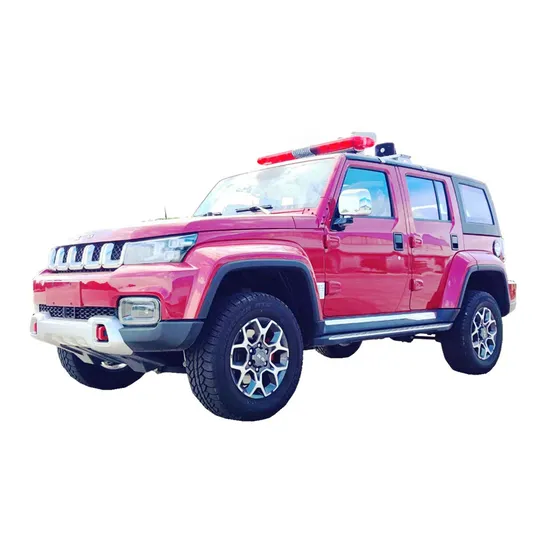
The BAIC BJ40 4WD Fire Command Vehicle is a compact four-wheel-drive vehicle prepared for incident command and fire service support. It is a passenger-carrying off-road platform rather than a pump or tanker, intended to carry a small command team to the scene of an incident quickly, including along rough or steep approaches where a conventional van would struggle.
With four seats, a short wheelbase and a tight turning circle, it suits fire brigades, industrial fire teams, site safety departments and rescue organisations that need a nimble lead vehicle ahead of heavier appliances. It also suits teams that run command posts at remote sites where the access roads are unpaved or uneven.
Matching the truck to your job
Command vehicles are judged by how early they arrive and how well the team can work from them. The BJ40 is small enough for narrow access roads, plant gates and crowded yards, and its four-wheel drive helps on gravel, mud and slopes. It works best as the first vehicle to reach an incident, setting up command while larger appliances follow.
If your duties are mostly on paved city streets, ask yourself whether you need the off-road ability at all. If you cover forests, quarries, rural tracks or hilly sites, the ground clearance, approach and departure angles and climbing ability described below become far more important than the top speed of the vehicle.
Chassis, engine and drivetrain
Drive is 4WD on a 2745 mm wheelbase. The engine has a displacement of 2290 mL, a maximum power of 170 kW and a maximum torque of 600 Nm, and the vehicle can reach up to 160 km/h on suitable roads. Fuel is carried in an 80 litre tank, and the emission level is Euro V with OBD.
For rough ground the figures are 220 mm minimum ground clearance, a 37 degree approach angle and a 31 degree departure angle, together with a 6.4 metre minimum turning radius and a maximum gradeability of 60 per cent. Front suspension is double-wishbone independent, and the tyres are 265/65R17.
Cab and crew layout
Four occupants are carried, which usually means a driver, a commander and two crew members or specialists. Command work happens as much on the radio, the map table and the notebook as at the wheel, so think about where each person sits and what each one needs within reach. We discuss the interior arrangement with you during configuration.
Fire command vehicles are often fitted with warning lights, sirens, radios and markings. Which of these are included on your vehicle, and how they are mounted, is confirmed in the quotation. Tell us the equipment you already own, so that we can plan mounting positions and wiring around your existing standards and procedures.
What to confirm before ordering
Before ordering, confirm the drive side: we can supply left-hand or right-hand drive on request. Confirm the emission standard needed on the roads where you operate, and the colour and livery your service requires. Our team will also check which gearbox type you prefer, since this is fixed in the quotation for the chosen configuration.
Next, list the equipment you want fitted: lighting, audio, communication, storage and any special mounting points. The final configuration, equipment list and available options are confirmed in the quotation. Send us your duty description, the typical terrain and the number of crew, and we will propose a configuration that fits your service.
Request a current quotation for your selected configuration, quantity and delivery terms.