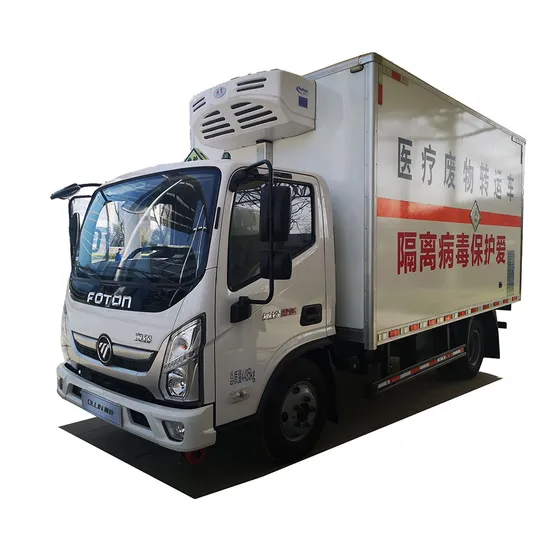
The Aumark E33 Biohazard Medical Waste Transport Vehicle is a diesel van-type truck designed to carry medical and biohazard waste from the point of collection to treatment. It is built on the Aumark E33 chassis with a single-row cab for three people, a manual gearbox and a 3360 mm wheelbase, giving a medium-capacity vehicle that stays manageable in urban traffic.
We offer it to hospitals, clinics, waste handling companies and municipal health services that run scheduled collection rounds. The enclosed van body keeps waste containers out of sight and away from the public, and the medium-duty chassis suits rounds that combine several pick-up points with a single drop-off at a treatment site.
Where this truck is used
Medical waste has to move in a controlled way. The truck serves as the link between small producers, such as wards and clinics, and the central facility that treats the waste. A closed van body means containers are loaded, carried and unloaded without exposing the load to the street or to passers-by.
Rounds are usually planned in advance, with fixed stops and set times. Drivers and loaders follow a handling routine: check the sealed containers, load them in order, close the body and record the pick-up. A van of this size is easy to park near building entrances and loading points where bigger vehicles struggle.
Chassis, engine and drivetrain
The engine has a displacement of 2.771 L and a rated power of 80 kW, with a maximum torque of 280 N.m. It runs on diesel and is paired with a manual transmission. These figures suit stop-and-go collection work, where torque at low speed matters more than top speed.
The overall size is 5995 × 2140 × 3110 mm, and the gross vehicle weight is 7500 kg. The rear suspension uses leaf springs in an 8+6 arrangement. Braking includes a gas-operated parking brake and an engine exhaust brake as the auxiliary brake. The truck runs on 7.00R16 tyres, with six wheels fitted plus one spare.
Cab and operator features
The cab is a single-row design, 1880 mm wide, with seating for three people. That allows a driver and two handlers to travel together, which is a common crew for collection rounds where containers must be lifted in and out at each stop. Left-hand drive is standard, and right-hand drive is available on request.
Daily use is easier when the cab is simple. A manual gearbox and an exhaust brake are controls that most drivers already know, and they reduce the training needed when crews change. We suggest drivers inspect the tyres, brakes and body doors at the start of each shift, and keep the cab free of loose items.
What to confirm before ordering
Please confirm with us the drive side, the emission standard required for your registration, and the payload you plan to carry. Emission level and payload figures depend on the configuration and are confirmed in the quotation, so please give us the rules that apply to your vehicle and your expected load per round.
Also tell us how you want the van body arranged. Interior fittings, container racks, washing arrangements and any marking or signage can be discussed with our team before the quotation is finalised. The more precisely your waste handling routine is described, the better we can match the fit-out to the way your crew works.
Request a current quotation for your selected configuration, quantity and delivery terms.