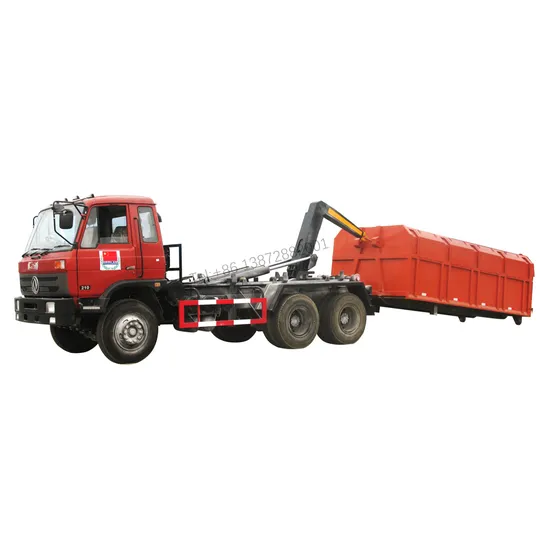
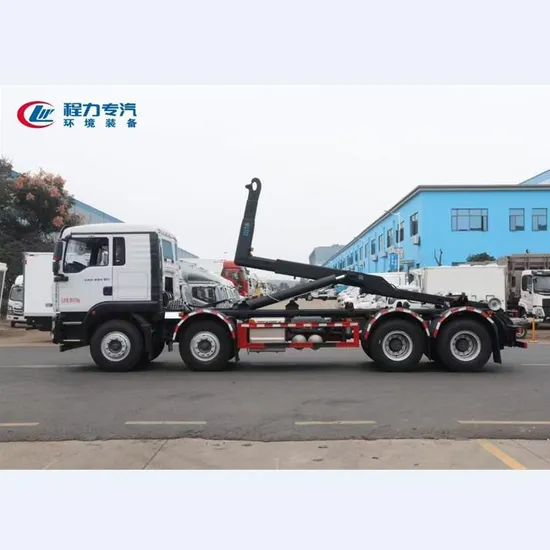
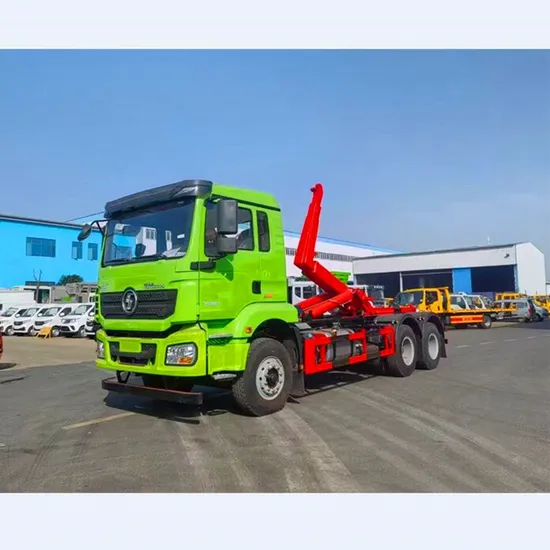
The Dongfeng 6x4 Hook Lift Garbage Truck 16-18m3 Euro 4 is a three axle waste truck that uses a hook arm to load, carry and tip detachable containers. The model number is CLW5250ZKX3. A Dongfeng cab and chassis, a B210 33 engine rated at 210HP and left hand drive set the base, with a container volume in the 16m3 class.
This kind of truck suits transfer stations, industrial parks, large building sites and contractors who handle bulky waste in changeable containers. One chassis can serve a number of containers, which cuts the number of vehicles a depot needs.
How a hook lift system works
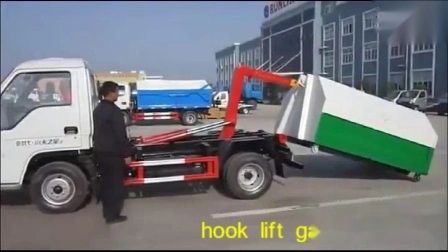
A hook lift has a frame that pivots at the rear of the chassis and an arm with a hook. The hook catches a bar on the front of the container, and hydraulic cylinders pull the container onto rails. To tip, the frame raises the container to an angle so the load slides out of the rear. To set a container down, the process runs in reverse. The whole sequence is controlled from the cab or from a control at the side of the truck.
Because containers are detachable, the truck is not tied up while a container is being loaded. A crew can fill one container while the truck is out hauling another, which keeps the machine on the road for more of the shift. Containers of different shapes, such as open skips and closed bodies, can be mixed if they share the same hook bar height and rail spacing.
Chassis, engine and drivetrain
The B210 33 engine is a straight six cylinder, four stroke, water-cooled, inter-cooled diesel with 5.9L displacement. It is rated at 210HP and 155kW. The gearbox is a manual unit with eight forward gears and one reverse. Steering is power assisted and the brakes are air operated, which suits a loaded truck of this size.
The drive configuration is 6×4, with a wheelbase of 4350 mm plus 1300 mm. Axle ratings are 5 tons at the front and 10 tons at the rear, the tyres are 10.00-20 with ten fitted and one spare, and the top speed is 90 km/h. Curb weight is 8795 kg. The three axle layout spreads the load, which gives more stability when the container is raised for tipping.
Container and body details
The container is a 16m3 unit with side plates of 4 mm steel and a bottom plate of 5 mm steel. The overall dimensions are 8250 × 2490 × 3050 mm. The floor is the part that takes the most wear when abrasive waste slides out, so a thicker bottom plate than side plate is sensible.
This truck is offered in the 16-18m3 class, so more than one container volume may be fitted. Ask which container sizes can be matched to this chassis, and what the loaded weight will be for the waste you carry. Bulky, light waste fills a large container by volume, while dense waste reaches the weight limit early.
Matching the truck to your job
Think about where the containers sit and how the truck reaches them. A hook lift needs clear space behind the truck to pull the container on and off, roughly the length of the container plus room for the arm. Check this at every site on your route, and check the height under gates and covers when the container is raised for tipping.
Think about the tipping end too. The container must be raised to a steep angle, so the discharge bay needs overhead clearance and firm, level ground. Many operators measure the tipping point before choosing between the lower and higher container options.
What to confirm before ordering
These points are confirmed in writing with the quotation: the drive configuration, the payload class, the container volume and size, and the overall dimensions of the finished vehicle.
Also confirm the emission standard, the drive side, the hook arm lifting capacity and the hydraulic equipment supplied, the container design and its mounting details, and the cab and body colour. When these are agreed, the final specification can be used as a checklist for the finished truck.
Request a current quotation for your selected configuration, quantity and delivery terms.