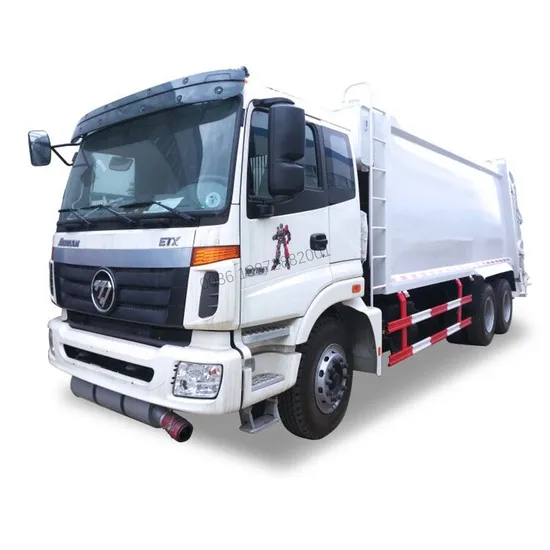
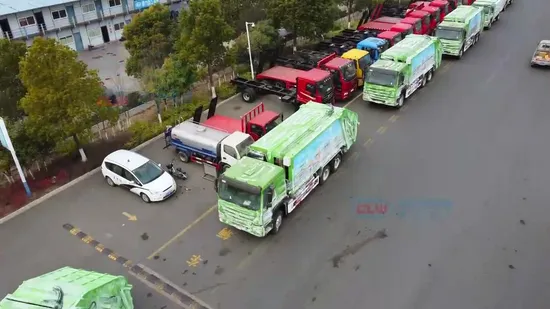
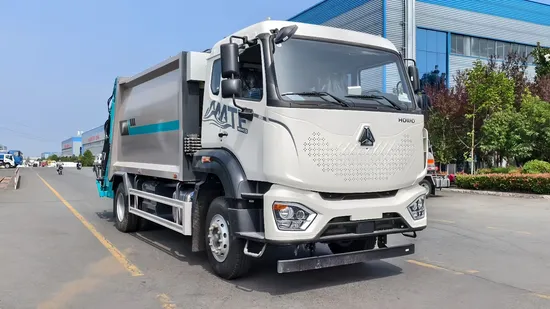
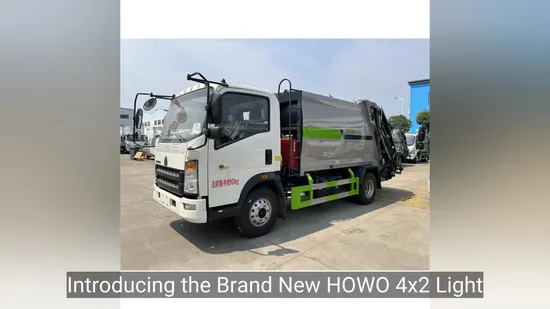
The Foton Auman 6x4 Garbage Compactor Truck 15m3 Euro 5 is a heavy refuse truck on a three-axle Foton Auman chassis. It has left-hand drive, a SC9DK270Q3B1 diesel engine of 8820 ml, a manual eight-speed gearbox, a cab with air conditioning and a compression-type body, and its overall length is 10400 mm.
It is designed for city cleaning departments and waste contractors with long collection routes or distant disposal sites, where a large body and a strong chassis cut the number of trips. The 6x4 layout, with two driven rear axles, suits a heavy load that must carry on kerbs, ramps and landfill tracks.
Where this truck is used
A large compactor truck serves wide arterial streets, commercial areas, industrial estates and transfer stations. It is often used for second-stage haulage, where smaller collection vehicles tip into a transfer point and a large truck takes the waste on to the final site. The body is in the 15 m³ class, and the exact volume depends on the configuration and is confirmed in the quotation.
The overall dimensions are 10400 × 2500 × 3300 mm and the wheelbase is 4725 + 1300 mm. This is a long vehicle, so check turning room at depots, transfer ramps and weighbridges. A 2500 mm width is the usual limit on many roads.
Chassis, engine and drivetrain
The engine is a SC9DK270Q3B1, an in-line six-cylinder of 8820 ml with a rated power of 199 kW at 2200 rpm and a maximum torque of 1125 N·m at 1400 rpm. The gearbox has eight forward gears and one reverse. Steering is power assisted and the brakes are air operated.
The rear axle rating is 10 tons. The curb weight is 13800 kg. The cab is ETX2200 with air conditioning. Tyres are 10.00R20 and there is a spare. High torque at low engine speed is exactly what a refuse truck needs: it has to pull away repeatedly with a full body and run the hydraulic pump while the vehicle is almost stationary.
Body and compaction system
A compression-type body packs the waste in a hydraulic cycle and presses it against the bulkhead, so the truck can carry far more than an open skip. Ask our team for the hopper size, the cycle time and the hydraulic pressure of this model. Also ask about the thickness of the body plate, particularly at the floor and sides where wear is highest, and about the leachate tank, which holds liquid squeezed from the waste.
The unloading method should suit the disposal site. Ejection by push-out panel works well at tipping floors and in confined space, while tipping the body needs headroom. Check the clearance at your usual disposal sites.
Crew safety deserves a place in the specification. Ask about rear steps and handholds, emergency stop buttons within reach of the crew at the hopper, work lights and a reversing camera or alarm. A truck of this length is hard to see around, and the people working behind it are the most exposed.
Maintenance and daily checks
Before each shift check the engine oil and coolant, the hydraulic oil level and filters, the air brake tanks and the tyres. Look for oil leaks at cylinders and hoses, test the packer cycle, inspect the tailgate seal, and clean the hopper. Waste trucks need regular greasing at pivots and sliding surfaces, and a weekly check of the wear plates inside the body.
What to confirm before ordering
The body volume, the payload, the emission standard, the steering side and the colour depend on the configuration and are confirmed in the quotation. This is a Euro 5 truck, so check that the version quoted meets the rules where the truck will be registered. Please also state the bins and containers you collect, your route lengths, and the type of disposal site.
Request a current quotation for your selected configuration, quantity and delivery terms.