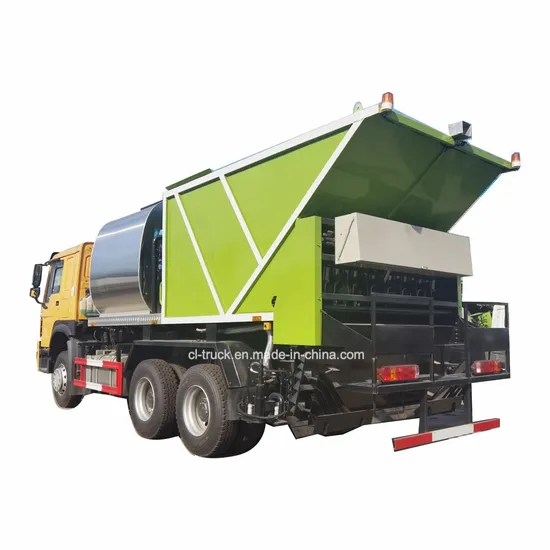
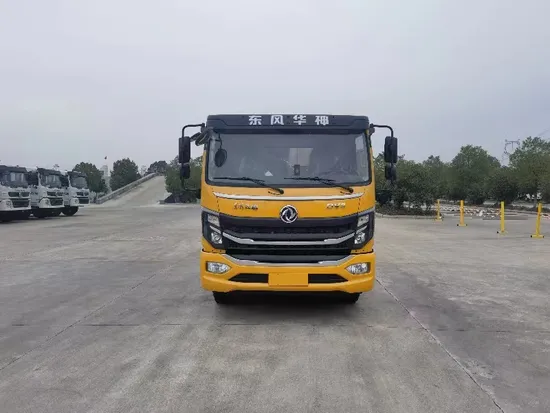
The Sinotruk HOWO 6x4 Emulsified Asphalt Chip Sealer Truck is a synchronous chip sealer: one vehicle that sprays emulsified asphalt onto the road surface and spreads aggregate over it in the same pass. It is built on a Sinotruk HOWO chassis with 6x4 drive, a WD615.69 engine and a manual transmission, and it suits road maintenance teams that apply chip seal surface treatments.
Because binder and stone are laid together, the binder has no time to cool or collect dust before the chips land on it, which is the main reason crews choose a synchronous machine over separate spraying and spreading vehicles. The cab is left-hand drive as standard, and right-hand drive can be arranged on request.
How a synchronous chip sealer works
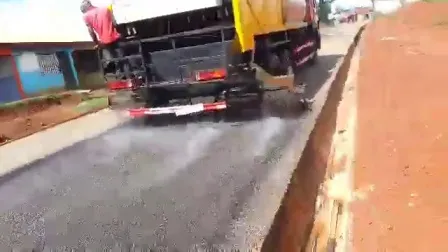
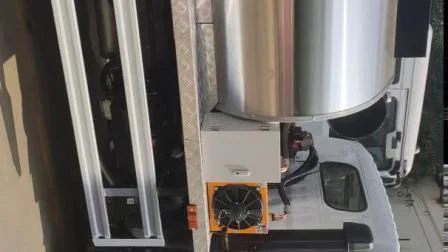
The tank carries the binder, which is pumped to a spray bar and applied across the width of the pass. The distribution width for this model is 4 m. The pump is rated at 584 r/min and delivers 950 l/min at a working pressure of 0.8 MPa, which sets the rate at which binder can be laid as the truck moves forward.
Behind the spray bar the aggregate unit drops chips onto the fresh binder. The aggregate application accuracy is ± 2%, which helps keep coverage even from one stretch of road to the next. Even coverage matters because too little stone leaves binder exposed, while too much is wasted and can be swept away by traffic.
Chassis, engine and drivetrain
The engine is the WD615.69, a six-cylinder in-line, water-cooled, intercooled diesel of 9.726 L displacement. It drives through an HW15710 manual transmission with ten forward gears and two reverse gears, behind a dry single-plate clutch with hydraulic booster. The wide gear range gives the driver fine control of slow working speeds.
Steering is ZF8098. The rear drive axles are rated at 13 tons each and the front axle at 7 tons, on 12.00R20 14PR tyres fitted as 10+1. The wheelbase is 4600+1500 mm and the overall dimensions are 10200 × 2500 × 3563 mm, so check road access and depot gates against these figures before the truck goes to work.
Typical working routines
A usual job begins with a clean, dry road surface and a binder tank filled to the level needed for the section. The crew sets the spray width and rate, loads the aggregate and then drives at a steady working speed while spraying and spreading. Keeping the speed constant keeps the binder and stone rates even along the whole pass.
After the pass a roller normally follows to press the chips into the binder, and loose stone is swept off. At the end of each shift the spray system should be flushed and the lines drained so emulsion does not set inside pipes. This habit protects the pump and nozzles and keeps the next day's start trouble-free.
What to confirm before ordering
Please confirm the tank volume you need, because the capacity is set to your requirement and stated in the quotation. Also confirm the emission standard your area requires, the engine output, the drive side and the colour. Each of these affects the final configuration and should be fixed in writing before production starts.
Tell us the aggregate type and size you plan to spread, the binder grade, and the working width you expect. We will then confirm the spray and spreading settings with you. Send details of the roads you will work on, such as typical gradients and access limits, so we can check that the chassis suits them.
Request a current quotation for your selected configuration, quantity and delivery terms.