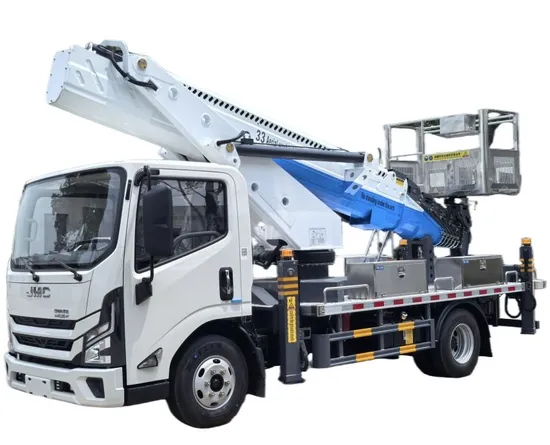
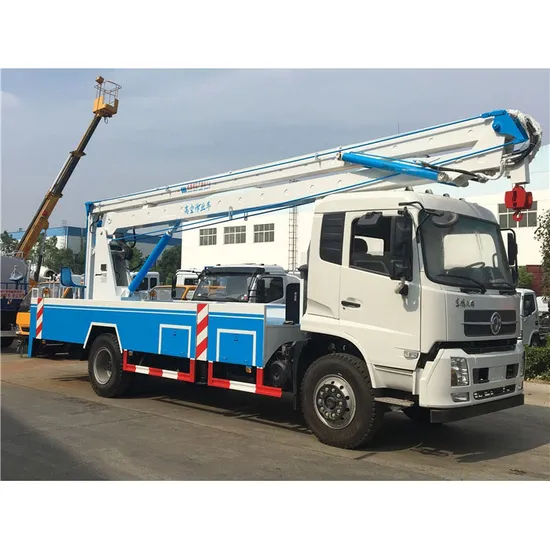
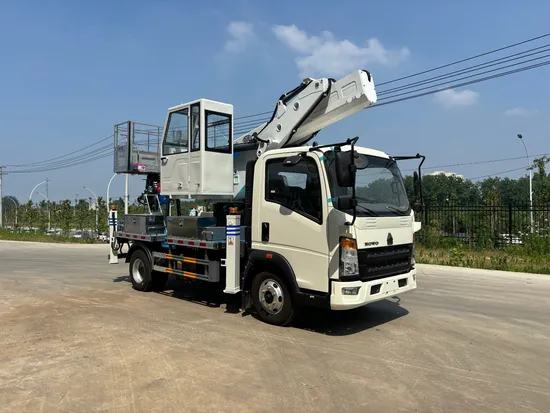
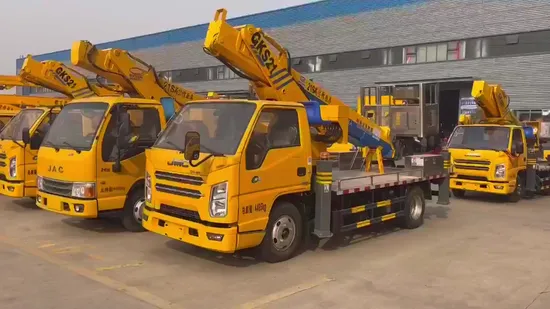
The JMC Single Row Aerial Work Truck 28-33m is a high-altitude working truck on a JMC chassis with a single-row cab. It is offered in working heights of 28 m, 32 m and 33 m, so the buyer chooses among three height versions.
It suits power-line crews, street-lighting and signage maintenance teams, facade cleaners and contractors who need a raised platform that can be driven to the job and set up without scaffolding.
Where this truck is used
Aerial work trucks replace scaffolding and ladders for jobs that are brief and spread across many sites. Typical uses include trimming trees near roads, replacing street lights, repairing overhead lines, cleaning high facades and inspecting bridges and signs. A boom working at 28 m or more reaches well above what compact platform lifts can manage.
Because the truck drives between sites at road speed, one vehicle can cover several jobs in a day. A single-row cab has one set of seats, so the number of crew who ride with the driver is limited; ask how many seats are fitted.
How an aerial work truck operates
Most truck-mounted aerial platforms rest on a rotating turret behind the cab. A telescopic or articulated boom, raised by hydraulic cylinders, carries a work basket at its end. The hydraulic system is powered by the truck engine through a power take-off, and the operator controls the boom from the basket or from a ground station. Before the boom is raised, the truck is levelled on outriggers that spread the load to the ground.
The outriggers are the part most often under-used by crews in a hurry. Soft ground, a slope or a kerb can reduce the safe reach, so the operator should place support pads under each outrigger foot and check the levelling indicator before raising the boom. Wind speed also limits use at height, and the maker's guidance should be followed.
Choosing the working height
The three heights are 28 m, 32 m and 33 m. Higher is not always better: a taller boom is heavier, needs a bigger outrigger footprint and may restrict where the truck can be set up. Measure the highest point you need to reach, add a margin for the basket and the worker's position, and look at how far the truck can park from the work. Working height and platform height are measured differently, so ask which figure applies.
Rated basket load and horizontal outreach matter as much as height. A boom may reach its full height but carry less at full extension, so ask for the working-range chart, which shows the basket load allowed at different heights and outreach.
What to confirm before ordering
Everything is fixed in the quotation: which of the three heights you are buying, the boom type, platform dimensions, rated basket load, the outrigger layout and any insulation rating if you will work near live lines. Ask also about the chassis engine, power, drive side, emission standard, gearbox, and overall dimensions and weight.
Confirm the operator controls at the basket and on the ground, emergency lowering if the engine fails, and the fall-arrest points in the basket. Describe your work sites so that our team can check ground conditions and clearances.
Request a current quotation for your selected configuration, quantity and delivery terms.