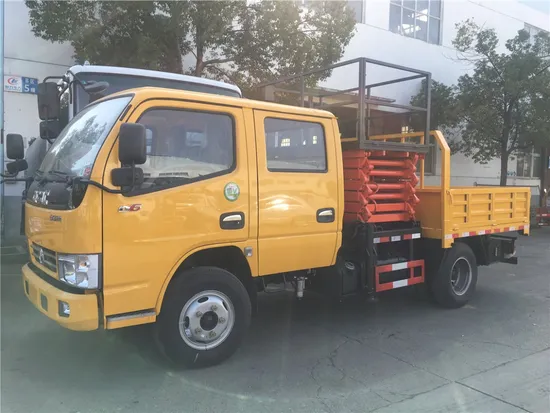
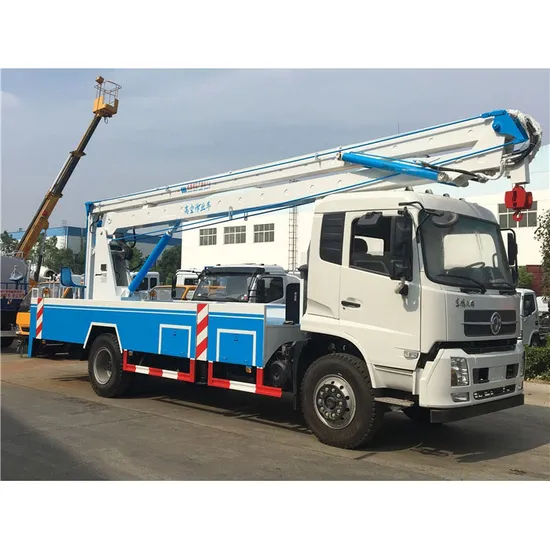
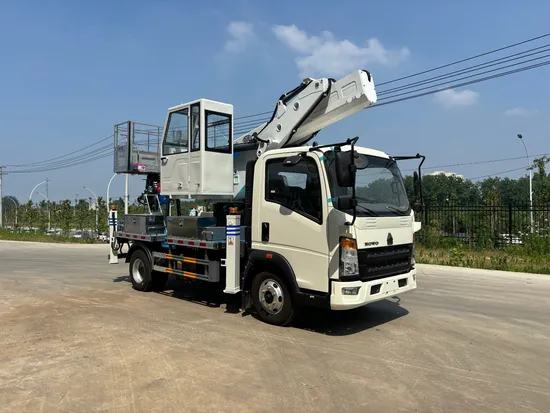
The Dongfeng 4x2 High-Altitude Operation Truck 120HP is a diesel aerial work vehicle built around a two-axle, rear-wheel-drive chassis with a manual gearbox. A hydraulic boom and a work platform are mounted behind the cab, and the truck meets the Euro 3 emission standard with a reach in the range of 11 to 16 m.
It is a practical choice for maintenance teams, contractors and utility crews that want a compact aerial truck for repeated short jobs: changing lamps, working on signs, clearing branches, repairing building exteriors or reaching overhead lines. The final chassis and cab configuration is confirmed in the quotation.
Matching the truck to your job
Before comparing models, write down the highest point you must reach, how far the platform has to stand away from the truck, and where the truck can park. A boom lifts straight up only to a limited degree; as the platform moves outward, the usable height at the platform and the load it can carry both change. For that reason the working height printed in a model name is only a starting point, and the load chart for the chosen boom is the document that tells you what is allowed at each position.
The payload rating depends on the chassis, so ask which rating applies to the unit you are quoted. If your work includes carrying tools, ladders, lamp heads or small materials on the deck, mention it so that the chassis is chosen with enough margin.
Configuration
The engine is model 4DW91-63NG2, a straight four-cylinder, four-stroke, water-cooled engine with intercooling, displacing 2.545 L. Its power rating is confirmed in the quotation. The gearbox has five forward speeds and one reverse, with manual operation. Steering is power assisted, and the brakes are air operated, a system that is familiar to most workshops that service light trucks.
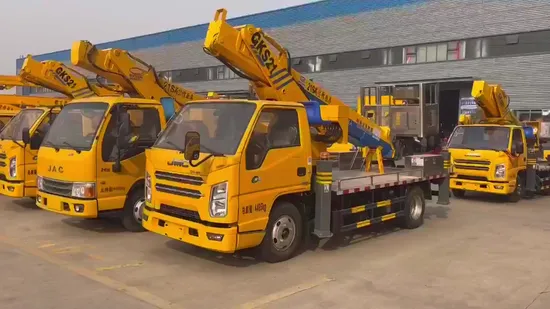
Overall dimensions are approximately 7300 × 1980 × 3100 mm on a wheelbase of 3360 mm, with a curb weight of approximately 5600 kg. The rear axle is rated at 4 tons. Standard tyres are 6.50-16, six in use plus one spare. The cab is a Foton Forland type, and body colour is optional. Because HOWO Light, JAC and Isuzu are also offered as chassis, cab and axle details can differ if a different base vehicle is selected.
Setting up on site
Good set-up habits matter more than any single specification. Park on firm, reasonably level ground and check what is beneath the support leg pads, since a buried pipe, a drain cover or soft verge can give way under load. Extend all four hydraulic support legs, confirm the truck body is level, and only then raise the boom. The arm turns through 360 degrees at 0-2 r/min, a slow speed that makes it easier to bring the platform gently up to the work.
The hook is rated at 1000 kg, which can be used to raise materials to the work position. Confirm the permitted load for people and tools when you receive the quotation. Keep a walk-around routine at the start of every shift: look for hydraulic oil leaks, check hose condition, test the controls at both the platform and the lower station, and confirm the legs retract fully before driving off.
What to confirm before ordering
Ask for written confirmation of the following: the chassis brand and cab that will be supplied, the engine model and its rated power, the working height and boom type, the payload rating, and the platform rated load. The emission standard is Euro 3, and you should check that it suits the places where the truck will operate.
Also state whether you need left hand drive or right hand drive, the body colour, and any equipment you want added, such as work lights, a warning beacon or a toolbox. The more clearly you describe the jobs, the access conditions and the working heights, the closer the quoted configuration will be to what you need on day one.
Request a current quotation for your selected configuration, quantity and delivery terms.