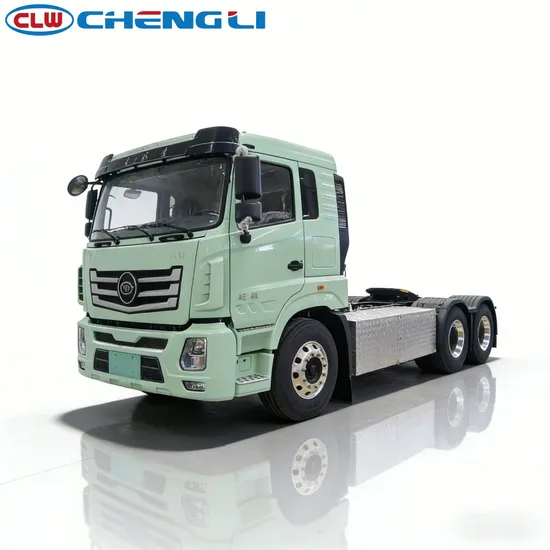
Truck tractor specifications come down to five lines on the sheet: drive layout (4x2, 6x4 or 6x6), engine power, axle ratings, fifth wheel size and the gross combination weight the tractor is built to pull. On the configurations listed on this site, diesel tractors run from 340 hp to 430 hp, front axles are rated 7,000 to 9,500 kg, rear axles 11,500 kg (single) to 2 x 16,000 kg (tandem), and hauling capacity is quoted at 35,000 to 40,000 kg. Read each line in the order below and you can compare two quotations line by line.
| Configuration listed on this site | Drive | Engine / power | Axle ratings (front / rear) | Wheelbase (mm) | Curb weight (kg) | Hauling / towing |
|---|---|---|---|---|---|---|
| Dongfeng 4x2 tractor head | 4x2 | 340 hp | 7,000 / 11,500 kg | - | - | 35,000 kg |
| Shacman F3000 X3000 4x2 | 4x2 | WP10.340E32, 340 hp (380-440 hp optional) | 7.5 t / 13 t | 3,600 | 7,300 | - |
| Dongfeng 6x4 tractor head | 6x4 | DCI420-51, 420 hp, 12-speed | 7,000 / 18,000 kg | - | - | 40,000 kg |
| Shacman F2000 6x4 | 6x4 | WP10.340E32, 250 kW at 2,200 rpm (380-440 hp optional) | 7.5 t / 2 x 13 t | 3,175 + 1,400 | 9,400 | - |
| HOWO 6x4 prime mover | 6x4 | Weichai WP12S430E201, 430 hp, 11.6 L | 9,500 / 2 x 16,000 kg | - | - | Over 50 t class |
| Shacman 6x6 tractor head | 6x6 | 6-cylinder turbocharged diesel, 351-450 hp class | - | 3,775 + 1,400 | approx. 8,400 | Over 50 t class |
| CLW CL4251EVB electric 6x4 | 6x4 | Electric, 400 kWh battery | 6,500 / 13,000 kg | 4,160 + 1,350 | 10,300 | 38,700 kg (49,000 kg gross) |
1. Drive layout: the first two numbers
The drive formula gives total wheel positions first and driven positions second. A 4x2 has two axles with one driven; a 6x4 has three axles with the two rear axles driven; a 6x6 drives all three. The layout sets how much weight the tractor can put on its rear axles and how much traction it has on loose or steep ground.
On the configurations above, the 4x2 tractors carry a single rear axle rated 11,500 to 13,000 kg, while the diesel 6x4 tractors carry a tandem rated 18,000 to 32,000 kg. That difference in rear-axle rating, not the engine, is the main reason a 6x4 is quoted for heavier trailers. For a side-by-side look at when each layout makes sense, see Prime Movers: 4x2, 6x4 and 6x6 Truck Heads Compared.
2. Engine and driveline
Horsepower and kW
Spec sheets give power in hp, PS or kW. One kW is about 1.36 PS, so the 250 kW at 2,200 rpm listed for the Shacman WP10.340E32 is the same engine sold as 340 hp. Check the rpm at which power is rated and ask for the torque figure, because two engines with the same peak power can pull differently at low speed.
Transmission and axle ratio
The gearbox model and the rear axle ratio decide how the engine power reaches the road. The configurations here list FAST 9JS135 (9 forward, 1 reverse) on a 4x2, FAST 12JSD160 (12 forward, 2 reverse) on the 6x4 and 6x6 Shacman units, and an HW19712 gearbox with a 5.26 axle ratio on the HOWO 430 hp. A numerically higher ratio gives more pulling force and a lower top speed; listed top speeds here range from 89 km/h on the electric unit to 102 km/h on the Dongfeng tractors.
Horsepower on its own does not tell you how much a tractor may pull. The separate article Tractor Truck Horsepower vs Gross Combination Weight covers what to ask a supplier when comparing engines against a load.
3. Axle ratings and curb weight
Each axle has a technical load rating. Add them and you get the most the tractor itself can carry, including its own weight and the load from the trailer kingpin. Subtract the curb weight and you see roughly how much kingpin load is left. For example, a 6x4 rated 7.5 t front and 2 x 13 t rear has 33.5 t of axle capacity; with a 9,400 kg curb weight, the rest is the upper limit for kingpin load before weight distribution and road rules are applied.
In practice the front axle is rarely loaded to its rating, and road limits per axle are often lower than technical ratings. Use the sum as a ceiling, not a target.
4. Fifth wheel (saddle)
The fifth wheel is the coupling plate on the tractor that locks onto the trailer kingpin. Three points matter on a spec sheet:
- Kingpin size. The two common sizes are 50 mm (2 inch, often written 50#) and 90 mm (3.5 inch, 90#). The 90 mm size is used for heavier trailers. The HOWO 6x4 prime mover above is listed with a 90# saddle. The trailer kingpin and the fifth wheel must match.
- Height. Fifth wheel height must suit the trailer's coupling height, which also affects overall height. Listed overall heights on these tractors run from 3,030 mm to 3,950 mm, depending on model and cab.
- Position. Moving the fifth wheel forward puts more load on the front axle; moving it back puts more on the drive axles. Ask where the plate is set and whether it can be adjusted.
5. Gross combination weight (GCW)
GCW is the total weight of tractor, trailer and cargo together. Some sheets give it directly; others give a hauling or towing capacity instead. The electric CL4251EVB shows how the figures connect: 10,300 kg curb weight plus 38,700 kg towing capacity equals the 49,000 kg gross figure. Diesel tractors listed here quote hauling capacity of 35,000 kg (4x2) and 40,000 kg (6x4), with some 6x4 and 6x6 units placed in the over-50 t class.
Always ask whether a tonnage means cargo only, trailer plus cargo, or the full combination. The same truck can look very different depending on which one is quoted.
6. Cab, tires, fuel and other lines
- Cab: flat roof, high roof, one or two sleepers, air conditioning. The HOWO HW76 and Shacman F2000/F3000 cabs are listed with sleeping berths.
- Tires: 12.00R20 radial on several 6x4 units (10 tires plus a spare), 12R22.5 or 315/80R22.5 tubeless on others.
- Fuel tank: 400 L on the Shacman and HOWO units; the Dongfeng 4x2 lists an aluminium alloy tank.
- Emission standard: Euro 2 to Euro 5 depending on the model and the order.
- Drive side: left-hand drive standard, right-hand drive on request.
Spec-sheet checklist
- Drive layout and number of driven axles
- Engine model, rated power with rpm, and torque
- Gearbox model, number of gears and rear axle ratio
- Front and rear axle ratings, and curb weight
- Fifth wheel kingpin size, height and position
- Whether the tonnage is cargo, towing capacity or GCW
- Cab type, tire size, fuel tank volume and emission standard
FAQ
What are the main truck tractor specifications to compare?
Drive layout, engine power and torque, gearbox and axle ratio, front and rear axle ratings, curb weight, fifth wheel size, and the hauling capacity or gross combination weight.
What does 6x4 mean on a tractor truck?
It has six wheel positions on three axles, and four of them (the two rear axles) are driven. It carries more weight on its rear tandem than a 4x2.
What is the difference between a 50# and a 90# fifth wheel?
They take different kingpin sizes: 50 mm (2 inch) and 90 mm (3.5 inch). The 90 mm size is used for heavier trailers. The fifth wheel must match the trailer kingpin.
Is GCW the same as towing capacity?
No. GCW includes the tractor's own weight. On the CL4251EVB, 10,300 kg curb weight plus 38,700 kg towing capacity gives the 49,000 kg gross figure.
Does more horsepower mean a higher GCW?
Not by itself. Axle ratings, driveline, brakes and road rules all limit the combination. Compare the full specification, not just the engine.