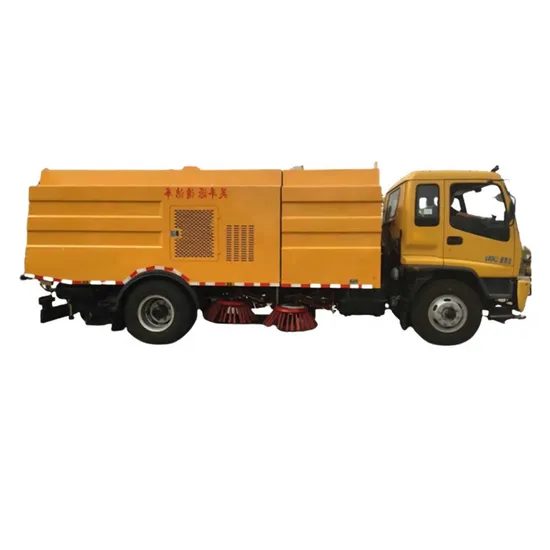
Select a vacuum sweeper truck by describing what must be collected and where it lies. Fine dry dust, sand and fallen leaves create different equipment questions. A supplier can respond more precisely to debris size, moisture and surface conditions than to a general request for a powerful road sweeper.
Translate the cleaning task into equipment questions
| Task | What to describe | Equipment to discuss |
|---|---|---|
| Fine dust on a dry paved surface | Dust level, moisture and the area to be cleaned | Water application, suction arrangement and dust-handling system |
| Sand and grit near the road edge | Particle size, depth and location relative to the curb | Brush reach, pickup opening and hopper loading |
| Leaves and light litter | Typical size, wet/dry condition and accumulation pattern | Pickup arrangement, blockage considerations and hopper space |
| Mixed debris in a yard | Surface, obstacles and the largest expected material | Selected combined package and any separate preparation required |
Photographs of representative debris and the cleaning area help define the requirement. Do not treat a single maximum-particle entry as proof that every object of that size can be collected in every condition.
Understand how brushes and suction work together
The Isuzu 600P street sweeper lists a road-sweeper package with four central sweeping discs, a centrifugal fan and a stainless-steel garbage bin. It gives a 2.8 m sweep-width entry. This is a useful reference for discussing how the brushes present debris to the pickup system.
The same page separately describes a vacuum-sweeper package with a central suction pickup and alloy tanks. Ask which package the quotation includes rather than assuming every listed component belongs to one installation. Describe the edge or lane that needs cleaning so the supplier can address actual brush and pickup positioning.
Specify the water function
Water application may be part of the selected cleaning package. A water tank alone does not identify all spray functions. The Isuzu 600P road-sweeper description marks front flushing, rear sprinkling, front spray and bin self-cleaning as optional. State which functions the job requires.
The Isuzu FTR road sweeper contains three distinct configurations: a four-disc road sweeper, a vacuum sweeper and a cleaning sweeper with two discs and high-pressure equipment. Keep their water and suction specifications attached to the correct package.
Plan hopper emptying and water refilling separately
The FTR road-sweeper package lists 4 m³ of water and 8 m³ of dust storage. Its vacuum-sweeper package lists 2 m³ and 8 m³ respectively. The cleaning-sweeper package instead describes 8.5 m³ of water and 7 m³ of waste storage. These are separate configurations, not capacities to add together.
Describe the distance to the water source and waste-receiving point. The bin stores collected material, while the water supply supports the selected cleaning functions. One may require a service stop before the other is exhausted. Do not calculate a universal working duration from tank volumes without the job and operating data.
Write a debris-based inquiry
Send Chengliwei the debris type, typical size, wet or dry condition, surface and available cleaning width. Add parked-vehicle or curb restrictions, the cleaning frequency, and refill and emptying arrangements. Request a named package with its brushes, pickup, water functions and hopper stated together. That connects the equipment to the task rather than selecting from a broad sweeper label.