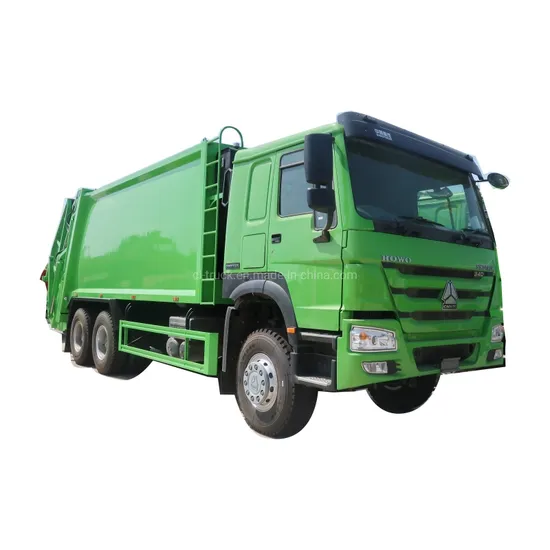
A garbage compactor truck body performs several connected jobs: receiving refuse, moving it into the storage body, compacting it and discharging it at the receiving location. A specification sheet often places the related figures together, but each belongs to a different part of this sequence. Reading the equipment in material-flow order makes the system easier to understand.
Receiving refuse: the loading connection and hopper
The loading connection is where refuse enters the equipment. The selected container-handling arrangement and the receiving hopper should be identified separately from the main storage body. A hopper or fill-volume entry describes an intermediate space, not the total body capacity.
The HOWO 6×4 compactor truck detailed table lists a 1.2 m³ fill volume and a 16 m³ body. These figures describe different parts of the system. Its loading-time entry of 20–30 seconds is also separate from the listed 50–60-second loading cycle.
Moving and compacting material into the body
Loading-cycle information describes equipment movement, while the main body receives the material moved through that cycle. A cycle time should retain the supplier's label. It should not automatically be interpreted as the complete time needed to service a bin location.
The HOWO light 5.5 m³ compactor example lists a hopper loading time of 10–12 seconds and a loading-cycle entry of 50–60 seconds. These are useful system descriptions without establishing a route collection rate. Neither figure supplies a compaction ratio.
Storage: body construction and liquid collection
The HOWO light example specifies 4 mm side and bottom panels. The larger HOWO 6×4 detailed configuration lists 5 mm sides and bottom. The Isuzu FTR 12 m³ compactor lists 4 mm sides and a 5 mm bottom. Keep thickness values associated with their particular body surfaces.
All three descriptions include a 200 L sewage tank. This is a separate liquid-collection component and should not be added to the refuse-body volume. It belongs in the body equipment inventory alongside the main container and loading assembly.
Hydraulics and controls: related but distinct fields
| Specification field | What it identifies |
|---|---|
| Hydraulic pressure | A stated hydraulic-system parameter |
| Loading-cycle time | A labelled equipment sequence duration |
| Electrical voltage | An electrical-system characteristic |
| Control arrangement | How functions are selected and coordinated |
The larger HOWO table gives about 16 MPa hydraulic pressure, while the Isuzu table lists 16 MPa. Pressure alone does not prove compaction force, because the mechanism and actuator geometry also matter. The Isuzu electrical entry of 12 V/24 V should likewise not be presented as a named control-system architecture.
Discharge completes the system description
The HOWO light example explicitly lists push-out unloading, with a 30–40-second unloading entry. The larger HOWO and Isuzu tables provide unloading-time entries but should not inherit a discharge mechanism from another model. The selected truck's body drawing and equipment schedule should identify its own arrangement.
For fleet buyers, a useful specification follows this same sequence from intake to discharge. It keeps the hopper, storage body, liquid tank, hydraulic data and controls individually visible, allowing the complete refuse-handling system to be discussed without confusing one component's specification with another.