An aerial platform working envelope describes a set of reachable positions under stated equipment conditions. It is not a rectangle created by combining maximum height with maximum horizontal outreach. Those maximum values can occur at different boom positions. The relevant load and support configuration are part of the information needed to interpret the range.
Start with the axes and reference points
On the supplied working-envelope document, identify what each axis measures and which units are used. Read the reference point for horizontal distance and the reference used for vertical height. Do not assume the origin is the bumper, the centre of the vehicle or another convenient point without the document identifying it.
A site sketch should use compatible reference points. Otherwise a measured distance from the kerb or vehicle edge may be compared with an equipment dimension measured from a different origin.
Read a position as a pair of coordinates
A target has both a height and a horizontal offset. Both must relate to the same position within the documented envelope. Knowing the greatest height and greatest outreach separately does not prove that their combination lies inside the range.
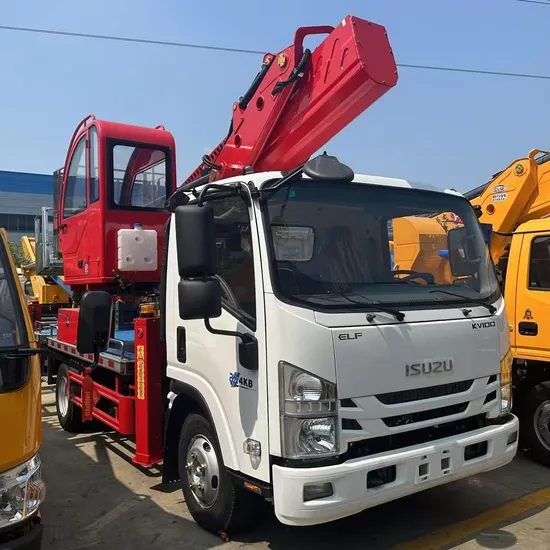
The Isuzu KV100 aerial platform truck detailed block lists a 32 m configuration and a 200 kg platform-load entry. These are useful selected-equipment references, but they do not provide a complete position-by-position working curve. No curve should be reconstructed from those two numbers alone.
Keep load labels attached to their range
If a supplied chart has different regions or lines, read the legend and the condition attached to each. A line may apply to a particular platform load or equipment configuration. Do not transfer a load label from one region to another or combine separate operating conditions into one assumed envelope.
The Isuzu aerial vehicle offered with 28 m title wording contains a 32 m detailed configuration and other standard-configuration information. The chart requested for procurement should identify the exact version being quoted, including its boom and support arrangement.
Match the document to the installed equipment
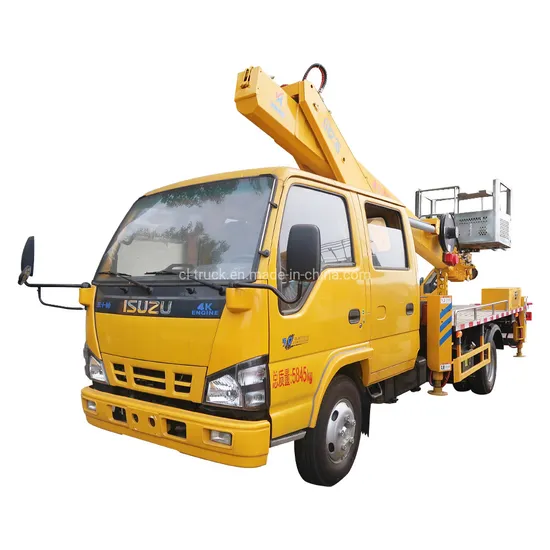
The Isuzu 600P double-row aerial vehicle describes a three-section boom, while the identified KV100 block describes six sections. A shared chassis brand or the same platform-load entry does not make their working envelopes interchangeable.
Check the model identifier and document revision before using a chart in a buying comparison. Keep support conditions, platform configuration and any stated restrictions with the chart rather than reproducing only its outer outline.
| Document element | Question it answers |
|---|---|
| Axes and units | How are height and horizontal position represented? |
| Reference points | Where are those distances measured from? |
| Envelope boundary | Which combinations of position are represented? |
| Load legend | What platform-load condition applies? |
| Configuration notes | Which boom, supports and version does the document cover? |
Send target information with the chart request
For maintenance buyers, provide the target height, horizontal offset, planned vehicle position and anticipated platform contents. Ask the supplier for the relevant working-envelope documentation and a response tied to those conditions. This keeps the purchase focused on reaching the actual target without treating separate maximum values as a simultaneous capability.