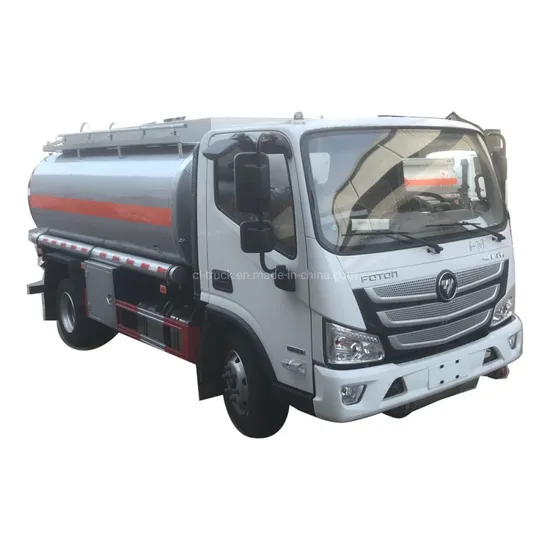
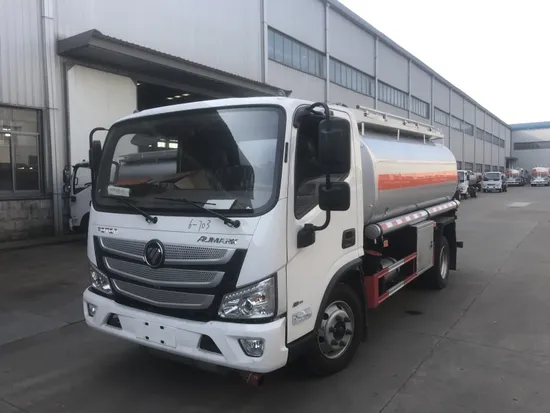
A small 4x2 fuel tanker truck typically holds 3,000 to 15,000 litres (3–15 m³), a 6x4 rigid truck 16,000 to 25,000 litres, an 8x4 rigid truck 30,000 to 35,000 litres, and a fuel tank semi-trailer 35,000 to 60,000 litres, most often 40,000 to 50,000 litres on three axles. Those figures are tank volume. How much fuel the vehicle may actually carry is set by its rated payload and the fuel's density: diesel weighs about 0.84 kg per litre and petrol about 0.74 kg per litre.
| Vehicle class | Typical tank volume | Example configuration listed on this site | Chassis / axles | Compartments |
|---|---|---|---|---|
| Small 4x2 | 3,000–15,000 L | CLW 4x2 light fuel tanker CL5041GJY6BWN: 3,000 L | 4x2, 5,430 × 2,000 × 2,500 mm overall | — |
| Small 4x2 | Chengliwei 4x2 aluminium fuel dispensing truck: 8,000 L | Dongfeng EQ1125SJ8CDCWXP | — | |
| Small 4x2 | Dongfeng 145/153 4x2 fuel tanker with dispenser: 10,000 L | Dongfeng 4x2, 3,950 mm wheelbase | 4 (two large, two small) | |
| Small 4x2 | Dongfeng 12 m³ refuelling tanker truck: 12,000 L | Dongfeng | 1–4 | |
| Small 4x2 | Dongfeng 4x2 aluminium alloy fuel truck: 15,000 L | Dongfeng 4x2, payload 11,200 kg | — | |
| 6x4 rigid | 16,000–25,000 L | CLW 6x4 oil tank truck: 16,000 L | 6x4, rear axles 2 × 13 t | — |
| 6x4 rigid | Beiben 6x4 fuel tanker truck: 20,000 L | Beiben 6x4, payload 20,000 kg | — | |
| 6x4 rigid | Chengliwei HOWO 6x4 fuel tank truck: 20–25 m³ | HOWO 6x4, 9,850 × 2,500 × 3,200 mm | — | |
| Three-axle rigid | Aluminium alloy fuel tank truck for gas stations: 25,000 L | FAW CA1260 chassis | 1–4 | |
| 8x4 rigid | 30,000–35,000 L | Beiben 8x4 fuel tanker truck: 30,000 L | Beiben 8x4, about 12,000 × 2,500 × 3,400 mm | — |
| 8x4 rigid | 8x4 aluminium alloy fuel tanker truck: 30–35 m³ | Sinotruk ZZ1326N466GE1K, payload 20,365 kg | — | |
| Full trailer | 18,000–20,000 L | Chengliwei full fuel tank trailer: 20 m³ | 2 axles | 2 |
| Semi-trailer | 35,000–60,000 L | Aluminium alloy fuel tank semi-trailer: 42 m³ | 3 axles (BPW) | 3–5 |
| Semi-trailer | 3-axle aluminium fuel tank semi-trailer: 45,000–50,000 L | 3 axles, 13 t each | 3–5 | |
| Semi-trailer | Chengliwei 4-axle aluminium fuel tank semi-trailer: 60,000 L | 4 axles, 13 t each | 3–5 | |
| Semi-trailer | Chengliwei fuel tanker semi-trailer: 20–55 m³ to order | 2, 3 or 4 axles, 13,000 × 2,500 × 3,800 mm | 1–9 |
A dash means the compartment layout is chosen when the tank is ordered. Left-hand drive is standard on the trucks; right-hand drive is available on request.
Fuel tanker volume in litres, m³ and US gallons
One cubic metre is 1,000 litres, so a 20 m³ tank and a 20,000 L tank are the same size. One US gallon is 3.785 litres (1,000 L is about 264 US gallons). An imperial gallon is larger, 4.546 litres, so always check which gallon a figure uses before comparing tanks.
| Litres | m³ | US gallons | Diesel mass at 0.84 kg/L | Petrol mass at 0.74 kg/L |
|---|---|---|---|---|
| 5,000 L | 5 | 1,321 | 4.2 t | 3.7 t |
| 10,000 L | 10 | 2,642 | 8.4 t | 7.4 t |
| 15,000 L | 15 | 3,963 | 12.6 t | 11.1 t |
| 20,000 L | 20 | 5,283 | 16.8 t | 14.8 t |
| 30,000 L | 30 | 7,925 | 25.2 t | 22.2 t |
| 40,000 L | 40 | 10,567 | 33.6 t | 29.6 t |
| 50,000 L | 50 | 13,209 | 42.0 t | 37.0 t |
| 60,000 L | 60 | 15,850 | 50.4 t | 44.4 t |
The conversions are exact arithmetic; the mass columns use typical densities at around 15 °C. Real fuel varies slightly with grade and temperature, and liquid expands as it warms, so tanks are not filled to the last litre.
How density limits payload
Tank volume tells you how much space there is. Rated payload tells you how much weight the chassis or trailer may carry. The smaller of the two sets the real load.
Take the 8x4 aluminium tanker in the table, with a rated payload of 20,365 kg. Filled with diesel at 0.84 kg/L, that payload is reached at about 24,200 litres. With petrol at 0.74 kg/L the same payload allows about 27,500 litres. This is why a petrol tanker can use a larger tank than a diesel tanker on the same chassis, and why a tank volume alone does not tell you how many litres of a particular fuel a truck will deliver per trip.
Use the same check for any vehicle: divide the rated payload in kg by the fuel density in kg/L to get the maximum litres. For a 3-axle semi-trailer with three 13 t axles, the trailer's own weight and the tractor's fifth-wheel load also have to fit inside the road limits for the whole combination.
Total volume and compartment volume
Total tank volume describes the tank as a whole. The compartment schedule describes how that volume is divided by internal bulkheads. Configurations listed on this site range from a single compartment up to nine on a made-to-order semi-trailer, with 3–5 compartments common on 3- and 4-axle trailers and 1–4 on rigid trucks.
Compartments let one vehicle carry several products, such as diesel and petrol, or deliver measured quantities to several stations on one trip. Each compartment has its own manhole and outlet valve. For a multi-product delivery, list each fuel and the quantity assigned to it, and ask for the volume of every compartment, not only the total.
Choosing a rigid truck or a semi-trailer
| Delivery operation | Configuration to compare | What to specify |
|---|---|---|
| Refuelling equipment at construction or mining sites | 4x2 or 6x4 rigid truck with pump, meter and hose reel | Fuel type, delivery rate and site access |
| Deliveries to several stations | 6x4 or 8x4 rigid truck with 1–4 compartments | Quantity of each fuel per stop |
| Bulk transfer between depots | 3- or 4-axle fuel tank semi-trailer with tractor | Route, coupling and combination weight limits |
To estimate trips, divide the total volume needed by the usable volume of one load and round up: 100,000 litres takes three loads in a 40,000 L semi-trailer, or ten in a 10,000 L truck.
Reading capacity figures in a quotation
Product names often combine several units, for example litres, cubic metres, gallons and tonnes in one title. Treat them as separate figures. Ask for the selected capacity in litres, the compartment schedule, the tank material and thickness, and the rated payload of the complete vehicle, each in its own field. Gross vehicle weight is not the fuel payload, and a tonnage in a title may describe the chassis rather than the tank.
Video: aluminium fuel tanker truck walkaround
Watch a short exterior walkaround of the Chengli CL5323GYYLC6 aluminium-alloy fuel tanker truck. This is a vehicle example for the guide; the footage does not establish tank volume, compartment capacities or payload, and it does not depict the specifications of every model listed below.
Common questions about fuel tanker capacity
What is the capacity of a fuel tanker truck?
On the configurations listed on this site, a small 4x2 fuel truck holds 3,000 to 15,000 litres, a 6x4 truck 16,000 to 25,000 litres, an 8x4 truck 30,000 to 35,000 litres and a semi-trailer 35,000 to 60,000 litres.
What is the capacity of a petrol tanker?
Petrol tankers use the same tank sizes, but because petrol is lighter, about 0.74 kg/L against 0.84 kg/L for diesel, a vehicle can carry about 13% more litres of petrol than diesel before reaching the same payload.
How many gallons does a fuel tanker hold?
A 10,000-litre truck holds about 2,640 US gallons, a 30,000-litre truck about 7,925 and a 50,000-litre semi-trailer about 13,200 US gallons.
Is tank volume the same as payload?
No. Volume is space in litres or m³; payload is the weight the vehicle is rated to carry. Multiply litres by density to get the weight of the fuel and check it against the rated payload.
How many compartments does a fuel tanker have?
Rigid trucks listed on this site have 1 to 4 compartments, 3- and 4-axle semi-trailers usually 3 to 5, and made-to-order semi-trailers up to 9.
Fuel tankers listed on this site
Browse all fuel trucks and fuel tank trailers, or go straight to the 10,000 L Dongfeng 4x2 tanker, the 30,000 L Beiben 8x4 tanker or the 45,000–50,000 L 3-axle aluminium semi-trailer. When you are ready, request a capacity-specific quotation with fuel type, litres per trip and compartment layout.