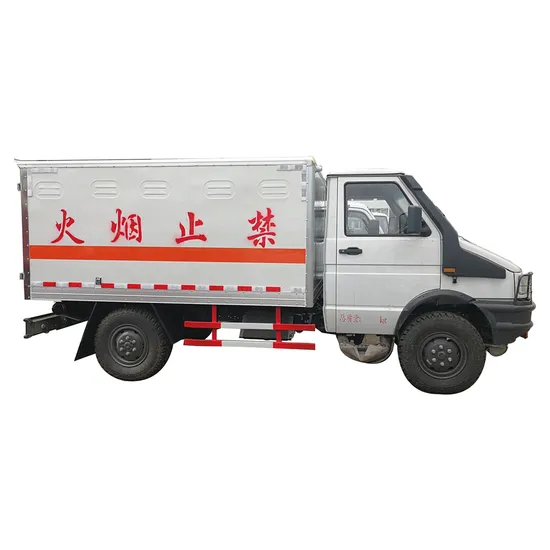
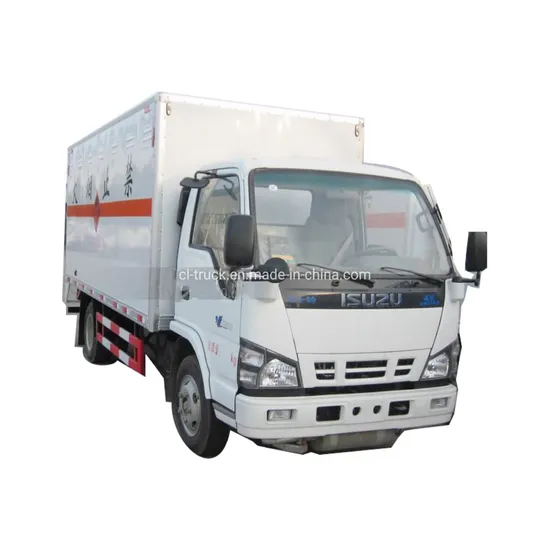
An explosion-proof truck is a van truck built so that the vehicle itself cannot ignite flammable or explosive cargo: sparks, hot exhaust, electrical faults and static are kept away from the cargo box. It is a set of measures on the chassis and body, not one part, so each measure should be listed and confirmed in the quotation. The explosion-proof van trucks listed on this site are light 4x2 and 4x4 trucks with 1 to 5 t payload, cargo boxes from 3,100 to 4,100 mm long and 116 to 120 hp diesel engines.
| Configuration listed on this site | Drive | Payload | Cargo box (L x W x H, mm) | Overall size (mm) | Curb weight | Engine |
|---|---|---|---|---|---|---|
| Small explosion-proof equipment van truck | 4x2 / 4x4 | 1-3 t | 3,100 x 1,900 x 1,340 | 5,550 x 2,050 x 2,430 | 3,350 kg | Under 150 hp, Euro 5 |
| Chengliwei HOWO Light 4x2 explosion-proof truck | 4x2 | 5,000 kg | 4,100 x 2,000 x 1,800 | approx. 5,995 x 2,160 x 2,900 | approx. 3,600 kg | YN4102QBZL, 116 hp (85 kW) |
| Isuzu 4x2 explosion-proof equipment truck with power gate | 4x2 | 5,000 kg | 4,100 x 2,000 x 1,800 | approx. 5,995 x 2,160 x 2,900 | approx. 3,600 kg | 120 hp |
What makes a truck explosion-proof
Fire or explosion needs three things: a fuel, oxygen and an ignition source. In a truck carrying explosives, fireworks, flammable materials or blasting equipment, the cargo can supply the fuel, so the design goal is to remove ignition sources from the cargo area and to limit the damage if a fire starts. The measures fall into five groups.
1. Exhaust and engine heat
Hot exhaust gas and carbon particles can ignite vapour or dust. Typical measures are a spark arrester or flame arrester on the exhaust and routing the exhaust pipe away from the cargo box and fuel tank. Confirm with the quotation whether an arrester is fitted and where the pipe exits.
2. Electrical system
Switches, lamps, relays and loose wiring can spark. Typical measures are a battery master (isolation) switch that cuts all power when parked, sealed or explosion-protected lamps and wiring in or near the cargo box, protected fuses, and no ordinary electrical fittings inside the box. Confirm with the quotation which circuits are protected and whether the box has any electrical equipment at all.
3. Static electricity
A moving truck builds up static charge. Typical measures are a grounding strap or chain that keeps the chassis in contact with the road, and bonding between body and chassis. Confirm with the quotation how the body is earthed.
4. Cargo box construction
The box should keep cargo secure, avoid sparks from metal-to-metal contact and resist fire from outside. Typical measures are a non-sparking floor and inner lining, insulation, ventilation openings, lockable doors and internal tie-down points. Confirm with the quotation the materials of the floor, walls and lining, and the locking arrangement. On the configurations listed here, box sizes run from 3,100 x 1,900 x 1,340 mm on the small van to 4,100 x 2,000 x 1,800 mm on the 5 t trucks.
5. Fire fighting and marking
Typical measures are fire extinguishers mounted on the cab and body, a protected fuel tank, hazard warning signs or placards, and a warning lamp. Confirm with the quotation the number and size of extinguishers and which markings are included.
Chassis specifications to compare
The explosion-proof vans listed on this site are all light trucks. Compare these chassis lines alongside the explosion-proof measures above.
- Payload: 1-3 t on the small van, 5,000 kg on the HOWO Light and Isuzu 4x2 trucks.
- Drive: 4x2 for paved roads; 4x4 is offered on the small van for unpaved or steep site roads.
- Engine and gearbox: the HOWO Light lists a YN4102QBZL engine rated 116 hp (85 kW), intercooled and water-cooled, with a WLY6T46 6-speed manual gearbox and 90 km/h top speed.
- Axles and tires: the HOWO Light lists 2.4 t front and 4.2 t rear axles on 7.00R16 tires (6 plus 1 spare). The small van runs on 4 x 255/85R16LT tires.
- Wheelbase: 3,050 mm on the small van; 3,360 mm on the HOWO Light, with 3,815, 4,200, 4,500 and 5,200 mm listed on some versions.
- Loading: the Isuzu version comes with a power tail gate for loading heavy equipment cases.
- Emission standard: Euro 2 or Euro 5, depending on model.
- Drive side: left-hand drive standard, right-hand drive on request.
What to send with an inquiry
- The cargo: type of material, its hazard class and the largest quantity per trip
- The routes: paved road, unpaved site road, gradients
- Required cargo box size and any internal racks or compartments
- The local rules for vehicles carrying explosives or dangerous goods, and any approval the truck must pass after delivery
- A list of the explosion-proof measures you need, so each can be confirmed line by line in the quotation
Whether a particular truck may carry a particular cargo is decided by the regulations and permits where it operates. Check that with the local authority before ordering.
FAQ
What is an explosion-proof truck?
A van truck with measures that keep the vehicle from igniting its cargo: protected exhaust, protected electrical system, static grounding, a suitable cargo box and fire extinguishers.
What are explosion-proof trucks used for?
Carrying explosives, blasting equipment, fireworks and other flammable or dangerous goods, often to mines and quarries.
How much can an explosion-proof van truck carry?
On the configurations listed on this site, 1-3 t on the small 4x2/4x4 van and 5,000 kg on the HOWO Light and Isuzu 4x2 trucks.
Is a spark arrester enough to make a truck explosion-proof?
No. It handles only the exhaust. Electrical, static, cargo box and fire-fighting measures are also needed. Confirm each one in the quotation.
Can I get a 4x4 explosion-proof truck?
Yes, the small explosion-proof equipment van is offered in 4x2 and 4x4, with a 3,100 x 1,900 x 1,340 mm cargo box.