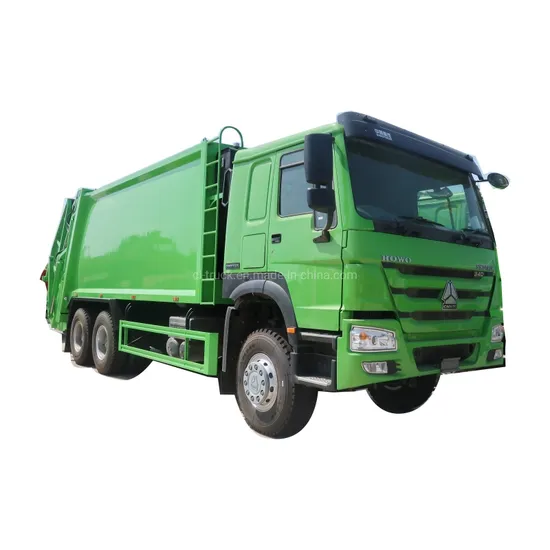
The HOWO 5m³/6m³ compactor and HOWO 6x4 25000L compactor are different product configurations. Compare them against neighborhood access, the bins to be handled and the journey to the unloading point. A shared brand does not make body size or loading equipment interchangeable.
Put the two configurations in separate columns
| Field | HOWO 5–6 m³ listing | HOWO 6x4 25000L listing |
|---|---|---|
| Detailed body capacity | 6 m³ | 18 m³; title instead states 25,000 L |
| Loading hopper | 1.2 m³ | 1.8 m³ |
| Drive layout | 4x2 | 6x4 |
| Detailed overall dimensions | about 7,400 × 2,450 × 2,800 mm | 9,800 × 2,496 × 3,048 mm |
| Wheelbase | 3,800 mm | 4,325 + 1,350 mm |
| Steering | Left- or right-hand-drive options | Left-hand drive |
| Discharge description | Push-out | Pushing-out plate and lifting rear assembly described |
Twenty-five thousand liters equals 25 m³, but that conversion does not resolve the larger listing's separate 18 m³ body entry. Request the body selected for the quotation. The smaller truck's 5–6 m³ title is its own configuration description and should not be mixed with the larger product's figures.
For neighborhood collection, begin with access
The smaller HOWO's shorter detailed envelope is relevant when the route includes compact collection points. Provide the tightest entrance, turning area and parked-vehicle constraints. Its listed width is still substantial, so do not assume that “small” means it can enter every residential lane.
Describe how the crew brings bins to the vehicle and the space to pass available behind it. Request the exact lifter and compatible bin interfaces. A smaller body does not automatically mean a shorter or simpler loading operation at each stop.
For more collected volume, include the unloading journey
The larger HOWO's detailed body and hopper entries provide a starting point for a route with greater volume between disposal visits. State the number of stops, expected waste and distance to the receiving facility. Ask for rated loading information and the selected compaction configuration.
Do not calculate a fixed increase in route capacity by dividing normal body volumes. Waste composition, carried mass and the actual selected body affect the result. The longer vehicle must also fit the collection route and the unloading facility.
Compare loading functions, not just cycle numbers
The smaller listing gives separate hopper loading and loading-cycle entries. The larger one also supplies cycle descriptions and optional rear equipment. Those labels should be matched before using timing figures in a comparison; they may describe different actions.
Ask each supplier to identify the loading sequence, controls and supplied rear assembly. The larger listing names PLC control and multifunctional rear equipment among options. Confirm inclusions rather than assuming every listed feature is standard.
Assign the truck from route conditions
A constrained neighborhood route should first emphasize access and bin handling. A route with suitable space and larger collection demand should examine storage between unloading visits and the complete trip to the disposal point. Both require confirmed rated loading and compatible rear equipment.
Send Chengliwei the bin details, route dimensions, estimated waste quantity and disposal distance. Request a selected body, chassis and loading configuration for each truck, then compare how each fits the actual collection plan.