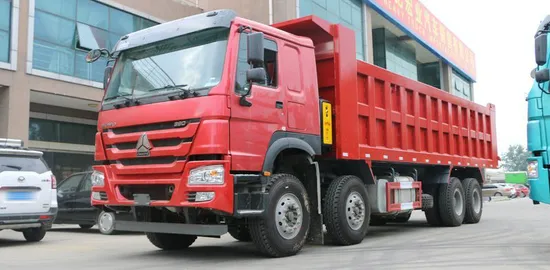
The Shacman F2000 6X4 20 Cubic Meters Dump Truck and HOWO 8X4 dump truck with right-hand-drive wording should be compared along the complete haul route. The loading point, connecting roads and unloading area may each impose different constraints. Axle layout is one part of that assessment.
Use the detailed vehicle entries as separate references
| Item | Shacman F2000 listing | HOWO 8x4 listing |
|---|---|---|
| Detailed drive layout | 6x4 | 8x4; summary also contains a 6x4 entry |
| Wheelbase | 3,775 + 1,400 mm | 1,800 + 3,800 + 1,350 mm |
| Detailed overall dimensions | 8,329 × 2,490 × 3,450 mm | 10,310 × 2,500 × 3,450 mm |
| Body dimensions | 5,600 × 2,300 × 1,100–1,600 mm | One entry: 7,600 × 2,300 × 1,500 mm; another: 7,600 × 2,350 × 1,500 mm |
| Body plate entries | Bottom 8 mm; sides 6 mm | Bottom 8 mm; sides 6 mm |
| Lifting descriptions | Front lifting in summary; center lifting in detail | Front lifting |
| Steering information | Detailed table: left-hand drive | Title: right-hand drive; detailed table: left-hand drive |
Resolve the selected configuration in a final drawing. Do not average the HOWO body widths or combine the Shacman body-height alternatives into an assumed volume. The product-name cubic-meter figures and the listed dimensions need a clearly stated measurement basis.
At the loading point, compare the vehicle envelope
Provide the loader position, available approach and turning space, and any overhead restrictions. The shorter overall dimension in the Shacman detailed table is relevant to a restricted layout. It is not proof of a turning advantage under every condition. Ask the supplier to address the selected vehicle's maneuvering requirements.
For the HOWO, assess whether the loading point accommodates the about 10.31-meter vehicle described in its detailed table. State the loading method and material so the body and vehicle arrangement can be evaluated together.
Along the route, describe conditions rather than infer performance
Give the supplier the route length, surface condition, significant gradients and known width or space to pass restrictions. Include the weight and type of material normally transported. Request complete-vehicle rated weights for the selected body and chassis.
Neither the 6x4 nor the 8x4 label alone establishes fuel consumption or a permitted road payload. Likewise, catalog axle descriptions do not establish approval for your destination. Keep route requirements and the supplier's offered vehicle specification explicit rather than deriving them from the axle count.
At the unloading point, include operating space
The body must be considered in its intended unloading arrangement as well as its travel position. Provide the dimensions and conditions of the unloading area and request the operating-envelope information for the chosen lifting system.
The Shacman listing has different summary and detailed lifting descriptions, so the quotation needs to state the final choice. Do not compare an empty-body timing entry against an assumed loaded unloading cycle. The supplier's documentation should relate to the selected installation.
Make steering position an explicit procurement field
The HOWO product title highlights right-hand drive, but the detailed table says left-hand drive. Buyers who require right-hand drive should write that requirement into the inquiry and ask for a matching configuration and confirmation in the quotation. The title alone does not resolve the difference.
The Shacman title refers to F2000, while its table lists several cab references. Request the chosen cab as well as steering position. For your project, identify the country and the actual fleet requirement rather than assuming a universal specification.
Send Chengliwei the material, loading-point layout, route conditions, unloading-space details and required driving position. The suitable tipper is the confirmed combination that meets those conditions, with body and vehicle specifications kept distinct from marketing tonnage.