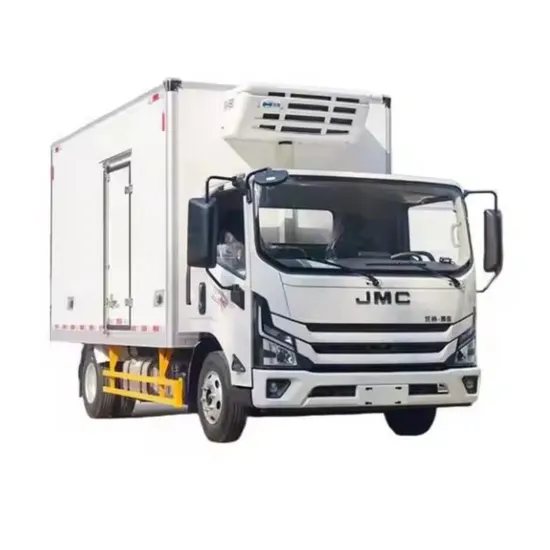
The Isuzu 600P refrigerated truck and JMC freezer truck should be compared against the goods and route they will serve. Three questions narrow the choice: will the shipment fit, can the complete truck reach the delivery point, and what refrigeration package is included?
Read the box and chassis information side by side
| Specification | Isuzu 600P | JMC |
|---|---|---|
| Overall-dimension entry | 5,995 × 2,130 × 2,960 mm | about 5,990 × 2,100 × 3,100 mm |
| Cargo-box information | 4,100 × 1,800 × 1,900 mm | SC: 4,100 mm; DC: 3,100 mm, with customization mentioned |
| Insulation description | Glass-reinforced plastic surfaces; 8 cm polyurethane insulation | XPS wording; 8 cm insulation layer |
| Wheelbase reference | Main table: 3,360 mm | 3,360 mm |
| Engine information | 4KH1-TCG40; 2.999 L; 88 kW | 2,771 cc; 68 kW at 3,600 rpm |
| Transmission | Five-speed manual | 5MT |
| Cooling information | Hanya/Carrier/Thermo King options; temperature-to-minus-18-degree entry | No specific refrigeration-unit model in the listed specification |
The JMC cargo-length entries do not provide a complete internal loading envelope. Ask which body/cab version is being quoted and obtain its width, height and door-opening dimensions. For the Isuzu, also establish whether the listed box measurements are internal or external before arranging pallets or crates.
Will the shipment fit?
Provide the number, size and weight of packages loaded on a normal trip. Ask for a loading layout that preserves the space required by the refrigeration equipment and its air path. normal box dimensions are a starting point, not proof of a particular pallet count.
The two listings use different payload descriptions and weight fields. Have the supplier identify rated loading information for the selected finished vehicle. Do not assume that “5tons” in a product description gives the same usable carried load for every body and cooling-unit combination.
Can it reach the loading and delivery points?
Compare the overall dimensions with actual height restrictions, gate openings and unloading space. The listed JMC overall height is greater than the Isuzu entry. Neither dimension replaces a drawing of the truck as ordered. The common wheelbase reference alone does not prove identical turning behavior.
For an urban delivery route, send photographs or measurements of the tightest entrance, the planned parking position and the loading method. Request the selected vehicle's access dimensions and allow for opening the doors and handling the goods.
What will control the cargo temperature?
The Isuzu page offers several refrigeration brands. The final quotation should select a unit model rather than repeat the alternatives. The JMC page needs an explicit cooling-unit specification to make the offers comparable. Ask for the model, power arrangement and stated performance for the chosen box and duty.
An engine brand or engine-output figure does not prove insulation performance. Similarly, matching 8 cm insulation entries do not prove identical construction. Compare the panel material, joints, door seals and cooling package separately from chassis performance.
Two buyers should prioritize different questions
A buyer making frequent urban stops should emphasize door access, package handling, opening frequency and the dimensions of restricted delivery points. Ask both suppliers to address the same stop pattern when specifying refrigeration.
A buyer moving larger consolidated shipments between depots should emphasize usable box dimensions, rated transport loading, journey duration and the selected unit's operating conditions. State the target temperature and the condition of goods at loading.
Send those requirements with the Isuzu and JMC product references. Select the complete refrigerated-truck configuration that fits the delivery organization, with the box and unit defined clearly enough to compare.