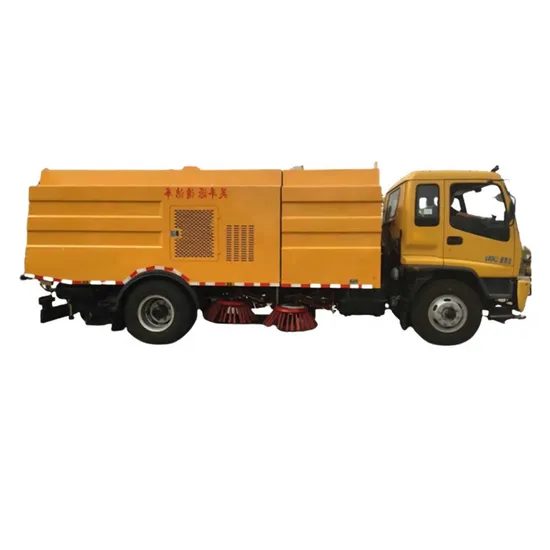
The Isuzu 600P street sweeper and Isuzu FTR road sweeper differ in vehicle size and the storage information provided. Both pages also describe more than one cleaning package. Select the package first, then compare water refilling, waste emptying and road access.
Compare matching specification fields
| Field | Isuzu 600P | Isuzu FTR |
|---|---|---|
| Drive layout | 4x2, left-hand drive | 4x2, left-hand drive |
| Overall dimensions | about 5,995 × 2,300 × 2,570 mm | about 8,500 × 2,490 × 3,350 mm |
| Wheelbase | 3,360 or 3,815 mm | 4,500 mm |
| Chassis engine entries | 130 HP; 96 kW | 205 HP; 151 kW |
| Road-sweeper equipment | Four central discs, centrifugal fan, lifting/unloading bin; 2.8 m width entry | Four central discs, centrifugal fan, lifting/unloading bin; 2.8 m width entry |
| Water capacity | No capacity specified in the listed equipment information | Road package: 4 m³; vacuum package: 2 m³; cleaning package: 8.5 m³ |
| Waste capacity | No capacity specified in the listed equipment information | Road and vacuum packages: 8 m³; cleaning package: 7 m³ |
The FTR's water and waste capacities belong in separate rows because they serve different purposes. They should not be added into one usable storage quantity. Likewise, do not assign the FTR's capacities to the 600P where that page does not supply them.
Resolve the cleaning package before planning service stops
The FTR title's 8 m³ garbage plus 2 m³ water description corresponds to the capacities given for its vacuum package. Its road-sweeper and cleaning-sweeper descriptions use different combinations. The latter also describes two sweeping discs and high-pressure equipment.
Ask which package is being quoted and which water functions are included. The 600P road-sweeper description identifies several flushing and spraying features as optional. A comparison of standard packages should not silently include those options on one side.
Plan water refills and waste emptying independently
Give the supplier the expected debris, cleaning frequency and route length. Identify where water can be obtained and where collected material can be unloaded. One service need may interrupt the route before the other, depending on the selected functions and material collected.
Request the missing 600P capacities before estimating its service pattern. Even with the FTR's listed volumes, do not claim a fixed working duration or number of completed streets without the relevant consumption and collection information.
Assess access using the complete vehicle
The 600P's shorter and lower listed envelope makes it a useful starting reference for a constrained route. Provide narrow points, parked-vehicle restrictions, overhead clearances and the planned turning areas. Obtain the final drawing for the selected wheelbase rather than assuming both listed alternatives have the same dimensions.
The FTR inquiry should address its about 8.5-meter length and the space required at both service points. Larger stated storage does not remove access constraints. Conversely, a smaller vehicle envelope does not guarantee suitability for every narrow street.
Keep vehicle power and cleaning power distinct
The chassis-engine entries describe the transport vehicle. The cleaning sections separately mention auxiliary-engine configurations. Ask the supplier to identify the actual auxiliary power and drive arrangement for the selected package. Do not infer suction or cleaning performance from chassis horsepower.
Send Chengliwei the route dimensions, debris, required cleaning functions, refill point and waste-receiving arrangements. Compare one confirmed 600P package with one confirmed FTR package, with water and waste capacities kept separate throughout.