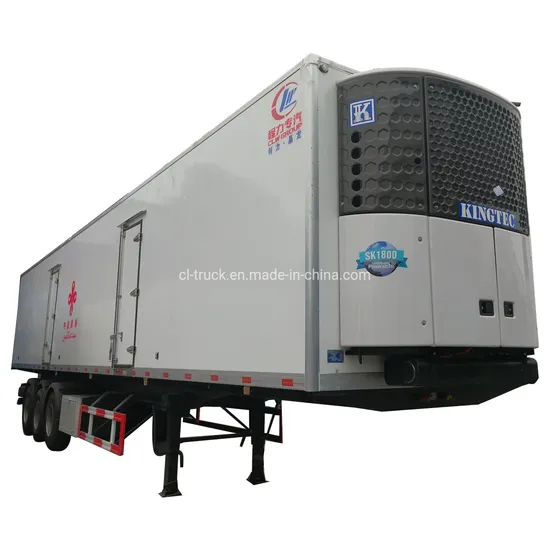
A refrigerated truck vs refrigerated trailer decision changes the transport arrangement as well as the load space. A rigid truck combines the driving chassis and refrigerated body in one vehicle. A semitrailer requires a suitable tractor and enough access space for the complete combination. The best fit depends on existing towing resources, delivery locations and the size and timing of shipment batches.
Compare the two purchase objects
The Isuzu 600P refrigerated rigid truck detailed specification describes a 4×2 left-hand-drive vehicle with overall dimensions of 5995 × 2130 × 2960 mm. Its body dimensions are listed as 4100 × 1800 × 1900 mm.
The tri-axle refrigerated semitrailer is a trailer purchase object. Its detailed table lists overall dimensions of 13500 × 2600 × 3995 mm and a body configuration of 13300 × 2400 × 2300 mm, alongside other body options. Those external dimensions describe the trailer, not the tractor-and-trailer combination.
| Comparison point | Isuzu rigid truck | Refrigerated semitrailer |
|---|---|---|
| Vehicle arrangement | Driving chassis with fitted body | Trailer requiring a suitable tractor |
| Listed overall length | 5995 mm | 13500 mm for trailer alone |
| Body example | 4100 × 1800 × 1900 mm | 13300 × 2400 × 2300 mm |
| Refrigeration description | Hanya, Carrier or Thermo King options | Independent refrigeration-unit options |
| Planning focus | Individual vehicle and delivery route | Tractor allocation and complete-combination access |
Start with the tractor resources available
If the fleet has no suitable tractor, the semitrailer enquiry needs to include the towing arrangement as a separate requirement. If tractors are already available, provide their specifications so fit and scheduling can be discussed. Do not assume that a trailer quotation includes a tractor.
A rigid truck may suit a plan organised around one vehicle leaving and returning as a complete unit. A trailer arrangement may suit an operation already structured around tractor allocation and larger transfer batches, provided the complete combination fits the sites.
Describe loading and unloading positions
Provide entrance dimensions, yard layouts and the available standing space at both ends of the journey. Include the intended loading method and selected door arrangement. The semitrailer page presents alternative door configurations, so the chosen version should appear in the final specification.
The smaller rigid-truck footprint is relevant when delivery locations are restricted. It should still be assessed against actual turns and loading positions rather than accepted solely because its overall length is shorter.
Match the body to shipment batches
Provide package dimensions, measured shipment mass and the number of consignments dispatched together. State the required cargo conditions and delivery sequence. Body volume alone does not determine usable loading arrangements or establish refrigeration performance for a particular route.
For distributors, compare one selected rigid-truck configuration with one selected trailer configuration and its towing plan. This makes the choice conditional on the actual delivery organisation, without assuming running costs or treating two very different vehicle forms as equivalent capacity options.