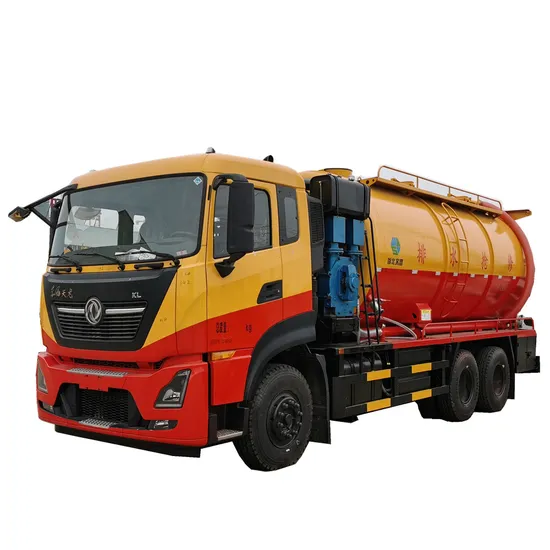
A larger vacuum truck can bring substantial tank capacity to a septic collection route, but the route must first accommodate the vehicle. Narrow entrances, unsuitable parking positions and a distant receiving facility can determine the day's work more strongly than the tank size. For municipal contractors and private sanitation operators, route planning should begin with individual service points and finish with a complete collection-and-discharge cycle.
Check whether the truck can reach each service point
Record the entrance width, overhead obstructions, approach surface and space available to turn or reverse. Include the proposed parking position and the location of the septic access point. A truck that reaches the property gate may still be unable to work from a suitable position inside it.
The Dongfeng 6×4 sewage suction truck detailed specification lists dimensions of 9600 × 2490 × 3250 mm and a 16 m³ tanker. Treat it as a larger vehicle when surveying routes. Its listed dimensions are useful inputs for the survey, but they do not establish the turning space at a particular entrance.
Build a route record before assigning daily stops
| Route record | Information to capture | Planning use |
|---|---|---|
| Service point | Location, contact and access hours | Sequence stops around actual availability |
| Entrance and approach | Width, height restrictions, surface and turning space | Identify sites needing a different vehicle or arrangement |
| Working position | Parking area and distance to the access opening | Discuss hose reach and operating setup |
| Collection record | Observed volume and service duration | Improve future load and time estimates |
| Receiving facility | Location, acceptance arrangements and opening hours | Plan discharge journeys and arrival times |
| Route interruption | Traffic, queues or inaccessible stops | Adjust the next schedule using actual experience |
Match the collection sequence to usable carrying capacity
Do not translate nominal tank capacity into a fixed number of households. Individual septic systems and requested collection volumes differ. Use records from completed jobs to estimate the next route, then leave operational flexibility for a stop that produces more material than expected.
The Dongfeng Kinland 6×4 vacuum toilet suction truck detailed table describes a 15 m³ tank and approximate dimensions of 9930 × 2550 × 3850 mm. Its tank and vehicle dimensions should be considered together: additional carrying space is useful only on service points the selected truck can reach. Confirm the quoted tank capacity and permissible loaded condition for the ordered configuration.
Include the receiving facility in every route cycle
A collection route is incomplete until the truck reaches a facility that accepts the collected material and completes discharge. Establish the facility's receiving arrangements before promising a collection schedule. Record travel time from the service area, unloading access and any observed queue, then account for the return journey.
The Dongfeng heavy 6×4 sewage suction truck is another larger option, with approximate overall dimensions of 10100 × 2550 × 3850 mm. Its equipment listing includes a self-unloading function and hydraulically opening rear door. The unloading location must provide the working space required by the supplied arrangement; a collection-site access survey does not cover that separate requirement.
Use the first operating records to refine the plan
Start with a manageable route and record arrival, setup, collection, departure and discharge times separately. This reveals whether delays come from site access, collection work or travel. Avoid using an equipment pumping-time entry as the total duration of a customer visit.
Send prospective suppliers the route record, typical access conditions, receiving-facility arrangement and expected collection volumes. Ask them to identify a suitable larger vacuum truck and its exact hose, tank and unloading configuration. That brief connects the purchase to the complete service cycle and provides a practical basis for scheduling.